
China raises tariff on the U.S. 34% to 84%
China raises tariff

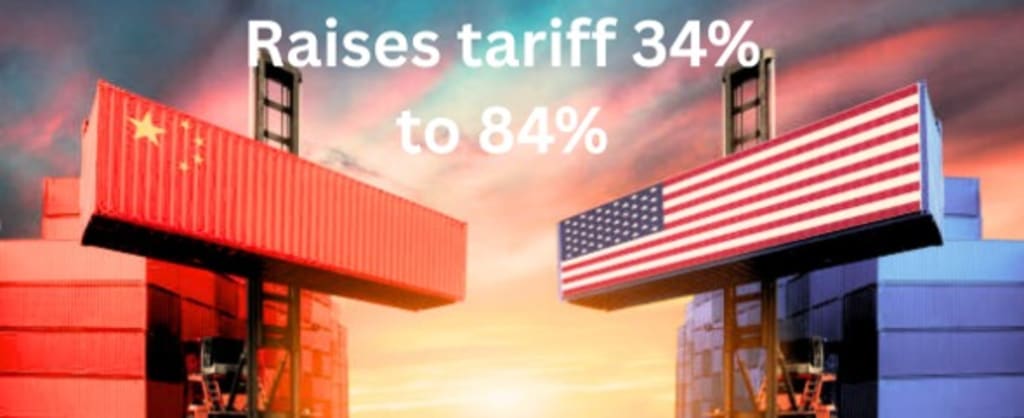
China has announced a bold and strategic increase in retaliatory tariffs on certain imports from the United States. The tariff rate has been raised to a staggering 84%, a sharp jump from the previous 34%, signaling a strong response from Beijing amid persistent trade tensions between the world’s two largest economies.
The Chinese government stated that the "unfair trade practices" of the United States administration are the direct cause of this tariff increase. While specific products subject to the new tariffs have not yet been fully disclosed, the measure is expected to target key American exports including automobiles, agricultural products, and high-tech goods. This decision comes during a period of growing geopolitical and economic tension between the two nations, and analysts believe it marks a renewed phase in their ongoing trade war.
Experts on trade say that China's move is designed to put Washington under financial pressure by making American goods much more expensive and less competitive in the Chinese market. With tariffs climbing to 84%, American products are likely to see a sharp decline in demand as Chinese businesses and consumers turn to alternative sources from other countries offering similar goods at lower costs. Farmers, automakers, and technology firms in the United States that heavily rely on Chinese customers may suffer the most from this. Because it comes at a time when the global economy is still recovering from supply chain disruptions and inflationary pressures brought on by recent geopolitical conflicts and post-pandemic challenges, the timing of this tariff hike is also considered to be strategically significant. According to a Beijing-based trade expert, “Rising tariffs mean rising costs. Ultimately, consumers and businesses on both sides will bear the burden.”
The financial repercussions for the United States of America could be significant. Many American companies, particularly those in the agriculture and manufacturing sectors, rely heavily on exports to China for their revenue. Some businesses may be forced to cut costs, lay off employees, or even cease operations as a result of the increased tariffs, which may result in a decrease in orders. Additionally, the tariff increase may cause the United States to reevaluate its trade policy and may prompt American retaliation, escalating the conflict even further. Economists and investors have expressed concern regarding the decision's long-term effects. The escalation could affect global trade flows, contribute to market instability, and impact supply chain strategies across multiple sectors. It also creates uncertainty for international companies with investments and operations in both countries. Multinational corporations may be forced to reevaluate their sourcing and manufacturing strategies, which could add to operational costs.
A Long History of Expansion This latest action is not a one-off, but rather a part of a larger pattern of protectionist policies that have shaped trade relations between the United States and China over the past few years. Since the beginning of their trade conflict, both countries have engaged in multiple rounds of tariffs and sanctions, affecting billions of dollars in bilateral trade. Despite numerous rounds of diplomatic negotiations, no comprehensive agreement has been reached. Trade philosophies and policy objectives are further apart, as evidenced by the growing use of tariffs as economic leverage. Implications for the World The ramifications of this tariff hike are not limited to the U.S. and China alone. There may be repercussions for the global economy, which is entwined with that of both nations. Countries with close trade ties to either the U.S. or China might experience disruptions in supply chains, fluctuating prices, and reduced access to essential goods. Developing economies, in particular, may feel the strain of shifting trade dynamics and reduced global demand.
China’s decision to increase tariffs to 84% on selected U.S. imports marks a critical turning point in the ongoing trade dispute. It reflects Beijing's intent to defend its economic interests while challenging U.S. trade policies. It is impossible to rule out the possibility of additional retaliatory actions because both nations maintain their steadfast positions. In the coming months, businesses, investors, and governments around the world will be closely monitoring the situation, bracing for potential fallout. A long-term resolution still appears distant, and until a meaningful compromise is reached, the uncertainty in global markets is likely to persist.
About the Creator
Akash Halder
I love writing articles. And love creating content that is interestingwell-researched, and easy to read.
My goal is to inform, inspire, and connect with readers through meaningful words.
Keep reading
More stories from Akash Halder and writers in Trader and other communities.
"The Journey from Youth to Adult"
The journey from youth to adulthood is a beautiful yet emotional path, filled with laughter, tears, memories, and lessons that shape who we become. It begins in the innocence of childhood, where worries are few and dreams are endless. We live freely chasing butterflies, drawing on walls, and believing that everything is possible. In those early days, life feels like a fairy tale where our parents are our heroes, our home is our whole world, and every day brings a new adventure.
By Akash Halder9 months ago in Motivation



Comments
There are no comments for this story
Be the first to respond and start the conversation.