
Australia Tomato Seeds Market Size and Forecast 2025–2033 | Renub Research
Greenhouse Expansion, Advanced Breeding, and Rising Demand for Local Produce Fuel Market Growth

Australia Tomato Seeds Market Overview
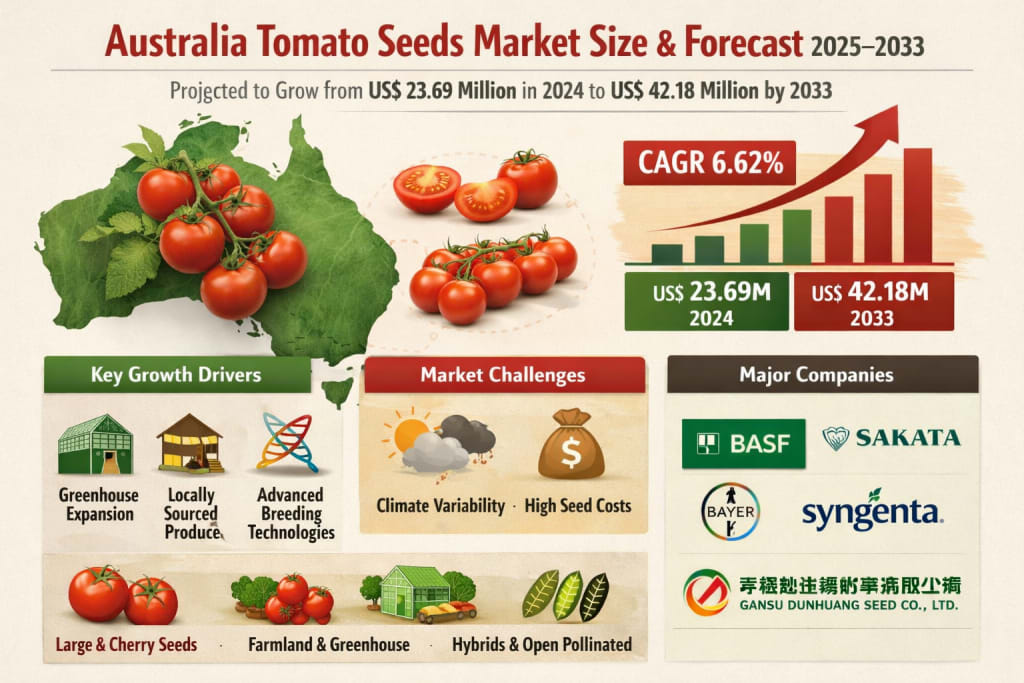
Australia Tomato Seeds Market is expected to reach US$ 42.18 million by 2033 from US$ 23.69 million in 2024, growing at a CAGR of 6.62% from 2025 to 2033. This steady growth highlights the increasing importance of high-quality seeds in supporting Australia’s evolving horticulture sector. The expansion of greenhouse farming, rising consumer preference for fresh and locally grown produce, and continuous improvements in seed breeding technology are collectively reshaping the country’s tomato production landscape.
Tomatoes are among the most widely cultivated horticultural crops in Australia, grown across diverse climatic regions ranging from tropical and subtropical zones in the north to temperate areas in the south. This wide geographic spread creates a consistent demand for a broad variety of tomato seed types that can adapt to different growing conditions. As farmers face increasing pressure to improve yields, manage climate risks, and meet strict quality standards, the role of advanced seed varieties has become more critical than ever.
In recent years, the market has seen a strong shift toward hybrid and disease-resistant seeds. These varieties offer higher productivity, better fruit quality, and improved resistance to pests and environmental stress. At the same time, the growth of protected cultivation and greenhouse farming has accelerated the demand for specialized tomato seed varieties that perform well in controlled environments and enable year-round production.
Beyond production efficiency, changing consumer preferences are also playing a key role. Australian consumers are increasingly choosing fresh, organic, and locally sourced produce, pushing growers to invest in superior seed quality that supports consistent supply, better taste, longer shelf life, and compliance with food safety and sustainability standards. Meanwhile, advances in breeding technologies—such as marker-assisted selection and improved hybridization techniques—are speeding up the development of tomato varieties with enhanced traits.
Despite these positive trends, the industry still faces challenges. Climate variability, extreme weather events, high seed costs, and strict biosecurity regulations continue to test farmers and seed suppliers alike. However, with sustained investment in agricultural research and development, expanding export opportunities, and stronger domestic demand, the outlook for Australia’s tomato seeds market remains firmly positive over the forecast period.
Australia Tomato Seeds Industry Overview
Supporting both home gardening and commercial agriculture, Australia’s tomato seed industry forms a vital part of the nation’s broader horticulture ecosystem. Tomatoes are a staple in Australian diets and are widely used across fresh consumption, food processing, and foodservice channels. This strong downstream demand ensures a stable and growing need for reliable, high-performance seed varieties.
One of the defining features of the Australian tomato market is its climatic diversity. From Queensland’s warmer regions to Victoria and South Australia’s cooler zones, tomato cultivation requires seed varieties that can thrive under very different environmental conditions. This has encouraged seed companies to continuously innovate and offer a wide portfolio of products tailored to regional needs.
The shift toward hybrid seeds has been especially significant. Hybrid varieties are increasingly preferred because they deliver higher yields, better uniformity, improved disease resistance, and more consistent fruit quality. For commercial growers, these advantages translate into better profitability and reduced production risk. At the same time, open-pollinated varieties still retain relevance, particularly among small farmers and home gardeners who value seed-saving and traditional varieties.
Greenhouse and protected cultivation have also become major growth drivers. These systems allow growers to better manage temperature, humidity, water, and nutrient use, leading to higher productivity and more predictable harvest cycles. As a result, seed varieties specifically designed for controlled environments are gaining strong traction in the market.
From a technology perspective, the industry is benefiting from rapid progress in plant breeding techniques. The use of genetic tools, data-driven selection methods, and advanced hybridization strategies is helping seed companies develop tomatoes with better flavor, longer shelf life, higher nutritional value, and stronger resistance to pests and diseases. This ongoing innovation is strengthening the overall competitiveness of Australia’s tomato seed industry.
Key Factors Driving the Australia Tomato Seeds Market Growth
Growth in Greenhouse Production
Greenhouse farming has expanded rapidly in Australia, particularly for high-value crops such as tomatoes. Controlled environment agriculture allows producers to reduce their dependence on seasonal weather patterns and maintain stable, year-round production. By carefully managing temperature, humidity, and light, greenhouse operators can achieve consistent yields and superior fruit quality.
Another major advantage of greenhouse cultivation is improved protection against pests and diseases. This reduces crop losses and lowers the need for chemical treatments, supporting both economic efficiency and sustainability goals. In addition, greenhouse systems enable more efficient use of resources such as water and fertilizers, which is increasingly important in a country prone to droughts and water scarcity.
As greenhouse production expands, so does the demand for specialized tomato seed varieties that perform optimally under protected cultivation. These seeds are bred for traits such as compact growth, uniform fruiting, disease resistance, and high productivity in controlled environments, directly fueling growth in the tomato seeds market.
Rising Preference for Locally Sourced Produce
Australian consumers are showing a strong and growing preference for locally grown, fresh, and organic produce. Tomatoes, being a staple ingredient in many households, are at the center of this trend. Locally produced tomatoes are often perceived as fresher, healthier, and more environmentally friendly due to shorter supply chains and reduced transportation emissions.
This shift in consumer behavior is encouraging farmers to adopt more sustainable and region-specific farming practices. As a result, there is rising demand for tomato seed varieties that are well-suited to local growing conditions, resilient to regional pests and diseases, and compatible with organic or low-input farming systems.
The push for local produce not only strengthens domestic agriculture but also stimulates innovation within the seed industry. Growers are increasingly seeking high-performance seeds that can meet consumer expectations for taste, appearance, and quality, while also delivering reliable yields and economic returns.
Technological Advancements in Seed Breeding
Advances in seed breeding technology are playing a transformative role in the Australian tomato seeds market. Techniques such as marker-assisted selection, improved hybridization, and data-driven breeding programs are enabling the development of superior tomato varieties faster and more efficiently than ever before.
These innovations have led to seeds with enhanced disease resistance, higher yield potential, improved stress tolerance, and better overall crop performance. For farmers, this means lower production risks, reduced reliance on chemical inputs, and more predictable outcomes even under challenging environmental conditions.
Moreover, modern breeding approaches allow seed companies to tailor varieties to specific regions and cultivation methods, including open-field and protected cultivation systems. This customization is helping to boost adoption rates of advanced seed varieties and is a key factor driving long-term growth in the tomato seeds market.
Challenges in the Australia Tomato Seeds Market
Climate Variability and Extreme Weather
Climate variability remains one of the most significant challenges facing Australia’s tomato seed industry. The country is increasingly affected by droughts, floods, heatwaves, and unpredictable weather patterns, all of which can disrupt crop cycles and reduce overall productivity.
Tomatoes are particularly sensitive to environmental stress. Extreme heat can affect flowering and fruit set, while excessive rainfall or flooding can damage crops and increase disease pressure. These conditions also impact seed germination rates and overall plant health, making crop planning more risky for farmers.
While climate-resilient seed varieties are being developed, they often come at a higher cost and may not be immediately accessible to all growers. As a result, climate uncertainty continues to pose a structural risk to consistent production and long-term investment decisions in the sector.
High Cost of High-Quality Seeds
High-quality seeds—especially hybrid and disease-resistant varieties—play a crucial role in improving productivity and crop reliability. However, their higher price remains a major barrier, particularly for small and medium-sized farmers operating under tight budget constraints.
Some growers may opt for cheaper alternatives or reuse seeds from previous harvests, which can lead to lower yields, inconsistent quality, and greater vulnerability to pests and diseases. This cost barrier also limits experimentation with newer varieties that might offer better flavor, resilience, or market appeal.
As a result, while advanced seeds are essential for the long-term growth of the industry, their affordability and accessibility remain important issues that could influence the pace of market expansion.
Market Segmentation
By Product
Large Tomato Seeds
Cherry Tomato Seeds
Others
By Application
Farmland
Greenhouse
Others
By Type
Open-Pollinated Varieties
Hybrids
Others
By Technology
Open-Field
Protected Cultivation
Competitive Landscape and Company Analysis
The Australia tomato seeds market features the presence of several major global and regional players, all focusing on innovation, product development, and strategic partnerships to strengthen their market positions. These companies invest heavily in research and development to create improved seed varieties that address challenges such as climate stress, disease pressure, and changing consumer preferences.
Key players covered in the market include:
BASF S.E.
Sakata Seed Corporation
Bayer Crop Science SE
Syngenta AG
Gansu Dunhuang Seed Co., Ltd.
UPL Ltd.
Rijk Zwaan Zaadteelt en Zaadhandel B.V.
Each company is analyzed based on:
Overview
Key Persons
Recent Developments
Revenue Analysis
Company Strategy and Market Position
These players compete through a mix of technological innovation, strong distribution networks, and region-specific product portfolios. Strategic collaborations with growers, research institutions, and distributors are also helping companies expand their footprint in the Australian market.
Outlook: What Lies Ahead for the Australia Tomato Seeds Market?
Looking ahead to 2033, the Australia tomato seeds market is poised for steady and sustainable growth. The combination of rising greenhouse adoption, continuous improvements in breeding technology, and strong consumer demand for fresh and locally grown produce creates a solid foundation for long-term expansion.
While challenges such as climate volatility and high seed costs will persist, ongoing investment in agricultural R&D and the gradual adoption of climate-resilient and high-performance seed varieties are expected to mitigate these risks over time. In parallel, the push toward sustainable farming and efficient resource use will further strengthen the role of advanced seeds in Australia’s tomato production system.
Final Thoughts
The Australia tomato seeds market is entering a phase of transformation driven by technology, sustainability, and changing consumer expectations. With the market projected to grow from US$ 23.69 million in 2024 to US$ 42.18 million by 2033 at a CAGR of 6.62%, the opportunities for seed companies, growers, and agribusiness stakeholders are substantial.
As greenhouse cultivation expands and breeding innovations continue to reshape crop performance, high-quality tomato seeds will remain at the heart of Australia’s horticultural growth story. For farmers, investors, and industry players alike, the coming decade promises not just higher volumes, but a smarter, more resilient, and more sustainable tomato production ecosystem.
About the Creator
Keep reading
More stories from shibansh kumar and writers in Trader and other communities.
United States Orthodontics Market Size and Forecast 2025–2033
Introduction: A Smile-Driven Market Enters a High-Growth Phase The United States Orthodontics Market is undergoing a remarkable transformation, driven by changing consumer attitudes toward dental aesthetics, rapid technological innovation, and broader access to specialized dental care. In 2024, the market was valued at US$ 2.04 billion, and it is projected to reach US$ 5.02 billion by 2033, expanding at a robust CAGR of 10.5% during the forecast period from 2025 to 2033.
By shibansh kumara day ago in Trader
What Investors Can Expect from Tesla (TSLA) Stock in 2026
Introduction Tesla Inc. has remained one of the most talked-about stocks in global markets for over a decade. Known for disrupting the automotive industry and pushing innovation in electric vehicles, energy storage, and artificial intelligence, Tesla continues to attract both long-term investors and short-term traders. As markets look ahead, many investors are asking what Tesla stock could look like in 2026 and whether it still offers strong investment potential.
By Hammad Nawaza day ago in Trader
The Cairn Beside the Lake
And so it came to pass that King Ertharion, Tenth King of Lombaia, stood beside the still lake below unrelenting and unassailable cliffs with the remainder of his harried host. In what was the tenth year of his reign and his forty-fourth upon this great green earth, Menigo the Betrayer, cousin of King Ertharion, pressed home his false claim.
By Matthew J. Frommabout 6 hours ago in Fiction




Comments
There are no comments for this story
Be the first to respond and start the conversation.