
Australia Solar Power Market 2026: Grows to USD 33.9 Billion by 2034 on Clean Energy Expansion
Strong policy support, rising adoption across residential and commercial sectors, and falling technology costs are driving solar power investment and deployment across Australia.


Australia Solar Power Market Overview
The Australia solar power market size is emerging as a cornerstone of the nation’s transition toward sustainable energy, with strong growth across residential, commercial, and utility segments. According to IMARC Group, the market reached USD 9.6 billion in 2025 and is forecast to grow to USD 33.9 billion by 2034, expanding at a compound annual growth rate (CAGR) of 15.00% during 2026–2034.
This robust expansion reflects Australia’s abundant solar resources, supportive government incentives, and rapidly declining costs for solar technologies — positioning solar power as a competitive and scalable clean energy alternative. As the nation pushes toward renewable energy targets and energy cost reductions, solar power markets are becoming attractive opportunities for investors, utilities, and technology providers alike.
Why the Market Is Growing So Rapidly
Supportive Government Policies and Renewable Targets
Government policy is a primary catalyst for solar power growth in Australia. Federal and state incentives — including rebates, feed-in tariffs, and clean energy targets — have considerably improved the economics of solar installations for households and businesses alike. These policy frameworks reduce upfront costs, enhance returns on investment, and accelerate deployment timelines, making solar an increasingly viable option compared to traditional grid electricity.
Declining Costs and Technological Advancements
The cost of solar photovoltaic (PV) systems has declined significantly over the past decade due to manufacturing scale, improved efficiencies, and advancements in energy storage integration. Falling prices for panels, inverters, and battery systems make solar power more accessible to a broader range of consumers and commercial adopters. Technological innovations — such as high-efficiency modules and digital energy management systems — also enhance performance, further strengthening the market’s value proposition.
Rising Electricity Prices and Consumer Adoption
High and rising electricity prices in Australia have made solar generation an attractive alternative for cost-conscious households and firms. By generating their own electricity — often at lower cost than grid retail rates — solar adopters can significantly reduce energy bills and hedge against future price volatility. This trend has driven strong uptake of rooftop solar systems across residential and commercial sectors.
Environmental Awareness and Corporate ESG Goals
Growing awareness of climate change and sustainability has amplified demand for clean energy solutions. Corporations and institutions increasingly adopt solar power as part of environmental, social, and governance (ESG) commitments. Solar installations help companies achieve emissions reduction targets and improve their public sustainability profiles, attracting investors and customers who prioritize responsible business practices.
Utility-Scale Deployments and Grid Integration
Utility-scale solar farms are playing an expanding role in Australia’s energy mix. These large installations contribute significant capacity to the grid and benefit from economies of scale, enhancing the reliability and affordability of solar energy generation. Coupled with grid modernization efforts and energy storage solutions, utility solar supports broader decarbonization strategies and strengthens national energy security.
Request a Sample Report with the Latest 2026 Data & Forecasts
What the Opportunities Are
1. Residential Solar and Storage Solutions
There is strong potential for integrated solar + battery storage systems that allow households to maximize self-consumption and reduce reliance on the grid.
2. Commercial Solar Installations
Businesses seeking energy cost savings and sustainability credentials can deploy large rooftop or ground-mounted systems, creating demand for tailored enterprise offerings.
3. Utility Solar and Grid-Scale Projects
Developers and investors can capitalize on utility projects that contribute meaningful capacity to Australia’s renewable energy targets, especially where storage is integrated.
4. Clean Energy Financing and Green Bonds
Financial instruments such as green bonds and renewable financing products can mobilize capital to scale solar deployment, particularly for large-scale and community energy projects.
5. Solar Tech and Smart Grid Integration
Technology providers offering advanced monitoring, predictive maintenance, and smart grid solutions can enhance system performance and optimize energy distribution.
6. Local Manufacturing and Supply Chain Development
Investment in domestic solar component production can reduce supply chain dependencies while creating jobs and strengthening industry resilience.
7. Energy Services and Performance Contracts
Service models focusing on operations, maintenance, and performance contracts can unlock recurring revenue streams while ensuring long-term system efficiency.
Recent News & Developments
• January 2025: Australia’s rooftop solar output surged significantly, contributing to a 20% increase in total solar energy generation compared to the previous summer. Government officials cited this growth as evidence of strong household adoption and the effectiveness of solar incentive programs, with rooftop systems now accounting for record levels of electricity production during peak demand periods.
• July 2025: The federal government launched a 30% rebate on solar battery installations under the Cheaper Home Batteries program, aiming to boost storage adoption from current levels to one million units by 2030. This initiative is expected to significantly enhance the value proposition of solar + storage systems for homeowners and small businesses by reducing upfront costs and shortening payback periods.
• October 2025: Renewable energy investors raised concerns that solar and wind investment commitments in Australia had hit a decade low, with slowdowns in large-scale projects signalling the need for stronger policy and infrastructure support to meet long-term clean energy targets. Despite these concerns, analysts remain optimistic that expanded schemes and future project commitments could reinvigorate investment pipelines.
Why Should You Know About the Australia Solar Power Market?
The Australia solar power market represents a major shift in the nation’s energy landscape — combining economic, environmental, and technological transformation. For investors, the sector’s strong growth trajectory and diversified opportunities across residential, commercial, and utility applications offer compelling prospects for capital deployment and long-term returns. For businesses, solar solutions present pathways to lower operating costs and strengthen ESG performance. For policy makers, supporting solar power aligns with national decarbonization goals, energy security priorities, and consumer affordability objectives.
As the world transitions to cleaner energy systems, Australia’s solar market stands at the forefront — harnessing one of the most abundant renewable resources on the planet to create economic value and sustainable impact.
About the Creator
Amyra Singh
Market research analyst who loves spotting patterns, digging into data, and turning insights into strategies that help brands grow and stay ahead of the curve.
Keep reading
More stories from Amyra Singh and writers in Trader and other communities.
Australia Real Estate Market 2026: Set to Reach USD 306.07 Billion by 2034 on Strong Demand and Policy Support
Australia Real Estate Market Overview The Australia real estate market size remains one of the most significant pillars of the nation’s economy, blending residential demand, commercial activity, and investor-driven growth. According to IMARC Group, the market generated USD 215.34 billion in revenue in 2025 and is forecast to reach USD 306.07 billion by 2034, expanding at a compound annual growth rate (CAGR) of 3.98% over the 2026–2034 period.
By Amyra Singh2 days ago in Trader
Australia Eco Friendly Bricks Market: Sustainable Construction on the Rise
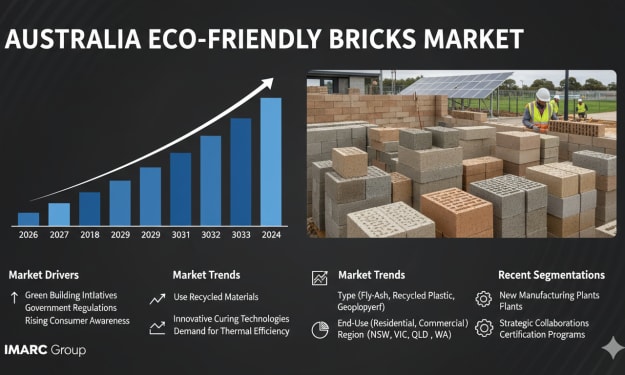
The Australia eco friendly bricks market reached USD 24.0 Million in 2025 and is anticipated to grow to USD 42.6 Million by 2034, exhibiting a compound annual growth rate (CAGR) of 6.56% between 2026 and 2034.
By Amélie Belle4 days ago in Trader
I Don't Need My Phone... Wait, Is That Actually True?
My parents gave me my first cell phone when I was twelve years old. It wasn't a fancy iPhone or anything, not even close. Just a simple black flip phone for when I needed to call or text them after school.
By Madison "Maddy" Newtonabout 15 hours ago in Humans



Comments
There are no comments for this story
Be the first to respond and start the conversation.