
Australia Solar Power Equipment Market 2026: Set for Triple-Digit Expansion as Renewables Surge
Strong policy support, technology advances, and high solar adoption are driving the Australia solar power equipment market toward USD 14.1 billion by 2034.

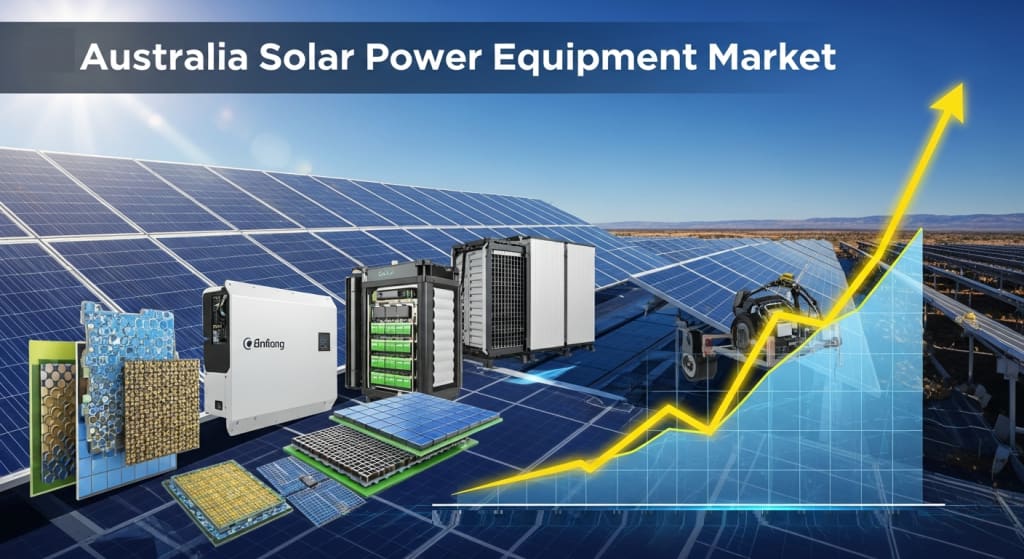
Australia Solar Power Equipment Market Overview
The Australia solar power equipment market is experiencing one of the most dynamic growth phases in the nation’s energy sector, supported by robust government incentives, rising electricity costs, environmental imperatives, and technological innovation. According to IMARC Group, the Australia solar power equipment market size reached USD 4.5 billion in 2025 and is projected to grow to USD 14.1 billion by 2034, representing a compound annual growth rate (CAGR) of 13.44% during 2026–2034.
This rapid expansion highlights Australia’s transition toward a sustainable and resilient energy ecosystem. Solar power equipment — encompassing solar panels, mounting and tracking systems, storage systems, and other ancillary components — is increasingly becoming a strategic investment for households, businesses, and utilities. Below, we explore the factors driving this trend, key opportunities on the horizon, and the latest developments shaping the landscape through 2025.
Why the Market Is Growing So Rapidly
The Australia solar power equipment market’s strong trajectory is backed by a blend of policy, economic, and technology trends reshaping both supply and demand.
1. Supportive Government Policies and Incentives
Australia’s national and state governments continue to champion clean energy through direct and indirect policy support. Initiatives such as rebates, feed-in tariffs, and long-term renewable energy targets have made solar equipment more financially attractive for residential and commercial adopters. These incentives reduce upfront costs, accelerate deployment cycles, and support economies of scale across the solar value chain.
2. Rising Electricity Costs Driving Adoption
Persistent increases in conventional electricity costs have encouraged households and businesses to seek cost savings through self-generated solar power. Solar installations help consumers lower monthly bills, hedge against volatile utility pricing, and achieve predictable energy expenses over the lifespan of a system. This economic incentive remains one of the strongest demand drivers for solar power equipment.
3. Technological Innovations Enhancing System Efficiency
Continuous advancements in solar technologies — including anti-hail modules, higher-efficiency photovoltaics, and improved energy storage systems — are elevating system performance and resilience. These innovations address real-world challenges such as weather extremes and grid intermittency, offering users long-term reliability and stronger returns on investment.
4. Growing Residential and Commercial Solar Uptake
Australia’s high solar irradiance and widespread rooftop installations have established the country among global leaders in per capita solar adoption. From urban homes to regional business premises, solar systems are becoming standard features of modern energy portfolios, driving demand for a broader range of equipment from panels to mounting systems and storage units.
5. Environmental Awareness and Corporate Sustainability Goals
Heightened awareness of climate change and corporate sustainability commitments are accelerating the transition to renewable energy sources. Companies across sectors are increasingly investing in solar power as part of broader ESG strategies, not only to reduce carbon footprints but also to signal environmental leadership to stakeholders.
Request a Sample Report with the Latest 2026 Data & Forecasts
What the Opportunities Are
The Australia solar power equipment market presents a range of strategic opportunities for investors, manufacturers, and service providers:
1. Scaling Utility-Scale Solar Projects
As solar becomes central to Australia’s renewable energy goals, large-scale solar farms present high-volume demand for advanced equipment — including high-efficiency PV modules, tracking systems, and associated storage solutions.
2. Expansion of Battery Storage Integration
Energy storage is a critical complement to solar generation, enabling greater grid stability and off-peak utilization. Market players can leverage this trend by providing integrated solar-plus-storage solutions tailored to residential and commercial clients.
3. Local Manufacturing and Supply Chain Development
Strengthening domestic manufacturing capabilities for solar components — such as panels and mounting structures — can reduce reliance on imports, create jobs, and enhance supply chain resilience while capturing value within the national economy.
4. Service and Maintenance Solutions
As solar assets proliferate, there is a growing need for after-sale services, performance monitoring, and maintenance. Companies offering lifecycle management, warranty support, and performance optimization can carve out profitable niches.
5. Innovation in Resilience-Focused Technology
Developing equipment designed to withstand harsh climate conditions — such as high-heat, hailstorm-resistant modules — can differentiate offerings and expand adoption in challenging environments.
6. Integration with Smart Grid and IoT Platforms
Smart solar equipment that interfaces with IoT and grid management systems offers enhanced efficiency and real-time performance insights, opening pathways for premium products and data-driven services.
7. Export and Regional Partnerships
Australia’s solar industry can leverage regional demand by forming export partnerships and positioning locally manufactured equipment for Southeast Asia and Pacific Island renewable projects.
Recent News & Developments
• March 2025: Government Incentive Enhancements: The Australian Renewable Energy Agency (ARENA) expanded incentive programs for solar equipment installation and local supply chain growth. This includes increased grants for solar module assembly facilities and incentives for energy storage equipment, aiming to accelerate deployment and domestic technology capabilities.
• June 2025: Major Solar Storage Project Launch: Sungrow played a pivotal role in Australia’s largest operational DC-coupled solar and battery storage project in Cunderdin, Western Australia. This project integrates advanced storage systems designed to enhance grid stability and scale renewable integration across utility networks, reflecting the growing importance of storage-linked solar equipment.
• September 2025: Strategic Market Expansion: Omnidian announced the acquisition of Solar Service Guys (SSG), a leading solar services provider in Australia. This strategic move strengthens Omnidian’s presence in performance assurance and lifecycle services for solar equipment, supporting customer adoption across residential and commercial segments.
Why Should You Know About Australia Solar Power Equipment Market?
The Australia solar power equipment market isn’t just growing — it’s reshaping the country’s energy landscape. For investors, the high CAGR and diversified demand signals long-term growth potential across equipment, services, and technology layers. For business leaders and manufacturers, the market represents an opportunity to innovate, localize production, and integrate value-added services. For policymakers, supporting a vibrant solar ecosystem can enhance energy security, reduce emissions, and create sustainable jobs.
As Australia continues its transition toward a cleaner and more resilient energy system, understanding the solar power equipment market is crucial for anyone looking to participate in or benefit from one of the country’s most transformative industrial trends.
About the Creator
Amyra Singh
Market research analyst who loves spotting patterns, digging into data, and turning insights into strategies that help brands grow and stay ahead of the curve.
Keep reading
More stories from Amyra Singh and writers in Trader and other communities.
Australia Ethanol Market 2026:Gears Up for Sustained Growth Amid Energy Transition and Bioeconomy Push
Australia Ethanol Market Overview The Australia ethanol market growth is advancing as a critical component of the country’s broader energy and sustainability agenda. Fueled by rising demand for low-carbon fuels, government bioenergy support, and technological innovation in waste-to-fuel processes, the market reached USD 2.1 billion in 2025 and is forecast to grow to USD 3.6 billion by 2034, reflecting a compound annual growth rate (CAGR) of 5.94% during 2026–2034 according to IMARC Group research.
By Amyra Singh3 days ago in Trader
Bitcoin’s Sudden Crash After the Epstein File Release
Bitcoin’s Sudden Crash After the Epstein File Release: Coincidence or Market Psychology? When the long-anticipated Epstein-related documents were released to the public, the world’s attention was captured almost instantly. Media outlets, social platforms, and political commentators erupted with reactions, debates, and speculation. Around the same time, Bitcoin and the broader cryptocurrency market experienced a noticeable decline. This timing led many observers to ask a pressing question: Did the Epstein file release cause Bitcoin to crash?
By Wings of Time 3 days ago in Trader



Comments
There are no comments for this story
Be the first to respond and start the conversation.