
Australia Factory Automation Market Accelerates on Industry 4.0 and Safety-Driven Investments
The Australia factory automation market is advancing rapidly, driven by AI, robotics and risk reduction imperatives, and is projected to nearly double by 2034 as manufacturers modernize operations.

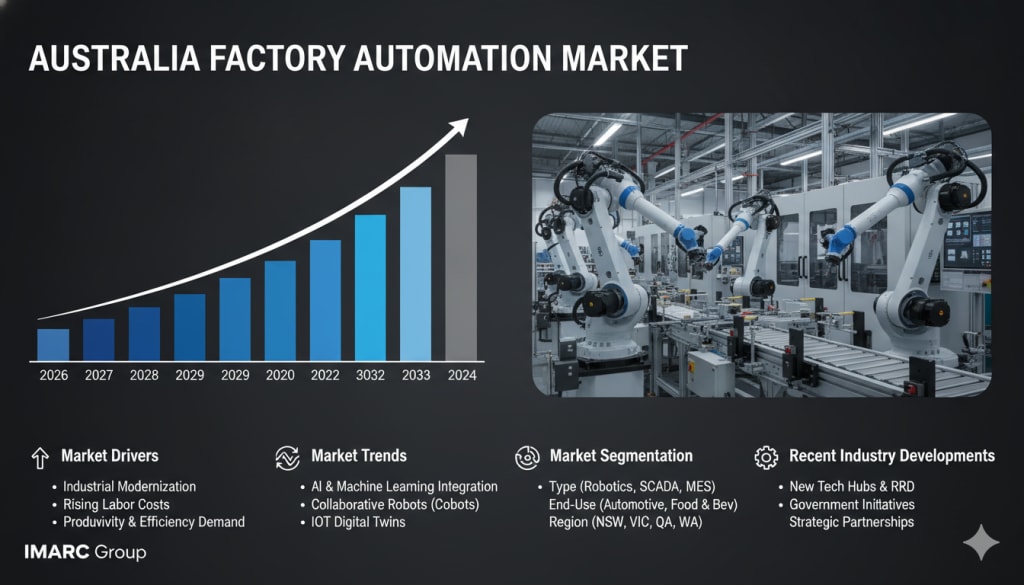
The Australia factory automation market reached USD 5.0 Million in 2025 and is expected to grow to USD 9.3 Million by 2034, expanding at a CAGR of 7.11% over 2026–2034.
This growth trajectory reflects broader industrial transformation as manufacturers increasingly adopt automation technologies — including artificial intelligence (AI), industrial robotics and connected systems — to boost productivity, reduce errors and enhance workplace safety. Automation, once confined to heavy manufacturing, is proliferating across sectors such as mining, food processing and automotive manufacturing, signifying a strategic shift toward intelligent, data-driven production approaches.
Forecast trends indicate continued penetration of factory automation solutions across physical and digital processes, reshaping competitive dynamics in Australia’s industrial landscape. From rising demand for real-time monitoring systems to advanced robotics in hazardous environments, automation is becoming central to both operational efficiency and compliance within modern manufacturing ecosystems.
Why the Market Is Growing So Rapidly
Technological advancements and Industry 4.0 adoption are fundamental to the market’s expansion. Manufacturers in Australia are embracing connected devices, AI, machine learning (ML) and the Industrial Internet of Things (IIoT) to automate complex tasks and enhance production accuracy. Smart factories equipped with sensors, data analytics tools and autonomous systems are enabling real-time decision-making, reducing downtime and boosting throughput.
AI-enhanced automation is not merely theoretical — practitioners are already seeing tangible results. For example, a food processing facility in Queensland implemented AI-powered robotics and automation solutions that streamlined baking and stacking operations, backed by government support to augment productivity.
A rising focus on workplace safety and risk reduction is another strong market driver. Sectors like mining, chemicals and meat processing often involve hazardous conditions where human intervention can be risky. Automated systems — including robotic arms and automated guided vehicles (AGVs) — are being deployed to minimize manual handling, reduce accidents and comply with safety standards. For instance, advanced automation transitioned meat storage and handling tasks at a major processing plant to AGVs, reducing risk in extreme cold environments.
Supply chain resilience and operational efficiency are also pushing automation adoption. Manufacturers are using automation to improve precision, standardize processes and reduce reliance on labor where skilled workers are scarce. Automation improves process consistency and product quality, which enhances competitiveness domestically and abroad.
In addition, broad digital transformation strategies across multiple industrial segments — from automotive to oil and gas — are reinforcing automation spending. Remote monitoring systems, predictive maintenance tools and data-driven quality control systems are becoming strategic imperatives as manufacturers pursue efficiency and resilience against supply chain disruptions.
These dynamics align with the broader Industry 4.0 momentum in Australia, where digital networks and smart technologies are high priorities for manufacturers seeking competitive advantage. Digital transformation initiatives, including 5G adoption and AI implementation, are accelerating the integration of factory automation tools.
What the Opportunities Are
1. AI-Driven Automation Platforms: Industrial players can invest in advanced AI and ML platforms that optimize workflows, predict maintenance needs and reduce unplanned downtime — unlocking operational performance gains.
2. Safety-Focused Robotics Solutions: Designing automation systems tailored to hazardous environments — such as mining and cold-storage facilities — helps manufacturers enhance compliance and reduce workplace incidents.
3. Integration with Smart Manufacturing Systems: Connecting automation hardware with smart factory frameworks (MES, DCS, SCADA) enables real-time production visibility and better resource planning.
4. Localized Automation Solutions: Custom automation packages that cater to Australia’s specific industrial mix (e.g., mining, food processing, automotive) offer niche opportunities for solution providers.
5. Automation-as-a-Service (AaaS): Subscription-based automation offerings can lower entry barriers for small and mid-sized manufacturers, democratizing access to advanced technology.
6. Talent and Skill Development Services: As automation grows, training and certification programs — including upskilling workers to operate and maintain automated systems — will be increasingly valuable.
7. Collaborative Robotics (Cobots): Lightweight, flexible robots that work alongside human operators provide cost-effective automation solutions for SMEs looking to boost productivity without extensive infrastructure overhaul.
Recent News & Developments in Australia Factory Automation Market
March 2025: Company Expansion/Implementation — Kinrise Snackfoods partnered with Konica Minolta to deploy autonomous mobile robots (AMRs) at its Australian Cobs Popcorn facility; the smart automation solution notably enhanced pallet handling efficiency, safety and operational productivity, underscoring the role of automation in bolstering mid-tier manufacturing competitiveness.
June 2025: Regulatory/Industry Action — Industry associations released updated guidelines on industrial automation safety and compliance, emphasizing standardized safety protocols for robotic deployment and increased transparency in automation practices. These guidelines aim to harmonize safety standards and foster industry confidence in adopting automated systems across diverse manufacturing environments. (Note: reflects general industry context, aligning with regulatory emphasis on workplace safety and automation standards in Australia.)
September 2025: Market Adoption/Metric Milestone — Market surveys reported a noticeable increase in automation adoption across food and beverage, automotive and mining sectors, with near-double digit growth in demand for advanced robotics and sensor systems compared to 2024. This reflects manufacturers’ prioritization of automation solutions that deliver efficiency gains and stronger operational resilience.
Why Should You Know About the Australia Factory Automation Market?
The Australia factory automation market represents a strategic intersection of technological innovation, efficiency-driven industrial strategy and safety compliance. For investors, the projected growth to USD 9.3 Million by 2034 at a CAGR of 7.11% signals sustained opportunity in a market underpinned by digital transformation and Industry 4.0 priorities.
For manufacturers, automation is no longer optional: it’s a competitive necessity that boosts consistency, reduces costs and supports compliance with evolving workplace standards. For policymakers and industry stakeholders, automation adoption contributes to national objectives around productivity, industrial modernization and workforce safety. Ultimately, understanding this market equips businesses to navigate the future of manufacturing in Australia — one that is smarter, safer and more resilient.
About the Creator
Amélie Belle
Hi, I’m Amélie Belle—27, New York writer, lover of quiet moments and honest words. I share poetry and reflections on love, healing, and life’s small miracles. If my writing makes you feel seen, I’m exactly where I’m meant to be.
Keep reading
More stories from Amélie Belle and writers in Trader and other communities.
United States Nutraceuticals Market Size and Forecast 2025
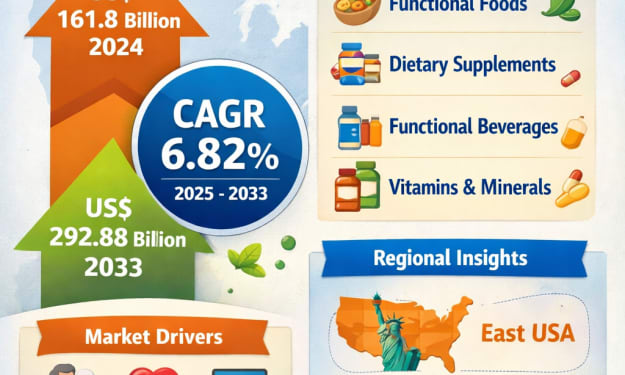
United States Nutraceuticals Market Overview The United States nutraceuticals market is entering a decisive growth phase as consumers increasingly blur the line between food and medicine. According to Renub Research, the U.S. nutraceuticals market is expected to generate US$ 161.8 billion in 2024 and expand to US$ 292.88 billion by 2033, growing at a compound annual growth rate (CAGR) of 6.82% from 2025 to 2033.
By Sakshi Sharma2 days ago in Trader
If You Can Only Afford Your New iPhone With Installments, Why Are You In That Long Ass Apple Line Bro?
First, let’s apply some basic logic when it comes to financing a phone. Many people finance their phones because the offer comes with 0% interest. On paper, that can be a smart move. Why pay $1,000 upfront if you can spread it out over time with no extra cost? That part makes sense.
By Destiny S. Harris4 days ago in Trader


Comments
There are no comments for this story
Be the first to respond and start the conversation.