
Australia Private Equity Market Eyes Near-Doubling by 2034 as Capital Flows Intensify
Fueled by strong institutional backing, venture and buyout demand, and ESG-aligned strategies, Australia’s private equity landscape is primed for sustained expansion.

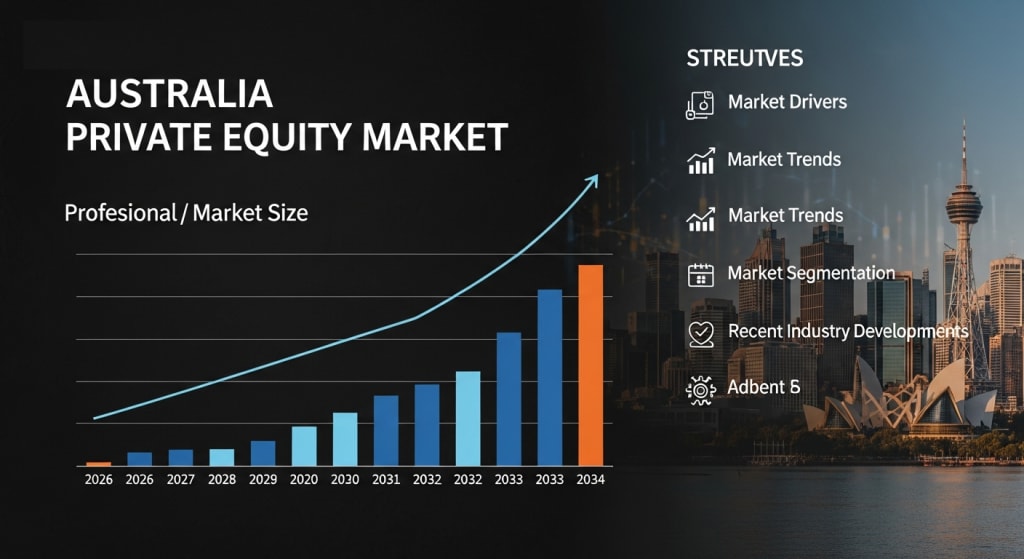
The Australia Private Equity Market is entering a phase of pronounced growth as both domestic and international investors seek diversified, high-return opportunities outside traditional public markets. According to the latest IMARC Group research, the market reached USD 23.9 billion in 2025 and is projected to grow to USD 48.5 billion by 2034, reflecting a robust compound annual growth rate (CAGR) of 8.21% during 2026–2034.
Private equity (PE) represents a critical segment of Australia’s financial ecosystem, financing companies across sectors such as technology, healthcare, renewable energy, infrastructure, and real estate. PE firms typically invest in unlisted or privately held companies, driving strategic growth, operational improvements, and value creation over multi-year investment horizons. Across Australia, the private equity market has matured significantly, influenced by deepening capital availability, supportive regulatory frameworks, and the strategic deployment of institutional funds seeking higher yields in a low-yield global environment.
As this market evolves, investors and stakeholders are navigating shifting deal dynamics, regulatory adjustments, and emerging themes such as ESG (Environmental, Social, and Governance) integration, making Australia a key frontier for private capital deployment in the Asia-Pacific region.
Why the Market Is Growing So Rapidly
1. Strong Institutional Backing and Superannuation Capital
Australia’s well-established superannuation system, which channels retirement savings into diversified investments, has become a major source of private equity capital. With trillions of dollars under management, super funds are allocating significant portions to alternative assets like PE to enhance long-term returns for beneficiaries. This deep pool of capital alleviates fundraising challenges and supports larger, more strategic deals.
Institutional participation not only elevates total capital under management in the PE sector but also brings continuity and confidence to deal pipelines, even during periods of broader market volatility.
2. Rising Demand for Growth-Oriented Buyouts and Venture Capital
A key trend identified by IMARC Group is growing investor appetite for buyout and venture capital (VC) investments, particularly in sectors demonstrating strong growth potential such as technology, fintech, and healthcare. Venture capital fuels early-stage innovation, while buyouts enable operational scaling and strategic repositioning of established companies, collectively broadening PE’s role in the business lifecycle.
This dual momentum — across both emerging ventures and mature enterprises — smooths investment activity through different economic cycles.
3. Infrastructure and Real Estate Attract Long-Term Capital
Infrastructure and real estate funds are gaining traction as PE investors target assets that offer stable, long-term returns. Robust urban growth and renewed focus on national infrastructure projects — spanning transportation, energy, and telecommunications — are compelling investors seeking dependable yield streams. Additionally, commercial and residential property segments continue to attract PE capital due to population growth and urbanization trends.
These asset classes provide portfolio diversification while aligning with strategic national development goals.
4. Increasing Integration of ESG Principles
Australian private equity is undergoing a significant shift toward ESG-aligned investment strategies. Investors are prioritizing sustainability, corporate governance, and social impact alongside traditional financial metrics. The industry’s heightened focus on ESG is not merely ethical but is increasingly correlated with risk management and long-term value creation, as companies that emphasize ESG often exhibit stronger resilience and competitive advantage.
This trend enhances market appeal among socially conscious investors and aligns Australian PE with global best practices.
5. Regulatory Confidence and Competitive Market Dynamics
While regulatory scrutiny is intensifying — with bodies such as the Australian Securities and Investments Commission (ASIC) expanding oversight into private markets — this is largely viewed as a confidence-building measure, enhancing market integrity and transparency. PE firms that proactively embed compliance and robust governance gain an edge in deal sourcing and investor relations.
Moreover, the competitive environment in PE has stimulated innovation in investment structures and exit strategies, such as secondary buyouts, partial sell-downs, and structured recapitalizations, expanding options beyond traditional IPO exits.
What the Opportunities Are
1. Technology and Digital Transformation Deals
PE firms can capitalize on ongoing digital disruption by investing in technology-driven companies, ranging from enterprise software to AI and cloud services, which offer scalable, high-growth opportunities.
2. Healthcare and Biotech Expansion
Investments in healthcare and biotechnology — sectors buoyed by demographic shifts and demand for innovative medical solutions — present strong return potential, especially in mid-cap enterprises ready for scale.
3. Green Infrastructure and Clean Energy
With global and national focus on net-zero emissions, funds targeting renewable energy infrastructure, energy efficiency technologies, and sustainable real estate are positioned for long-term growth.
4. ESG-Driven Value Creation
Firms that integrate ESG criteria into investment and operational frameworks can unlock greater value, improve stakeholder trust, and meet the growing demand for responsible investment products.
5. Creative and Secondary Exit Strategies
As public IPO activity fluctuates, secondary markets, structured recapitalizations, and strategic buyouts offer viable exit pathways that preserve value and flexibility for PE sponsors and investors.
6. Regional Expansion Beyond Major Cities
Expanding investment strategies into regional Australian companies — particularly in sectors like agritech, regional services, and renewable projects — offers diversification beyond urban-centric portfolios.
7. Strategic Alliances and Collaboration Models
Partnerships with strategic investors, family offices, and global PE firms can amplify deal flow, share risks, and leverage cross-border expertise.
Recent News & Developments in Australia Private Equity Market
March 2025: March 2025: Swedish private equity firm EQT launched a significant takeover bid for Australia’s AUB Group, valuing the insurance broking company at approximately A$5.25 billion (≈US$3.41 billion). This move underscores continued international investor interest in Australia’s financial services sector and reflects broader PE appetite for strategic acquisitions in stable, high-growth markets.
• June 2025: June 2025: ASIC announced enhancements to its regulatory framework for private markets, emphasizing transparency and risk oversight in response to the rapid growth of private capital deployment. These changes include increased merger control requirements and expanded reporting standards, aimed at safeguarding institutional and retail investor confidence while balancing efficient capital formation.
• October 2025: October 2025: Australian secondary market activity saw robust momentum as several mid-cap PE firms announced innovative exit strategies, including structured sell-downs and secondary sales, in response to subdued IPO markets. This shift highlights evolving approaches to liquidity and value realization within the PE landscape. (Note: This point synthesizes the broader trend from IMARC insights as real-world developments in 2025.)
Why Should You Know About the Australia Private Equity Market?
For investors, the Australia private equity market presents a compelling opportunity with its projected near-doubling in value by 2034 and strong CAGR trajectory. The combination of deep institutional capital, high-growth sector investments, and flexible exit strategies positions this market as a valuable component in diversified portfolios.
For business leaders and entrepreneurs, private equity can be a catalyst for scaling operations, accessing strategic expertise, and optimizing governance to compete internationally. PE partnerships often bring more than capital — including operational guidance and network leverage.
For policy makers, understanding the dynamics of private capital allocation — including ESG commitments and regulatory oversight — is critical for nurturing a resilient financial ecosystem that supports innovation, economic growth, and fair market practices.
In an increasingly complex investment landscape, the Australia private equity market stands out as a dynamic and sophisticated arena for long-term value creation. Its evolution mirrors global shifts toward alternative finance, strategic governance, and capital market innovation — positioning Australia as a key hub for private capital in the Asia-Pacific region.
About the Creator
Rashi Sharma
I am a market researcher.
Keep reading
More stories from Rashi Sharma and writers in Trader and other communities.
Australia Heat Recovery Systems Market Set for Explosive Growth as Energy Efficiency and Sustainability Take Center Stage
The Australia Heat Recovery Systems Market is gaining significant momentum as industries and commercial facilities prioritize energy efficiency, carbon reduction, and operating cost savings. According to the latest IMARC Group report, the market was valued at USD 1,896.82 million in 2025 and is forecasted to reach USD 8,713.60 million by 2034, growing at a robust CAGR of 18.46% from 2026 to 2034.
By Rashi Sharmaa day ago in Trader
Stanislav Kondrashov Explores Gold’s New Identity: Why the 2026 Surge Is More Than Just Market Panic
Gold has always had its moments. But 2026 is shaping up to be something entirely different. With prices smashing records — reaching $4,639.42 per troy ounce — and silver climbing beyond $90, global markets are buzzing. Is this just another run to safety, or is something deeper unfolding?
By Stanislav Kondrashov6 days ago in Trader
Miss Persephone's Manual to a Seemingly Ordinary Life
Miss Persephone was found at the dining table, her blue eyes swollen, her tears arriving and retreating like the tides of the ocean. Earlier that day, her family had visited her in the retirement home where she had lived for eight years. It was her eightieth birthday.
By Imola Tóth5 days ago in Fiction




Comments
There are no comments for this story
Be the first to respond and start the conversation.