
Australia Printer Market Size and Forecast 2025–2033
How Digital Transformation, Hybrid Work, and Industrial Printing Are Reshaping Australia’s Printer Industry

Australia Printer Market: A Market in Transition
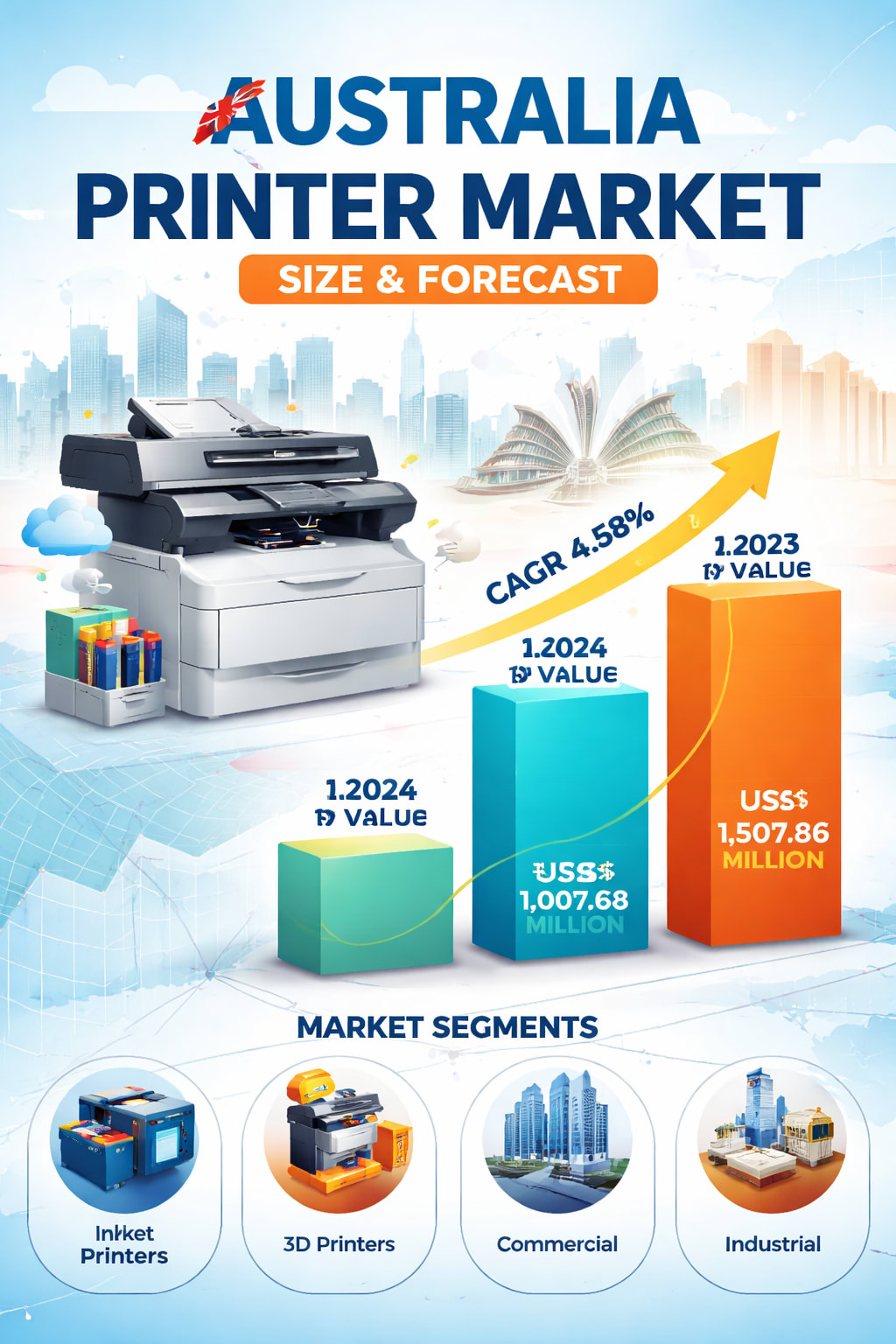
The Australia Printer Market is entering a new phase of transformation as businesses, institutions, and households rethink how they create, manage, and distribute documents and printed materials. According to Renub Research, the Australia Printer Market is expected to reach US$ 1,507.86 million by 2033, growing from US$ 1,007.68 million in 2024, at a CAGR of 4.58% from 2025 to 2033. This steady growth reflects not only the continued relevance of printing in a digital-first world, but also the industry’s ability to reinvent itself through innovation, efficiency, and new use cases.
For many years, the global narrative around printing was dominated by the idea of a “paperless office.” While digital tools have undoubtedly reduced certain types of printing, they have not eliminated the need for printers. Instead, printing in Australia is evolving. Today’s market is shaped by hybrid work models, expanding e-commerce, growing demand for packaging and labeling, and the rise of personalized and on-demand printing solutions. From home offices and corporate environments to industrial production floors, printers remain a critical piece of business infrastructure.
At the same time, the industry is undergoing a technological upgrade. Modern printers are no longer just output devices; they are smart, connected systems integrated with cloud platforms, enterprise software, and digital workflows. Features such as wireless connectivity, mobile printing, remote management, and multifunction capabilities are becoming standard rather than optional. This shift is helping the printer market remain resilient even as digital alternatives continue to grow.
Industry Overview: Technology, Flexibility, and Sustainability
The Australian printer industry is being reshaped by two powerful forces: technological progress and changing customer expectations. Traditional printing methods are increasingly being complemented—or replaced—by digital printing technologies that offer higher speed, better quality, and greater flexibility. Businesses today want printers that can do more than just print. They expect devices that can scan, copy, manage documents, connect to the cloud, and integrate smoothly into their IT ecosystems.
The rise of remote work and home-based businesses has further accelerated this trend. Compact, multifunction printers that can handle a variety of tasks in small spaces are in high demand. For many Australian households and small businesses, a single device now serves as a complete document management hub. This has expanded the residential and small office segments of the printer market, creating new opportunities for manufacturers and service providers.
Sustainability is another major theme shaping the industry. Environmental concerns, rising energy costs, and corporate sustainability goals are pushing both manufacturers and buyers to focus on eco-friendly printing solutions. Energy-efficient devices, reduced waste technologies, recyclable consumables, and ink-saving features are becoming important differentiators in purchasing decisions. Many companies are also rethinking their printing strategies to balance cost, environmental impact, and operational needs.
Despite these positive developments, the industry is also becoming more competitive. Global and regional players are investing heavily in innovation, customer service, and after-sales support to stand out in a crowded market. The result is a dynamic, fast-evolving landscape where success depends on a company’s ability to adapt to changing business models and user expectations.
Key Factors Driving the Australia Printer Market Growth
Government Initiatives Supporting Digital Transformation
The Australian government has been actively promoting digital transformation across multiple sectors of the economy, recognizing its importance for productivity, competitiveness, and long-term growth. Through various funding programs, incentives, and policy frameworks, businesses are encouraged to modernize their operations and adopt advanced technologies.
This push toward digitalization indirectly supports the printer market as well. Modern workplaces require smarter, more connected printing solutions that can integrate with digital workflows, cloud platforms, and cybersecurity systems. Government-backed digital initiatives encourage organizations to upgrade outdated equipment and invest in new-generation printers that offer better efficiency, security, and connectivity. This environment creates a favorable climate for both domestic and international printer manufacturers to introduce innovative products tailored to the evolving needs of Australian businesses.
Rising Demand for Personalized and On-Demand Printing
One of the most significant shifts in the printing industry is the move away from mass production toward personalized and on-demand printing. Businesses in retail, marketing, publishing, and events are increasingly looking for short-run, customized print solutions that can be produced quickly and cost-effectively.
This trend is being driven by changing consumer expectations. Customers today want personalized experiences—whether it is customized packaging, limited-edition promotional materials, or targeted marketing campaigns. Digital printing technologies make it possible to produce such materials without the high setup costs associated with traditional printing methods. As a result, demand for versatile digital printers capable of high-quality, small-batch production is growing steadily across Australia.
On-demand printing also helps companies reduce waste and manage inventory more efficiently by printing only what is needed, when it is needed. This aligns well with both cost-saving goals and sustainability objectives, further strengthening the case for investment in modern printing solutions.
Business Investment in Modern, Versatile Printing Solutions
Across industries, Australian businesses are increasingly investing in modern printing technologies that offer greater flexibility, speed, and cost efficiency. Multifunction printers that combine printing, scanning, copying, and document management features are now standard in many offices. In industrial and commercial environments, advanced digital presses and specialized printers are being adopted to support packaging, labeling, and large-format printing needs.
Cloud integration and wireless connectivity are also becoming essential features, especially for organizations with remote or hybrid workforces. These capabilities allow employees to print securely from different locations and devices, improving productivity and workflow efficiency. For many companies, upgrading their printing infrastructure is no longer just a hardware decision—it is part of a broader digital transformation strategy.
This continuous modernization is a key driver of market growth, as organizations replace older equipment with newer, more capable systems and expand their printing capabilities into new areas of business.
Challenges in the Australia Printer Market
Supply Chain Disruptions
Like many technology-driven industries, the printer market has been affected by global supply chain disruptions in recent years. Shortages of critical components, particularly semiconductors and electronic parts, have led to production delays, longer lead times, and occasional product shortages. Shipping delays and higher logistics costs have further added pressure to manufacturers and distributors.
For the Australian market, which relies significantly on imported hardware and components, these disruptions can create uncertainty in inventory planning and pricing. Companies are increasingly exploring strategies such as diversifying suppliers, building buffer stocks, and, in some cases, considering local assembly or regional sourcing. While these measures can improve resilience, they also increase operational complexity and costs.
Rapid Technological Changes
The pace of technological change in the printing industry is both an opportunity and a challenge. Innovations in digital printing, cloud connectivity, security features, and multifunction capabilities are constantly raising the bar for what customers expect from their devices. For manufacturers, this means continuous investment in research and development to stay competitive.
For customers—especially small and medium-sized businesses—the cost and complexity of upgrading to the latest technology can be a barrier. Rapid innovation also shortens product life cycles, putting pressure on both buyers and sellers to make timely investment decisions. Balancing innovation, affordability, and ease of use remains one of the key challenges facing the Australian printer market.
Market Segmentation
By Type
Inkjet Printers
Inkjet printers continue to be popular in both residential and small office environments due to their affordability, compact size, and ability to produce high-quality color prints. They are widely used for everyday document printing, photos, and small-scale business needs.
Laser Printers
Laser printers are preferred in corporate and commercial settings where speed, volume, and cost per page are critical factors. Their efficiency and reliability make them a staple in medium to large offices across Australia.
Dot Matrix Printers
Although considered an older technology, dot matrix printers are still used in specific applications such as continuous paper printing, invoices, and industrial environments where durability and low operating costs are important.
3D Printers
3D printing is an emerging and rapidly growing segment, especially in manufacturing, education, healthcare, and design. While still a smaller part of the overall printer market, it represents a high-potential area for future growth and innovation.
Offset Printers
Offset printing remains important in large-scale commercial printing operations, including publishing, packaging, and advertising, where high-volume and consistent quality are required.
Flexographic Printers
Flexographic printing plays a key role in packaging and labeling, particularly for food, beverages, and consumer goods. Growth in e-commerce and retail packaging is supporting demand in this segment.
Others
This category includes specialized and niche printing technologies used for specific industrial or commercial applications.
By End Use
Industrial
The industrial segment includes manufacturing, packaging, labeling, and large-scale production environments. Demand here is driven by growth in e-commerce, logistics, and consumer goods industries.
Commercial
Commercial users include offices, businesses, educational institutions, and service providers. This is one of the largest segments, supported by ongoing needs for document management, marketing materials, and operational printing.
Residential
The residential segment has gained importance with the rise of remote work, online education, and home-based businesses. Compact, affordable, and multifunction printers are especially popular in this category.
Competitive Landscape and Company Analysis
The Australian printer market is highly competitive, with both global technology giants and specialized manufacturers competing for market share. Key players covered in the market include:
Canon Inc.
FUJIFILM Corporation
Fujitsu Limited
Hitachi Ltd.
Honeywell International Inc.
HP Inc.
Panasonic Corporation
Seiko Epson Corporation
Toshiba Corporation
Xerox Corporation
These companies compete on the basis of product innovation, performance, reliability, pricing, and after-sales service. Many are also expanding their offerings beyond hardware into software solutions, managed print services, and integrated document management systems. Recent developments in the industry focus on improving energy efficiency, enhancing security features, expanding cloud connectivity, and introducing more user-friendly and versatile devices.
Revenue analysis and strategic initiatives show that companies investing in digital printing technologies, industrial applications, and service-based business models are better positioned to benefit from the evolving market landscape.
Outlook: What Lies Ahead for the Australia Printer Market?
Looking ahead, the Australia Printer Market is expected to continue its steady growth through 2033, supported by ongoing digital transformation, expanding industrial applications, and the enduring need for physical documents and printed materials. While the market will continue to face challenges from supply chain uncertainties and rapid technological change, it also has strong opportunities in areas such as personalized printing, packaging, labeling, and 3D printing.
The role of printers is shifting from simple output devices to smart, connected components of broader digital ecosystems. Companies that successfully align their products and services with this new reality—focusing on efficiency, sustainability, and integration—are likely to lead the next phase of market growth.
Final Thoughts
The Australia Printer Market is far from becoming obsolete. Instead, it is redefining itself in response to new business models, technological innovation, and changing customer expectations. With the market projected to grow from US$ 1,007.68 million in 2024 to US$ 1,507.86 million by 2033 at a CAGR of 4.58%, the industry demonstrates strong resilience and adaptability.
In a world that is increasingly digital, printing continues to play a vital supporting role—whether in offices, factories, schools, or homes. The future of the Australian printer industry will belong to those who can combine technology, sustainability, and user-centric design into solutions that meet the evolving needs of modern businesses and consumers alike.
About the Creator
Stock Market Today: Key Updates, Trends, and Insights
The stock market today reflects ongoing volatility as investors react to a combination of domestic and global factors. Indices such as the S&P BSE Sensex continue to serve as a benchmark for India’s top 30 companies, offering insight into the overall market direction. Simultaneously, global developments and digital assets like Bitcoin USD are increasingly influencing investor sentiment and trading decisions.
By Hammad Nawazabout 4 hours ago in Trader
How to Build a Stock Portfolio: A Beginner’s Guide to Diversified Investing
Introduction Building a stock portfolio is one of the most effective ways to achieve long-term financial goals. A well-constructed portfolio balances risk and reward, provides growth potential, and can generate income through dividends. For beginners, understanding how to select stocks, diversify holdings, and manage risk is essential for success in the stock market.
By Hammad Nawaz5 days ago in Trader




Comments
There are no comments for this story
Be the first to respond and start the conversation.