
Europe Electric Vehicle Charging Infrastructure Market Size and Forecast 2025–2033
Europe Electric Vehicle Charging Infrastructure Market Set for Rapid Expansion Amid Green Transition

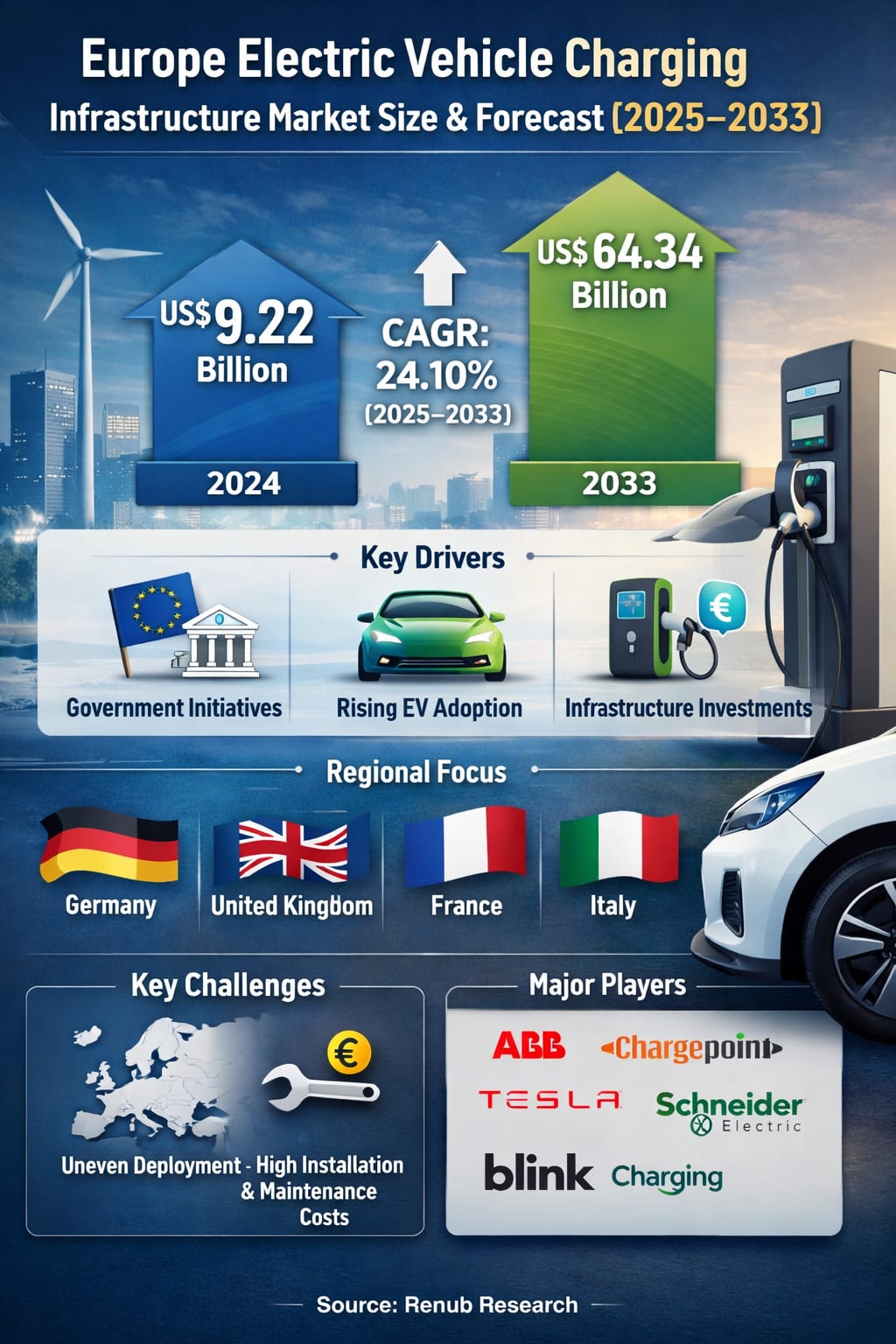
The Europe Electric Vehicle Charging Infrastructure Market is expected to reach US$ 64.34 Billion by 2033, rising sharply from US$ 9.22 Billion in 2024, registering a robust CAGR of 24.10% from 2025 to 2033. This remarkable growth is being driven by strong government support, accelerating electric vehicle (EV) adoption, massive infrastructure investments, rapid urbanization, and the presence of leading EV manufacturing hubs across the region.
Europe continues to dominate the global EV charging ecosystem due to its ambitious climate policies, coordinated regulatory framework, and early adoption of electric mobility. As the continent pushes toward carbon neutrality, charging infrastructure is becoming a strategic pillar of Europe’s clean transport transition.
Europe Electric Vehicle Charging Infrastructure Market Overview
The rapid expansion of Europe’s EV charging infrastructure is largely fueled by national policies and ambitious European Union targets aimed at reducing carbon emissions. By the end of 2023, the European Union had approximately 700,000 public charging points, with strong year-on-year growth in both AC and DC chargers. The European Commission has set a target of 3.5 million public charging points by 2030, although current installation rates indicate that deployment must accelerate significantly to meet this goal.
Supportive government regulations, technological progress in charging solutions, and the growing popularity of electric vehicles across Europe are the primary forces behind this expansion. Countries such as the Netherlands, Germany, and Norway are leading the way, with Norway having one of the highest numbers of charging points per capita. Alongside this, the integration of renewable energy sources such as wind and solar into charging networks is gaining momentum, aligning infrastructure development with broader sustainability objectives.
Despite these advances, challenges remain. High capital requirements, regulatory coordination across countries, grid capacity constraints, and the need for smart charging systems continue to shape the market’s evolution. Nevertheless, policy frameworks such as the European Green Deal and the Fit for 55 package are providing strong momentum for infrastructure investments.
In February 2025, more than 3,500 companies involved in EV charging solutions announced plans to significantly expand their workforce, potentially creating over 162,000 jobs between 2025 and 2030. Around the same time, a collaboration between E.ON, Eldrive, and ZSE was launched to deploy more than 1,400 charging stations across 13 European countries by 2027, backed by investments exceeding US$ 47 million. Such initiatives highlight the scale and seriousness of Europe’s commitment to building a future-ready charging network.
Key Factors Driving the Europe EV Charging Infrastructure Market
Growing Private Sector Investment
Private sector participation is playing a critical role in accelerating the growth of Europe’s EV charging infrastructure. Energy companies, automakers, and technology firms are investing heavily in charging networks, bringing not only capital but also technical expertise and innovation. Many automotive manufacturers are now deploying their own charging ecosystems to support EV sales and strengthen customer loyalty.
Public-private partnerships (PPPs) are becoming increasingly common, particularly for large-scale projects that require coordinated planning, financing, and execution. These partnerships are essential for bridging infrastructure gaps in both urban and rural areas, ensuring that charging availability keeps pace with Europe’s rapidly expanding EV fleet.
Sustainability Goals and Emission Targets
Europe’s strong commitment to sustainability and climate action is one of the most powerful drivers behind the expansion of EV charging infrastructure. The European Union’s long-term objective of achieving carbon neutrality by 2050 has pushed governments to introduce strict regulations and incentives aimed at phasing out internal combustion engine vehicles.
Countries such as Germany, France, and the United Kingdom have already announced timelines to restrict or ban the sale of new petrol and diesel vehicles. This policy direction makes the transition to electric mobility inevitable. A dense, reliable, and accessible charging network is essential to support this shift and to reduce greenhouse gas emissions from the transport sector, which remains one of Europe’s largest sources of pollution.
Urbanization and Smart City Development
As European cities continue to urbanize and adopt smart city strategies, EV charging infrastructure is increasingly being integrated into the broader urban ecosystem. Smart cities emphasize digital connectivity, efficient energy use, and sustainable transportation—all of which align closely with the goals of EV adoption.
Charging stations are now being installed in residential complexes, office buildings, shopping centers, and transport hubs. Many of these systems are grid-connected and feature smart energy management, demand-response capabilities, and integration with renewable energy sources. This urban focus is accelerating deployment and improving accessibility, particularly in densely populated metropolitan areas.
Challenges in the Europe EV Charging Infrastructure Market
Uneven Infrastructure Deployment
One of the biggest challenges facing Europe’s EV charging market is the uneven distribution of charging infrastructure across the continent. While Western and Northern European countries such as the Netherlands, Germany, and Norway boast dense and mature charging networks, many parts of Eastern and Southern Europe still lag behind.
Lower EV adoption rates, limited public funding, and weaker policy support in some regions have resulted in infrastructure gaps. This imbalance affects consumer confidence and complicates cross-border travel, reducing the overall convenience of owning an electric vehicle in Europe. Bridging this gap will require stronger EU-level coordination, targeted funding, and harmonized deployment strategies.
High Installation and Maintenance Costs
Installing EV charging infrastructure—especially fast and ultra-fast chargers—requires significant capital investment. Costs are driven by civil engineering work, grid upgrades, land acquisition, and compliance with strict environmental and municipal regulations. In addition, ongoing operational expenses such as maintenance, energy management, and customer service add to the financial burden.
These high costs can discourage investment, particularly in low-demand or rural areas. To address this, governments and private players are increasingly exploring cost-sharing models, subsidies, and innovative financing mechanisms to improve the long-term economic viability of charging projects.
Regional Outlook: Europe EV Charging Infrastructure Market
Western Europe currently dominates the market, with Germany, the Netherlands, France, and the United Kingdom leading in terms of installed charging points and investment activity. Eastern and Southern Europe are gradually catching up, supported by EU funding programs and national electrification strategies.
United Kingdom
The UK’s EV charging infrastructure market is expanding steadily, driven by strong environmental regulations and rising consumer demand for cleaner transport. The government has outlined clear plans to phase out internal combustion engine vehicles and is investing heavily in public and commercial charging networks. While fast and ultra-fast chargers are being rolled out across cities and highways, regional disparities—especially in rural areas—remain a challenge. Increasing private sector involvement is helping improve service quality and user experience.
Germany
Germany represents one of Europe’s largest and most strategically important EV charging markets. The government has set ambitious targets, aiming to install over one million charging points by 2030. Financial incentives and subsidies are encouraging both public and private investment, while automakers and energy companies are playing a key role in network expansion. Despite strong progress, challenges such as grid modernization and regional coverage gaps still need to be addressed.
Italy
Italy is actively expanding its EV charging infrastructure as electric mobility gains traction. Government incentives and regulatory measures are supporting nationwide deployment, while private companies are investing in both urban and highway charging solutions. Although progress is visible, continued investment and better regional coordination will be necessary to ensure uniform access and long-term network reliability.
France
France is strengthening its EV charging ecosystem through a mix of public policy support and private sector investment. The government is promoting charging station installation through financial incentives, while companies are expanding nationwide networks. Improving charging speed, availability, and user convenience remains a priority, especially in less-developed regions. Overall, France’s commitment to EV infrastructure is a key pillar of its broader energy transition strategy.
Market Segmentation
By Charger Type:
Slow Charger
Fast Charger
By Charging Type:
AC Charging
DC Charging
By Installation Type:
Fixed
Portable
By Connector:
CHAdeMO
CCS
Others
By Level of Charging:
Level 1
Level 2
Level 3
By Connectivity:
Non-connected Charging Stations
Connected Charging Stations
By Deployment:
Private
Public
By Application:
Commercial
Residential
By Region:
France, Germany, Italy, Spain, United Kingdom, Belgium, Netherlands, Russia, Poland, Greece, Norway, Romania, Portugal, Rest of Europe
Competitive Landscape
The European EV charging infrastructure market is highly competitive, with global technology providers, energy companies, and charging network operators actively expanding their presence. Major players covered in the market include:
ABB Ltd.
ChargePoint, Inc.
Blink Charging Co.
Eaton Corporation
Tesla Inc.
Webasto Group
Schneider Electric, Inc.
Siemens
Delta Electronics, Inc.
These companies are focusing on product innovation, strategic partnerships, and geographic expansion to strengthen their market positions. Key areas of competition include charging speed, software integration, grid compatibility, and user experience.
Final Thoughts
Europe’s electric vehicle charging infrastructure market is entering a decisive growth phase. With the market projected to rise from US$ 9.22 Billion in 2024 to US$ 64.34 Billion by 2033, the sector is becoming one of the most critical enablers of the continent’s clean mobility transition. Strong policy support, rising EV adoption, and increasing private investment are creating powerful momentum.
While challenges such as uneven regional deployment and high infrastructure costs remain, coordinated efforts between governments and industry players are steadily addressing these issues. As Europe moves closer to its long-term climate and sustainability goals, a robust, intelligent, and accessible charging network will be central to shaping the future of transportation across the region.
About the Creator
How AI and Directed Energy Could Trigger Miscalculations
How AI and Directed Energy Could Trigger Miscalculations Modern warfare is entering a phase where speed, automation, and precision are becoming more important than sheer firepower. Artificial Intelligence (AI) and directed-energy weapons—such as laser defense systems—are often presented as tools that will reduce human error and make war more controllable. Paradoxically, these same technologies may increase the risk of miscalculation, escalation, and even unintended large-scale conflict.
By Wings of Time 4 days ago in Trader
Mexico Fleet Leasing Market Size, Industry Trends, Share, Growth and Forecast
Why the Mexico Fleet Leasing Market Is Accelerating Business Mobility: Trends & Future Outlook Mexico’s fleet leasing market is becoming a strategic backbone for businesses that rely on transportation, logistics, and mobile operations. Instead of owning vehicles outright, companies increasingly prefer leasing models that provide flexibility, cost control, and operational efficiency. From delivery fleets to corporate cars and heavy commercial vehicles, leasing is transforming how organizations manage mobility.
By Jackson Watson2 days ago in Trader




Comments
There are no comments for this story
Be the first to respond and start the conversation.