
Australia Natural Gas Market: Energy Dynamics, Infrastructure Growth & the Future of Gas Demand
How supply expansion, industrial use and energy transition trends are shaping Australia’s natural gas landscape
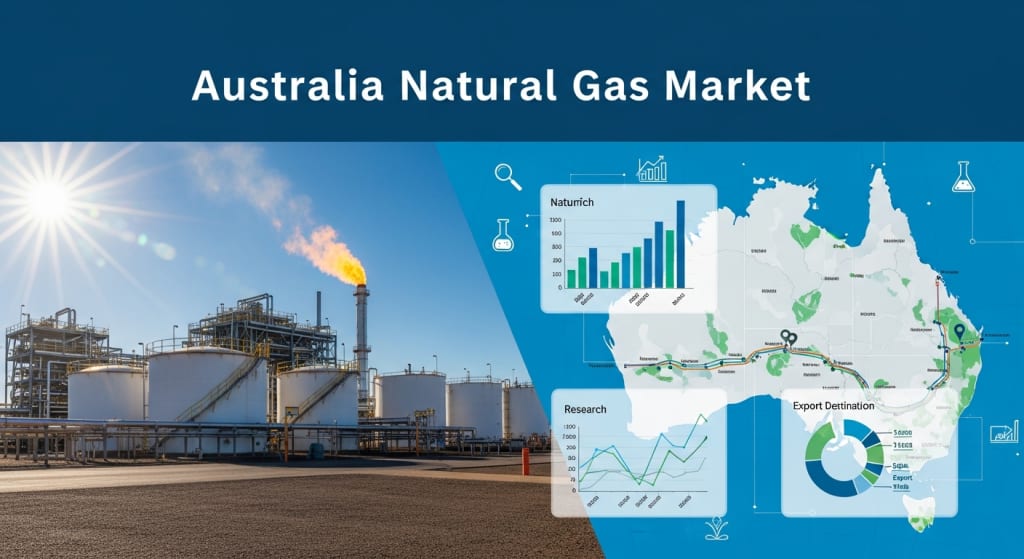
According to the latest data from IMARC Group, the Australia natural gas market reached USD 34.46 Billion in 2025 and is expected to climb to USD 73.82 Billion by 2034, growing at a strong 8.83% CAGR during 2026–2034. As one of the world’s leading LNG exporters and a key supplier of domestic industrial fuel, Australia’s natural gas sector remains a pillar of national economic performance. Gas plays a major role in power generation, heating, petrochemical feedstock, mining operations and manufacturing, while LNG exports significantly contribute to national revenue. At the same time, shifting global energy strategies, Australia’s domestic energy transition, and growing investment in infrastructure continue to reshape the natural gas landscape — making it one of the country’s most strategic and economically influential markets.
Australia Natural Gas Market Vision 2050
1. A Hybrid Gas-Renewable Energy Ecosystem
By 2050, Australia will maintain natural gas as a stabilising fuel supporting a renewable-dominant power system. Gas peaker plants, hydrogen-ready turbines and flexible generation facilities will underpin national grid reliability.
2. Natural Gas and Hydrogen Convergence
Pipeline networks, storage systems and export terminals are expected to become dual-fuel compatible, enabling hydrogen-natural gas blends. This shift will allow existing gas infrastructure to remain valuable while advancing Australia’s clean-energy ambitions.
3. Growth of Carbon-Neutral LNG Production
Carbon capture and storage (CCS), methane-emission detection and electrified LNG plants will help Australia deliver near-net-zero LNG to international buyers. Carbon-neutral LNG will be a competitive premium product for the Asia-Pacific market.
4. Digitisation and Automation of Gas Operations
AI-driven field monitoring, predictive maintenance, digital twins and real-time reservoir analytics will streamline gas production. Automated compression facilities and remote operations centres will drastically reduce operational cost and safety risks.
5. Integrated Domestic Gas Security Framework
National strategies will strengthen domestic allocation, support industrial zones, enhance storage capacity and reduce price volatility. By 2050, Australia aims to balance export profitability with energy affordability for households and businesses.
Recent Trends & Developments in the Australia Natural Gas Market
June 2025:
Australia’s LNG industry reported stronger export volumes, driven by rising demand from Asian buyers and improved production efficiency across major terminals. Several operators announced enhanced maintenance programs that increased plant uptime, supporting more stable year-round LNG supply. The industry also highlighted methane-reduction pilot projects aimed at lowering emissions across upstream operations.
February 2025:
Significant transmission upgrades were completed across eastern Australia, improving pipeline capacity for industrial hubs in New South Wales and Queensland. Engineers reported enhanced peak-hour throughput and reduced transport constraints, helping manufacturers secure competitive gas supply. The project aligns with broader national efforts to stabilise domestic gas availability during periods of high demand.
October 2024:
New digital gas monitoring systems were deployed across major processing facilities, integrating AI-based analytics to detect anomalies and reduce unplanned downtime. Early results indicated measurable improvements in operational efficiency and safety. The rollout is expected to expand further as companies prioritise automation and predictive maintenance across extraction and midstream operations.
Why Should Smart Investors and Businessmen Know About the Australia Natural Gas Market?
A High-Growth Energy Sector with Strong Revenue Potential
With market size projected to reach USD 73.82 Billion by 2034, natural gas remains one of Australia’s most lucrative resource industries. Investors can benefit from long-term export contracts, expanding industrial consumption and major infrastructure upgrades.
Critical to Australia’s Economic and Industrial Stability
Natural gas supports manufacturing, mining, chemicals, food processing and national electricity generation. Its importance to economic output makes it a strategic investment focus for businesses across multiple sectors.
Major Infrastructure and Technology Investment Opportunities
Pipeline expansions, storage enhancements, LNG terminal upgrades and digital transformation projects create sustainable growth avenues for engineering firms, EPC contractors, technology providers and capital investors.
Central Role in Australia’s Energy Transition
Gas provides flexible power generation necessary to balance high renewable penetration. This ensures long-term relevance even as Australia accelerates toward net-zero emissions.
Emerging Opportunities in Hydrogen and Clean Energy Convergence
Hydrogen blending, CCS-enabled LNG, and dual-fuel infrastructure present high-value opportunities for early investors aligned with Australia’s future energy roadmap.
The Australia natural gas market is entering a transformative phase, shaped by supply growth, export strength, technological advancement and the evolving energy-transition landscape. Supported by strong IMARC projections, the sector offers significant potential for investors, businesses and policymakers seeking long-term value in energy infrastructure, industrial fuel demand and advanced gas technologies. As Australia strengthens its position as a global energy supplier while modernising its domestic grid, natural gas will remain essential to powering economic growth and future-ready energy systems.
What is the Australia Natural Gas Market Key Growth Drivers?
Expanding Domestic and Industrial Consumption
Industrial users — including mining, chemicals, manufacturing and processing plants — continue to rely on natural gas for heat, power, and feedstock applications. As industrial output increases, demand for reliable and cost-effective gas supply grows, reinforcing gas as a critical component of Australia’s economic engine.
Rising LNG Export Capacity and Long-Term Asia-Pacific Demand
Australia remains one of the top LNG exporters globally. Strong energy import demand from Japan, South Korea, China and emerging Southeast Asian economies supports long-term LNG contracts. Infrastructure investments across northwest Australia continue to strengthen export volumes and terminal efficiency.
Infrastructure Upgrades Across Transmission and Distribution Networks
Major pipeline expansions, storage enhancements and grid-modernisation initiatives are improving supply reliability. Australia’s east coast and western grid systems are undergoing upgrades designed to reduce bottlenecks, support industrial precincts, and secure gas availability during peak seasonal demand.
Energy Transition and the Role of Gas as a Bridging Fuel
As Australia transitions toward renewable energy, natural gas is increasingly positioned as a low-carbon bridging solution, offering dispatchable power to stabilise the grid. Gas-fired facilities support renewable integration by providing backup capacity during wind and solar intermittency.
Technological Advancements in Gas Processing and Extraction
New extraction technologies, digital reservoir monitoring, advanced liquefaction processes and methane-reduction systems improve operational efficiency. These innovations reduce production costs, enhance environmental compliance and expand the economic life of existing gas fields.
About the Creator
Keep reading
More stories from Shrestha Roy and writers in Trader and other communities.
Australia Masterbatch Market: Colour & Additive Innovation, Polymer Processing & the Demand for High-Performance Plastics
According to the latest findings from IMARC Group, the Australia masterbatch market reached a value of USD 238.00 Million in 2024 and is projected to rise to USD 338.75 Million by 2033, expanding at a steady 4.00% CAGR during 2025–2033. This growth reflects the rising demand for high-performance plastics across Australia’s manufacturing sector, including packaging, automotive, agricultural films, construction materials, consumer goods and electrical components. As industries move toward more efficient polymer processing, advanced colour formulations, sustainability-driven material enhancements and specialty additive technologies, masterbatches have become essential to producing durable, consistent, and quality-enhanced plastic products. The market’s momentum is further supported by local manufacturing shifts, downstream processing upgrades and the increasing need for lightweight, cost-effective materials across industrial applications.
By Shrestha Royabout a month ago in Trader
The Cashless Island: How Singapore is Rewriting the Rules of Digital Payments
In most parts of the world, "cash is king." But in Singapore, cash is rapidly becoming a relic of the past. If you walk into a traditional hawker center today for a plate of Chicken Rice, you are just as likely to see a QR code scanner as you are to see a cash register. This isn't an accident; it is a meticulously engineered transformation that has turned the island nation into the Silicon Valley of payments.
By Sam walter4 days ago in Trader
A Dart at Dusk
Seconds ago, the sullen sun set on the two of us… my exuberant furry companion and me. A fresh breeze embraces us, delivering welcome relief from the day’s oppressive heat. His typical stumbling and staggering along — apace with a sloth — has turned into trip-trapping, high-stepping, almost skipping along.
By Angie the Archivist 📚🪶6 days ago in Petlife




Comments
There are no comments for this story
Be the first to respond and start the conversation.