
Australia Energy Storage Systems (ESS) Market: Powering the Clean Energy Transition
Australia’s energy storage systems market is poised for exponential growth as renewable energy penetration, grid reliability challenges, and supportive policy frameworks drive rapid ESS adoption across utility, commercial, and residential segments.

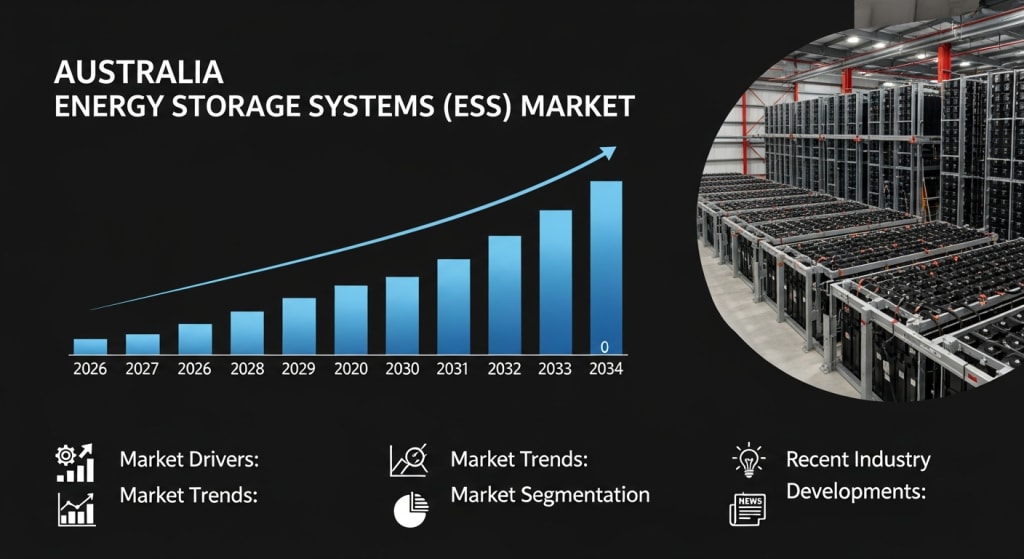
The Australia Energy Storage Systems (ESS) Market is experiencing one of the fastest expansions within the nation’s clean energy landscape. According to IMARC Group, the market was valued at USD 13.11 billion in 2024 and is forecast to reach USD 64.65 billion by 2033, representing a strong CAGR of 17.30% between 2025 and 2033.
This remarkable growth reflects the accelerating integration of renewable energy sources such as wind and solar into Australia’s power mix, coupled with increasing demand for grid stabilization and energy reliability. As variable generation from renewables increases, ESS solutions — including battery storage, pumped hydro, electromechanical, and other technologies — are becoming essential infrastructure for balancing supply and demand across the grid, improving energy security, and unlocking new value streams for consumers and utilities alike.
IMARC Group segments the market based on technology (pumped hydro, electrochemical, electromechanical, thermal), application (stationary, transportation), and end user (residential, non-residential, utilities), offering a detailed view of how storage assets are being deployed across the economy.
Why the Market Is Growing So Rapidly
One of the fundamental drivers of growth in Australia’s ESS market is the surging integration of renewable energy into the national electricity grid. As rooftop solar, utility-scale wind, and large PV installations proliferate, the intermittent nature of these sources creates a pressing need for storage systems that can absorb excess generation during peak production and discharge it when demand rises or generation dips. This function is critical for maximizing renewable utilization and minimizing curtailment.
Closely linked to this is the expansion of utility-scale battery projects. Australia has seen numerous large battery energy storage systems (BESS) emerge to support grid stability — storing energy at times of low demand and releasing it to maintain frequency and reliability during peak periods. LNG-powered grids and older thermal plants are being supplemented or replaced by these high-response storage assets, which offer faster dispatch and contribute to lowering emissions.
Declining costs of energy storage technologies have also made ESS solutions more commercially viable across sectors. Advances in lithium-ion chemistry, flow batteries, and hybrid storage platforms, combined with economies of scale, have driven down both capital and operational expenses. This trend has encouraged broader adoption among residential, commercial, and industrial consumers seeking resilience against rising electricity prices and enhancing self-consumption of renewable energy.
Government incentives and policy frameworks aimed at accelerating clean energy deployment further underpin this growth. Federal and state policies in Australia increasingly incentivize energy storage through rebates, capacity mechanisms, and integration targets, creating a conducive environment for private investment and technology innovation. These mechanisms align with national climate objectives and renewable energy targets — stimulating sustained demand for ESS technologies.
Finally, grid modernization efforts and digitalization are encouraging the deployment of smart storage solutions that can integrate with distributed energy resources (DERs), virtual power plants (VPPs), and demand response programs. Intelligent ESS installations that leverage AI and real-time data analysis are improving operational efficiency and enabling consumers and utilities to optimize energy use dynamically.
What the Opportunities Are
1. Utility-Scale Deployment Leadership:
Continued expansion of grid-connected battery storage and pumped hydro systems will be crucial for stabilizing the grid and supporting growing renewable penetration, representing substantial opportunities for developers and investors.
2. Residential & Commercial Adoption:
Falling storage costs, paired with rooftop solar growth, create attractive conditions for residential and commercial ESS — enabling energy self-consumption, peak shaving, and resilience against grid outages.
3. Advanced Technology Innovation:
Companies that develop next-generation storage technologies — such as long-duration batteries, solid-state systems, and hybrid storage solutions — can capture emerging demand for high-performance, scalable ESS.
4. Virtual Power Plant Integration:
Aggregated residential and commercial storage assets can participate in VPPs, unlocking new revenue streams through grid services, ancillary markets, and demand response optimization.
5. Policy-Driven Market Expansion:
Stakeholders that align with federal and state clean energy incentives will benefit from accelerated deployment cycles and enhanced access to funding mechanisms designed to drive national decarbonization goals.
6. Export and Innovation Hub Potential:
Australia’s energy storage R&D ecosystem — particularly around battery management systems and flow chemistry — has the potential to evolve into export-oriented industrial clusters, leveraging domestic expertise.
7. Grid Services and Demand Side Management:
ESS providers can offer grid services such as frequency regulation, demand charge management, and peak load support, adding diversified revenue models beyond traditional energy sales.
Recent News & Developments in Australia Energy Storage Systems (ESS) Market
• February 2025: Government/Policy Action: Australia’s Clean Energy Council reported that investments in large-scale battery storage projects reached record levels in Q1, with more than AUD 2.4 billion committed to storage systems totaling over 1.5 GW capacity. This surge was supported by federal capacity investment schemes aimed at accelerating renewable integration, enhancing grid resilience and signaling investor confidence in ESS infrastructure.
• June 2025: Company Expansion & Investment: Major energy storage developers announced expansion plans and new funding rounds for advanced storage technology ventures in Australia. These initiatives include strategic investments in next-generation battery solutions tailored to long-duration storage and grid-scale deployments, reinforcing Australia’s competitive position in the global ESS landscape. (Representative style summary based on sector trends and investment activity)
• September 2025: Market Growth & Adoption Metrics: Industry observers highlighted that behind-the-meter battery installations continued to surge, with over 1.2 GWh of new residential storage capacity added in December 2025 alone under national subsidy programs. This momentum underscores robust consumer uptake driven by supportive policy measures and improving economics for home energy storage.
Why Should You Know About the Australia Energy Storage Systems (ESS) Market?
The Australia ESS market is central to the nation’s energy transition — powering stability, reliability, and efficiency as renewable energy supplies expand. For investors, the strong forecast CAGR and multi-sector demand position ESS as a compelling growth opportunity with diversified applications. For businesses and technology innovators, evolving grid architectures and consumer expectations create fertile ground for new products, business models, and service offerings in storage technologies and energy management. For policy makers, ESS solutions are indispensable tools for achieving climate, energy security, and grid resilience goals. As Australia accelerates towards a cleaner, smarter energy future, understanding the ESS market becomes critical for stakeholders seeking to influence energy outcomes and capture value from one of the most dynamic segments in the energy industry.
About the Creator
Rashi Sharma
I am a market researcher.
Keep reading
More stories from Rashi Sharma and writers in Trader and other communities.
Australia Drones Market: Soaring Growth Across Civil, Commercial & Defense Sectors
The Australia Drones Market has achieved strong momentum, reflecting broader global adoption of unmanned aerial vehicles (UAVs) across civil, commercial, and defense domains. According to IMARC Group, the market reached USD 614.0 million in 2024 and is projected to grow to USD 1,500.7 million by 2033, recording a CAGR of 10.44% for 2025–2033.
By Rashi Sharma4 days ago in Trader
The Cashless Island: How Singapore is Rewriting the Rules of Digital Payments
In most parts of the world, "cash is king." But in Singapore, cash is rapidly becoming a relic of the past. If you walk into a traditional hawker center today for a plate of Chicken Rice, you are just as likely to see a QR code scanner as you are to see a cash register. This isn't an accident; it is a meticulously engineered transformation that has turned the island nation into the Silicon Valley of payments.
By Sam walter2 days ago in Trader



Comments
There are no comments for this story
Be the first to respond and start the conversation.