
Australia E-Invoicing Market Set for Strong Digital Growth on the Back of Standardization and Government Leadership
Driven by mandates, interoperability standards, and automation, Australia’s e-invoicing landscape is projected to expand rapidly from USD 445.2 Million in 2024 to USD 1,832.7 Million by 2033.

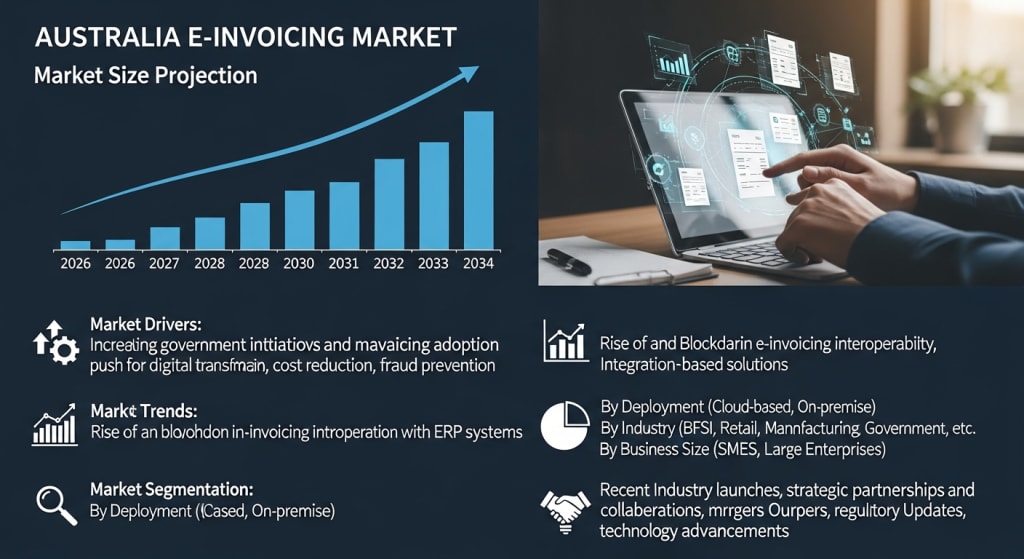
The Australia e-invoicing market is transitioning from paper-based and semi-digital billing processes to fully automated, standardized digital invoicing as businesses and government alike pursue efficiency, compliance, and enhanced cash flow management. According to IMARC Group, the market reached a value of USD 445.2 Million in 2024 and is expected to expand at a CAGR of 15.20% between 2025-2033, reaching USD 1,832.7 Million by 2033. This robust growth outlook reflects not only the broad opportunities presented by digital transformation initiatives but also active public-sector support and enterprise uptake of advanced e-invoicing solutions.
E-invoicing fundamentally involves the electronic exchange of invoice data between supplier and buyer systems in a structured machine-readable format. Unlike PDF or email invoices, e-invoices transmitted via the Peppol network are directly processed by ERP and accounting platforms, reducing manual tasks, minimizing errors, and enabling real-time reconciliation across supply chains. As Australia integrates Peppol standards into its national framework, enterprises of all sizes are reevaluating accounts payable and receivable workflows in favor of more scalable and secure digital alternatives.
The historical growth of the market has been underpinned by early adoption among federal agencies and forward-looking regulatory environments that recognize digital invoicing as a critical component of broader digital economy strategies. With the federal government mandating e-invoicing capabilities across its departments and encouraging compliance in the private sector, the stage is set for both demand-side pull and technology-led supply growth.
Why the Market Is Growing So Rapidly
A convergence of regulatory, technological, and economic drivers is fueling the rapid growth of the Australian e-invoicing market:
1. Government mandates and leadership:
The federal government has mandated that its agencies be capable of receiving e-invoices over the Peppol network, establishing a foundational user base and signaling commitment to digital transformation within the public sector. This leadership sets a precedent for broader adoption across state agencies and private enterprises.
2. Standardized interoperability via Peppol:
Australia’s adoption of the Peppol interoperability framework ensures seamless communication between disparate accounting and ERP systems. By eliminating format incompatibilities and reducing the need for manual data handling, this standardized backbone significantly lowers technical barriers and enhances trust between trading partners.
3. Efficiency gains driving business uptake:
Businesses, especially small and medium-sized enterprises (SMEs), are rapidly recognizing the operational advantages of e-invoicing. Cost savings from reduced manual processing, faster payment cycles, and improved cash flow visibility make digital invoicing an appealing alternative to legacy systems. Deloitte and SAP research suggests SMEs can save substantial operational costs through e-invoicing adoption, further incentivizing uptake.
4. Digital transformation and automation:
Artificial intelligence (AI) and robotic process automation (RPA) are increasingly integrated into e-invoicing solutions to enhance data extraction, validation, fraud detection, and workflow automation. These technologies improve accuracy and accelerate invoice processing, driving demand among sectors with high transaction volumes such as logistics, retail, and healthcare.
5. Enhanced cybersecurity considerations:
As digital transactions proliferate, so too do cybersecurity threats. Australian businesses and regulators are prioritizing robust security measures — from multi-factor authentication to encryption and blockchain-based verification — to safeguard sensitive invoice data and build confidence in digital finance systems.
What the Opportunities Are
For investors, technology providers, and policymakers eyeing the Australia e-invoicing market, several clear opportunities stand out:
1. Integration with end-to-end procurement systems:
Organizations can extend e-invoicing beyond isolated billing functions into fully automated procure-to-pay processes, driving deeper efficiencies and unlocking new value in enterprise resource planning (ERP) ecosystems.
2. SME digital inclusion:
There is significant scope to equip smaller businesses with affordable, Peppol-compliant e-invoicing solutions, enabling them to participate more effectively in larger supply chains and public tenders.
3. Cloud-based solution proliferation:
Cloud deployment models offer scalability, rapid implementation, and lower upfront costs — positioning them as the preferred choice for many firms transitioning from on-premises systems.
4. Cross-border commerce enablement:
As global trade networks harmonize around digital standards, Australian businesses positioned on Peppol platforms can more easily engage in cross-border transactions, improve settlement times, and optimize foreign receivables.
5. Sustainability value creation:
Reducing paper usage supports corporate ESG initiatives and aligns with broader environmental goals, creating a strong non-financial rationale for adoption that complements operational targets.
6. Security and compliance services:
Growth in cyber threats creates demand for advanced security solutions embedded within e-invoicing platforms, presenting opportunities for niche technology vendors and managed service providers.
7. Data analytics and cash flow intelligence:
Platforms that provide predictive cash flow insights and analytics dashboards can help CFOs and finance leaders make smarter strategic decisions, elevating e-invoicing from a transactional tool to a business intelligence asset.
May 2025: Australia’s federal digital transformation strategy released updated guidelines promoting Peppol-based e-invoicing for both public and private sectors, including a roadmap toward broader adoption incentives. The policy underscores increased funding for SME onboarding programs and enhanced support for cloud-native enterprise solutions, aiming to expand participation from smaller enterprises. — Regulatory action that strengthens market foundations and investment attractiveness.
Jul 2025: A leading Australian fintech announced the expansion of its e-invoicing and automated payment services to new industry verticals, enabling real-time invoice financing and settlement features. The company reported a year-on-year tripling of customer adoption rates and new partnerships with several national logistics and retail players, reflecting rising demand for integrated billing solutions.
Sep 2025: Industry surveys highlighted that digital invoice exchange volumes in Australia surpassed significant milestones, with more than 30% of all B2B invoices processed electronically via Peppol-enabled networks in the first nine months of the year. Firms cited measurable improvements in working capital efficiency and reduced dispute resolution times, reinforcing positive adoption trends.
Why Should You Know About the Australia E-Invoicing Market?
The Australia e-invoicing market represents a nexus of regulatory foresight, technological innovation, and business process modernization. For investors, it offers a high-growth segment powered by sustained digitization and standardized frameworks. Businesses that adopt early stand to benefit from cost savings, improved cash flow, and competitive supply chain positioning. Policymakers can leverage the momentum to enhance national productivity, strengthen compliance ecosystems, and promote inclusive participation among SMEs. As digital finance becomes a cornerstone of economic infrastructure, e-invoicing is not just a back-office solution — it’s a strategic lever for resilience and growth in the digital age.
About the Creator
Rashi Sharma
I am a market researcher.
Keep reading
More stories from Rashi Sharma and writers in Trader and other communities.
Australia Energy Storage Systems (ESS) Market: Powering the Clean Energy Transition
The Australia Energy Storage Systems (ESS) Market is experiencing one of the fastest expansions within the nation’s clean energy landscape. According to IMARC Group, the market was valued at USD 13.11 billion in 2024 and is forecast to reach USD 64.65 billion by 2033, representing a strong CAGR of 17.30% between 2025 and 2033.
By Rashi Sharma5 days ago in Trader
Novo Nordisk Stock: The Steady Climber Winning Investor Trust Worldwide
Novo nordisk stock continues to gain attention from investors who prefer calm and steady growth. In a market full of noise and fast changes, novo nordisk stock stands out for its stable path. The company behind it focuses on real health needs that do not fade with time. This article explains why novo nordisk stock keeps winning trust, what supports its growth, and how investors can view it with confidence.
By John.doe7984 days ago in Trader
Ludacris and Nelly draw backlash over bookings at MAGA-coded music festival
Ludacris and Nelly headlining a mostly right-wing event is good for them. It’s also great for the genre of hip hop. The two rap veterans have showcased their talents on other stages. Why can’t they perform for mostly MAGA folks and grab that bag?
By Skyler Saunders4 days ago in Beat




Comments
There are no comments for this story
Be the first to respond and start the conversation.