
Australia Carbon Credit Market: Emissions Reduction, Policy Support & Green Investment
How regulatory frameworks, corporate sustainability goals and global climate action are driving growth in Australia’s carbon credit ecosystem

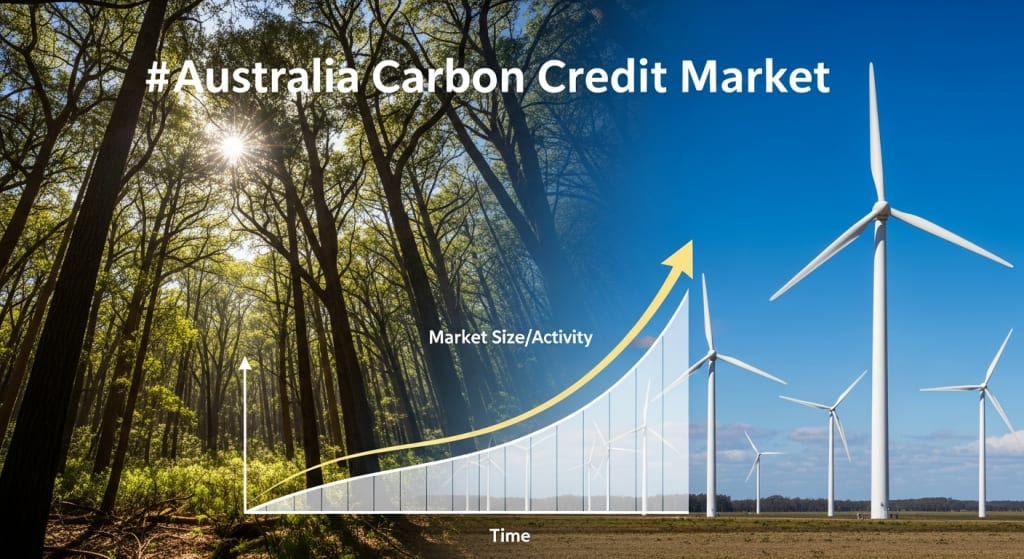
Australia Carbon Credit Market Overview
The Australia carbon credit market is gaining considerable momentum as climate policy, corporate sustainability commitments and international environmental standards converge to support the reduction of greenhouse gas (GHG) emissions. Carbon credits — tradable certificates representing the reduction or removal of one tonne of CO₂ equivalent — enable businesses, governments and individuals to meet emissions targets through verified climate action projects. The Australia carbon credit market size reached 18.35 Million ACCUs in 2024. Looking forward, the market is expected to reach 32.16 Million ACCUs by 2033, exhibiting a growth rate (CAGR) of 6.43% during 2025-2033. This surge highlights increased corporate participation, enhanced regulatory support, the rise of voluntary carbon markets and Australia’s commitment to international climate frameworks and net-zero goals.
The carbon credit ecosystem encompasses regulated compliance markets — where industries must meet mandated emissions caps — and voluntary markets — where organisations pursue emissions mitigation to demonstrate environmental stewardship. As Australian businesses align with sustainability targets, carbon credits have become financial instruments that facilitate greener operations, corporate social responsibility (CSR) reporting, and long-term environmental strategies.
What’s Driving Market Growth
National Climate Targets & Regulatory Support
Australia’s long-term commitments to reduce emissions and reach net-zero targets under global agreements such as the Paris Agreement are major drivers of carbon credit demand. Regulatory frameworks, cap-and-trade policies and national climate action plans encourage emission reductions while enabling carbon credit mechanisms that reward sustainable projects. Government oversight and policy stability provide confidence for investors and project developers participating in carbon markets.
Corporate Sustainability & Net-Zero Strategies
Businesses across key sectors — including energy, manufacturing, transport, agriculture and retail — are setting ambitious net-zero commitments and incorporating carbon credits into broader sustainability frameworks. Carbon credits allow companies to offset residual emissions while implementing internal mitigation strategies such as energy efficiency upgrades, renewable energy deployment and supply-chain optimisation. Investor and consumer expectations for transparent climate action further support participation.
Voluntary Carbon Market Adoption
The voluntary carbon market — where organisations purchase credits to demonstrate proactive climate responsibility beyond compliance obligations — is a significant growth driver. Voluntary credits support projects such as reforestation, renewable energy deployment, methane capture and soil carbon sequestration. These initiatives appeal to global brands, local enterprises and institutional investors seeking climate leadership, brand value enhancement and environmental risk management.
International Linkages & Trade Opportunities
Australia’s participation in international carbon trading mechanisms and linkages with global sustainability initiatives enhances market depth and credibility. As cross-border carbon credit exchanges mature, Australian entities benefit from broader market access, price discovery, and investment flows tied to international climate finance channels. This connectivity reinforces Australia’s role in global emission reduction efforts.
What the Opportunities Are
Green Investment & Carbon Finance Instruments
The carbon credit market opens avenues for innovative financial instruments such as carbon funds, green bonds, climate derivatives and structured carbon investment vehicles. Financial institutions that develop carbon-linked investment products can attract sustainability-oriented capital and provide diversified exposure.
Corporate Offsetting & Strategic Partnerships
Partnerships between corporations and project developers — such as renewable energy programmes, forestry initiatives and methane capture schemes — create scalable carbon credit supply while aligning companies with verified climate impact. Multi-stakeholder collaborations enhance project credibility and expand credit portfolios.
Tech-Enabled Monitoring & Verification
Advanced technologies — including blockchain, remote sensing, satellite monitoring and IoT-enabled reporting systems — enhance transparency, traceability and verification of carbon credit projects. Tech integration strengthens credibility, reduces fraud risk and fosters market trust among buyers and regulators.
Regulatory & Policy Framework Development
Continued policy refinement, clear emissions accounting standards and supportive regulatory frameworks reduce market uncertainty and attract long-term investment. Opportunities exist for policy advocacy, method development and standard setting bodies to shape efficient carbon pricing and market mechanisms.
Recent News and Developments in Australia Carbon Credit Market
Jul 2025: Australia’s federal government announced expanded guidance on voluntary carbon market standards, introducing enhanced verification protocols, transparent registries and compliance support mechanisms that strengthen market confidence and alignment with international best practices.
Sep 2025: Major corporations across mining, manufacturing and retail sectors unveiled net-zero roadmaps that include substantial voluntary carbon credit procurement, emphasizing renewable energy credits, reforestation projects and methane emission reduction partnerships as part of their sustainability commitments.
Nov 2025: Industry analysts reported that trading volumes of carbon credits increased significantly year-on-year, driven by both voluntary procurement and preparatory compliance strategies ahead of tightening emissions regulations, indicating heightened market liquidity and investor interest.
Why should You Know About Australia Carbon Credit Market?
You should know about this market because carbon credits are at the intersection of climate action, corporate responsibility and financial innovation — offering mechanisms for measurable environmental impact and strategic sustainability positioning. As the global and national focus on emissions reduction intensifies, carbon credit markets enable businesses to participate in structured climate mitigation while catalysing investment in clean technologies and ecological restoration.
For investors, the carbon credit market presents growth opportunities tied to regulatory evolution, ESG-linked investment products and expanding voluntary participation. With rising demand for meaningful climate strategies, carbon credits become tradable assets with economic, environmental and strategic value.
For corporates and project developers, understanding segmentation, project types and market dynamics aids in designing effective offset programmes, securing financing, and aligning with sustainability targets that resonate with stakeholders, customers and global frameworks. In essence, the Australia carbon credit market reflects how policy, finance and climate ambition converge — making it essential for forward-looking economic engagement, environmental leadership and long-term strategic planning.
About the Creator
Amyra Singh
Market research analyst who loves spotting patterns, digging into data, and turning insights into strategies that help brands grow and stay ahead of the curve.
Keep reading
More stories from Amyra Singh and writers in Trader and other communities.
Australia Home Appliances Market: Smart Living, Consumer Demand & Technology Innovation
Australia Home Appliances Market Overview The Australia home appliances market is experiencing steady expansion as households increasingly adopt modern, connected and energy-efficient appliances that enhance everyday convenience and quality of life. Home appliances — from refrigerators and washing machines to air conditioners, dishwashers, microwave ovens and smart kitchen devices — are essential tools that reflect evolving lifestyles, digital integration and sustainability priorities. The Australia home appliances market size reached USD 15.06 Billion in 2024. Looking forward, IMARC Group expects the market to reach USD 21.99 Billion by 2033, exhibiting a growth rate (CAGR) of 4.28% during 2025-2033. This growth stems from rising disposable incomes, increasing urbanisation, rapid digital adoption and demand for products that offer comfort, performance and energy savings.
By Amyra Singh5 days ago in Trader
Bitcoin Tests a Critical Zone as the Fed Signals a Pause
As of January 19, 2026, Bitcoin is once again approaching a psychologically significant price level. After climbing to approximately 97,000 dollars, Bitcoin has reached its highest level in nearly two months. This recovery has reignited market discussion around whether Bitcoin can attempt another move toward the 100,000 dollar mark before February. However, expectations that the Federal Reserve will maintain its current interest rate policy remain a critical variable shaping investor sentiment.
By crypto geniea day ago in Trader



Comments
There are no comments for this story
Be the first to respond and start the conversation.