
Australia Biochar Market Accelerates on Sustainable Agriculture, Carbon Sequestration and Circular Economy Commitments
With strong demand across farming, soil health and environmental applications, Australia’s biochar market is projected to more than double by 2034 on the back of regenerative agriculture and climate mitigation strategies.

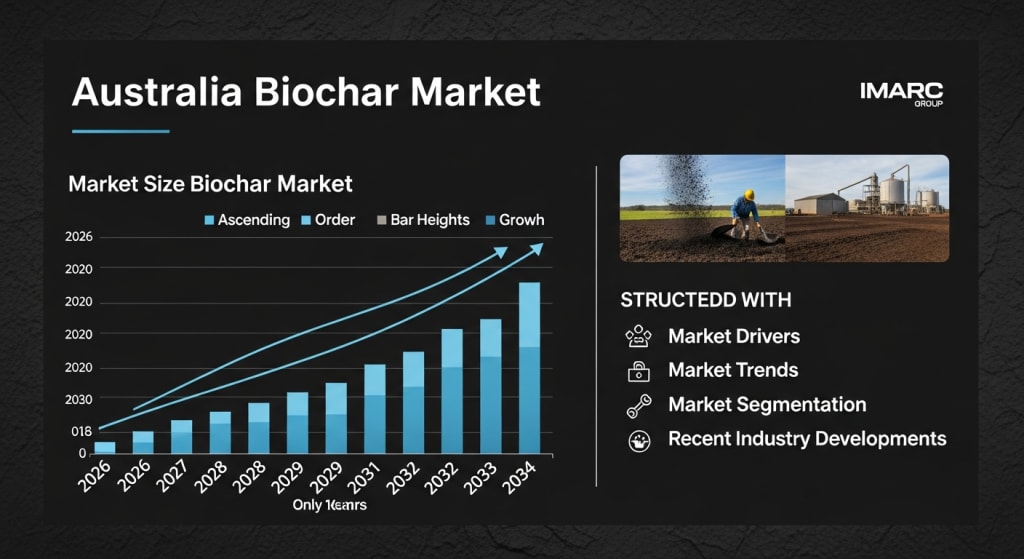
The Australia Biochar Market is expanding rapidly as sustainable farming practices, climate action goals, and innovative waste conversion projects gain traction across the country. According to the latest IMARC Group research, the market reached USD 68.1 million in 2025 and is expected to grow to USD 169.3 million by 2034, registering a compound annual growth rate (CAGR) of 10.64% between 2026 and 2034.
Biochar — a highly porous charcoal-like substance produced from organic biomass through processes such as pyrolysis, gasification and hydrothermal carbonization — is increasingly recognised for its ability to improve soil health, enhance water retention, sequester carbon, and support broader environmental management goals. In Australia, where agriculture contributes significantly to the economy and climate resilience strategies are front and centre, biochar adoption is being driven by both traditional farming needs and emerging ecological imperatives.
The biochar market’s growth reflects a convergence of ecological awareness, evolving agricultural practices, and public policy support that together are reshaping how biomass residues and organic wastes are valued. Its application spans from farming and gardening to soil, water and air treatment, underscoring biochar’s versatility and strategic importance in national sustainability agendas.
Why the Market Is Growing So Rapidly
1. Rising Demand for Sustainable Agricultural Solutions
Biochar’s role as a soil amendment that enhances nutrient retention, improves water holding capacity, and promotes microbial activity is a core growth driver in Australia’s agricultural sector. Farms across the country — particularly in dry, nutrient-depleted regions — are increasingly adopting biochar to boost crop yields and reduce dependency on chemical fertilisers. This trend resonates with broader moves toward regenerative agriculture and sustainable land management, which have become priorities for farmers and agribusinesses alike.
2. Climate Change Mitigation and Carbon Sequestration Initiatives
As part of Australia’s efforts to reduce greenhouse gas emissions and meet international climate commitments, biochar has gained recognition for its ability to sequester carbon in soils for extended periods. This potential aligns with carbon farming initiatives and government carbon credit schemes, which incentivise practices that lock carbon into the ground and help mitigate the effects of climate change. Such policy support is helping drive adoption across agriculture and environmental sectors.
3. Waste-to-Energy and Circular Economy Drivers
Biochar production processes enable the conversion of agricultural waste, forestry residues and other organic biomass into a value-added product while reducing waste streams. This circular economy approach not only mitigates landfill pressure but also provides an opportunity for waste management and renewable energy integration. Projects that turn feedstock — such as sugarcane residues — into biochar and low-carbon fuels illustrate the market’s dual environmental and economic benefits.
4. Technological Advancements in Production Methods
Innovations in pyrolysis, gasification and other biochar production technologies are enhancing the efficiency, scalability and quality of biochar products. These advancements improve control over key properties such as porosity and nutrient profile, making biochar increasingly suitable for tailored agricultural and environmental applications. As production becomes more cost-effective and scalable, adoption is expanding beyond early adopters into mainstream agricultural and industrial circles.
5. Ecosystem Services and Environmental Applications
Beyond agriculture, biochar is used in broader environmental applications — including water filtration, soil and air contamination remediation and livestock feed enhancements — increasing its market reach. Its high adsorption capacity makes it valuable in removing pollutants and supporting sustainable ecosystem services. Such multifunctional applications are contributing to rising demand and wider market recognition.
What the Opportunities Are
1. Scaling Biochar Adoption in Regenerative Farming
Farmers and agribusinesses can benefit from integrating biochar into regenerative agricultural practices, improving soil fertility, boosting drought tolerance and reducing chemical fertiliser dependence.
2. Carbon Credit Monetisation
With carbon farming initiatives and emerging carbon credit markets, producers can generate additional revenue streams by applying biochar as a carbon sequestration tool, aligning business models with climate policy incentives.
3. Waste Conversion and Circular Bioeconomy Models
Opportunities abound in converting biomass waste into biochar products, reducing waste disposal challenges and creating value through high-quality soil amendments and environmental treatment agents.
4. Premium and Specialty Biochar Products
Developing high-performance and tailored biochar formulations for specific crops or soil types can unlock premium pricing and specialised market segments, particularly in horticulture and viticulture.
5. Integration with Water and Air Treatment Systems
Biochar’s adsorption properties make it suitable for addressing water contaminants and air pollutants, offering pathways into municipal and industrial environmental services markets.
6. Collaboration with Research Institutions
Partnerships between producers, agricultural research bodies and universities can accelerate innovation, improve product performance and build broader acceptance among growers and environmental practitioners.
7. Policy-Driven Expansion and Incentive Programmes
Government grants, subsidies and supportive regulatory frameworks aimed at sustainable land management and climate mitigation can further spur biochar production and adoption across Australia.
• March 2025: March 2025: The Australian government announced expanded funding initiatives to accelerate sustainable agriculture and waste conversion projects, with a specific focus on technologies like biochar production that support carbon sequestration and soil health improvement. This includes grants targeting regenerative farming systems and rotational crop management programs across rural regions.
• June 2025: June 2025: A coalition of agritech firms partnered with regional grower associations to launch a pilot programme deploying advanced pyrolysis units on farms in Queensland and New South Wales. Early data from the initiative showed improved soil moisture retention and crop performance, highlighting biochar’s practical benefits and encouraging broader agricultural uptake.
• October 2025: October 2025: Environmental policymakers announced new enhancements to carbon credit frameworks for Australian farmers that recognise biochar application as an approved carbon sequestration method. The updated policy is expected to increase participation in carbon farming programs and expand market incentives for biochar producers and users.
Why Should You Know About the Australia Biochar Market?
For investors, the Australia biochar market presents a compelling growth story, with a projected CAGR of over 10% through 2034 and rising integration into sustainable agriculture and environmental applications. Its expansion reflects a broader structural shift toward climate-aligned agribusiness and circular economy models.
For farmers and agribusiness leaders, biochar offers a tangible tool for enhancing soil productivity, increasing resilience to climate variability and capturing additional value through environmental service markets such as carbon credits.
For policy makers and environmental planners, understanding biochar’s role in soil health, carbon sequestration and waste management is essential for shaping effective sustainability initiatives that support national emission targets and regenerative land practices.
In an era where agriculture and environmental stewardship converge, biochar stands out as a versatile, eco-friendly solution with multi-sector impact — and Australia’s market evolution underscores its potential to contribute meaningfully to both economic and ecological resilience.
About the Creator
Rashi Sharma
I am a market researcher.
Keep reading
More stories from Rashi Sharma and writers in Trader and other communities.
Australia Skin Treatment Market Set for Steady Growth as Clinical and Aesthetic Care Converge
The Australia Skin Treatment Market is witnessing sustained expansion as dermatological care and aesthetic services increasingly intersect with preventive and corrective health practices. According to IMARC Group’s latest research, the market was valued at USD 376.84 million in 2025 and is expected to reach USD 498.25 million by 2034, growing at a compound annual growth rate (CAGR) of 3.02% during 2026–2034.
By Rashi Sharmaabout 9 hours ago in Trader
Aluminium Powder Market: Trends, Growth, and Industry Outlook
Overview – Aluminium Powder Market The aluminium powder market is a specialized segment of the broader metal powders industry, driven by demand for lightweight, high-performance materials across sectors such as automotive, aerospace, construction, coatings, additive manufacturing, and electronics. Aluminium powder is widely used for its strength-to-weight ratio, thermal conductivity, and corrosion resistance, making it essential in applications ranging from paints and coatings to 3D printing feedstock and pyrotechnics. Growth is underpinned by industrial modernization, sustainability initiatives, and expanding use in advanced manufacturing processes.
By James Smitha day ago in Trader
l&t finance share price prediction 2026: What investors need to know
l&t finance share price prediction 2026 is on the minds of many investors who want to plan for the future. Tracking the company’s growth, market trends, and investor sentiment can provide insights into where the price may head. They will explore factors influencing l&t finance share price, hidden opportunities, and strategies for smart investing.
By John.doe7986 days ago in Trader




Comments
There are no comments for this story
Be the first to respond and start the conversation.