
Australia B2B Payments Market 2026: Poised for Nearly USD 47 Billion by 2034 as Digital Transformation Accelerates
Real time payments, SME cash flow innovation and cloud based platforms drive sustained growth at 6.73 % CAGR.

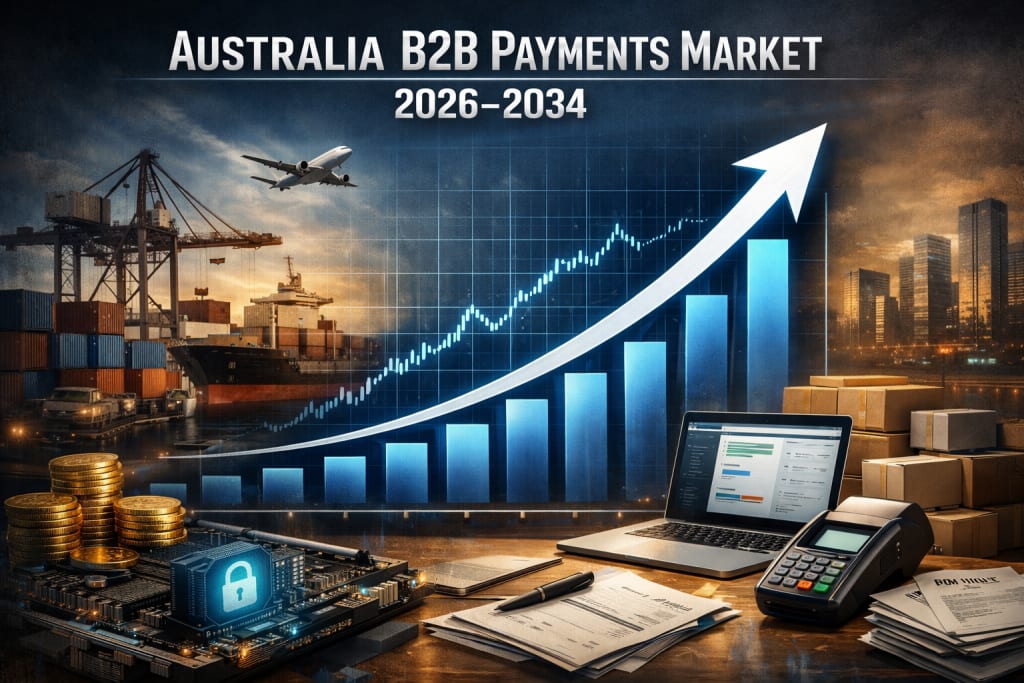
Australia B2B Payments Market Overview
The Australia B2B payments market growth is emerging as a cornerstone of enterprise finance modernization amid a sweeping shift toward digital payments and real time transaction capabilities. According to IMARC Group data, the market value is estimated at USD 25.5 billion in 2025, with projections to reach USD 46.7 billion by 2034, representing a compound annual growth rate (CAGR) of 6.73 % during 2026–2034. This substantial expansion reflects rising demand for efficiency, automation, and secure digital transactions across Australian businesses of all sizes.
Business to business (B2B) payments encompass the systems and technologies that enable companies to pay suppliers, vendors, partners, and service providers. Historically dominated by checks, bank transfers, and manual reconciliation, the landscape is rapidly evolving thanks to modern payment rails, cloud based platforms, integrated accounting solutions, and regulatory support encouraging digital innovation. For investors, operators, and policy makers, this market’s growth signals strong opportunities in fintech, payments infrastructure, and corporate financial tools.
Why the Market Is Growing So Rapidly
One of the central forces driving growth is digital transformation across enterprises. Australian businesses are increasingly embracing cloud based payment solutions that integrate seamlessly with accounting software, ERP systems, and procurement workflows. This integration reduces manual processing, accelerates reconciliation, and improves transparency — key value propositions for firms pursuing operational efficiency.
Closely tied to this shift is the expanding use of real time payment infrastructure, particularly through Australia’s New Payments Platform (NPP). NPP enables instant settlement of funds 24/7, streamlining working capital management and reducing the payment cycle between trading partners. Real time capability enhances supplier relationships, offers improved cash flow visibility, and reduces costs associated with delayed banking processes.
Another significant driver is SME cash flow needs. Small and medium enterprises — which constitute a substantial portion of the Australian economy — often operate under working capital constraints. Flexible B2B payment solutions, including invoice financing, early payment options, and Buy Now, Pay Later (BNPL) models tailored for businesses, provide SMEs with improved liquidity and more predictable cash cycles.
Cybersecurity and fraud prevention also play a role in shaping demand. As digital transactions proliferate, businesses seek payment platforms with robust security features — such as AI driven fraud detection and advanced encryption — to protect sensitive financial data and build trust with trading partners.
Finally, cross border trade growth underpins global B2B payments expansion. Australian companies engaged in international commerce — particularly in mining, agriculture, and services — require efficient cross border payment solutions. Providers that offer competitive FX rates, faster settlement times, and compliance support stand to benefit from increased demand tied to export and import activities.
What the Opportunities Are
1. Cloud First Payment Platforms
Platforms that deliver scalable, API driven B2B payment solutions can capture share as companies replace legacy systems with modern, integrated financial workflows.
2. Real Time Settlement Services
Solutions leveraging NPP and real time rails allow for instantaneous B2B settlements, enhancing working capital management and supplier relations.
3. SME Focused Payment Products
Tools such as BNPL, invoice financing, and flexible terms designed for SMEs address critical liquidity needs and expand service adoption across a broad business base.
4. Cross Border Payment Innovation
Services optimized for international transactions — including blockchain and digital FX tools — cater to export oriented suppliers and global supply chains.
5. AI Enhanced Security & Analytics
Integrating machine learning for fraud detection, predictive analytics, and cash flow forecasting provides premium capabilities that support risk management and operational insight.
6. Vertical Specific Payment Solutions
Custom payment workflows for manufacturing, healthcare, logistics, and other sectors drive deeper enterprise integration and command higher value service offerings.
7. Partnership Ecosystems
Collaborations between fintechs, banks, and accounting software vendors create seamless payment environments that drive customer retention and new adoption.
Recent News & Developments
• March 2025: Visa Unveils Australia B2B Integrated Payments: Visa launched its B2B Integrated Payments (VBIP) program in partnership with major banks ANZ, NAB, HSBC, and Westpac. This platform enables automated supplier payments — even to companies that traditionally don’t accept card payments — via the SAP Business Technology Platform. The launch marks a significant step in digitizing B2B payment workflows and enhancing working capital automation for Australian firms.
• May 2025: Fintech Bank Collaboration Expands Invoice Payments: A leading Australian accounting and business management software provider partnered with global fintech networks to embed payments functionality directly within invoicing workflows. The integration allows businesses to accept a wider array of payment methods — including card, wallet, and instant NPP transfers — significantly reducing days sales outstanding (DSO) and improving cash flow.
• October 2025: SME B2B Payment Adoption Climbs: Industry surveys reported that more than 60 % of Australian SMEs have adopted at least one digital B2B payment solution by late 2025, up sharply from 2023 rates. Adoption is strongest among wholesale, retail, and services sectors, driven by the need for faster settlements and reduced administrative costs — a clear sign of shifting preferences away from traditional payment modes.
Why Should You Know About the Australia B2B Payments Market?
For investors, the Australia B2B payments market offers a compelling growth narrative backed by digital transformation, regulatory support, and evolving enterprise needs. A near doubling of market size to USD 46.7 billion by 2034 reflects not just volume growth but fundamental shifts in how businesses transact — making it fertile ground for strategic investment in payment technologies and infrastructure.
For business leaders, modern B2B payment systems are not merely efficiency tools; they are strategic enablers of cash flow optimization, risk mitigation, and supplier relationship management. Embracing real time and integrated payment solutions can dramatically reduce cycle times and cost overheads.
For policy makers, supporting a robust payments ecosystem — through infrastructure like NPP, open banking frameworks, and cybersecurity standards — enhances national economic resilience and competitiveness. As Australian businesses expand domestically and internationally, a modern payments backbone becomes essential to trade fluidity and economic agility.
About the Creator
Amyra Singh
Market research analyst who loves spotting patterns, digging into data, and turning insights into strategies that help brands grow and stay ahead of the curve.
Keep reading
More stories from Amyra Singh and writers in Trader and other communities.
Australia Soda Ash Market 2026: Forecast to Reach USD 650.5 Million by 2034 on Industrial & Construction Demand
Australia Soda Ash Market Overview The Australia soda ash market is set for steady expansion over the next decade, underpinned by strong demand from industrial sectors such as glass manufacturing, soaps and detergents, chemicals, metallurgy, and water treatment. According to IMARC Group, the market was valued at USD 433.66 million in 2025 and is projected to reach USD 650.48 million by 2034, growing at a compound annual growth rate (CAGR) of 4.61 % from 2026 to 2034.
By Amyra Singh4 days ago in Trader
GCC Dark Chocolate Market Size and Forecast 2025–2033
Introduction The Gulf Cooperation Council (GCC) region is witnessing a notable shift in consumer preferences, with health awareness, premium indulgence, and lifestyle-driven consumption reshaping the food and beverage landscape. One of the clearest beneficiaries of this shift is dark chocolate—a product once seen as a niche indulgence but now increasingly positioned as a healthier, more sophisticated alternative to traditional confectionery.
By shibansh kumarabout an hour ago in Trader
Octopus Market Set to Soar to USD 10.0 Billion by 2033 | CAGR 1.71%
Overview of the Octopus Market The octopus market forms an important segment of the global seafood industry, encompassing harvesting, processing, distribution, and retail sale of fresh, frozen, canned, and processed octopus products. Octopus is widely consumed across Mediterranean and Asian cuisines and is valued for its high nutritional content, including iron, vitamin B12, and selenium. Increasing consumer interest in healthy seafood alternatives and exotic culinary experiences has broadened demand globally.
By James Smitha day ago in Trader
The Salt in her Voice
The myth says mermaids sing to lure sailors to their death. But why? The ocean is huge. Only 5 percent has been discovered by man. Why would a creature of the sea with that much space to roam ever care about the fate of men on ships? The answer, as it turns out, is not a simple one at all. The truth about the myth is older than the tides. Long ago before the first ship ever cut across the surface, the sea made a pact with the sky. The sky would take the souls of the drowned. Anyone who died in storms or any quiet accidents of the deep would have their soul lifted upward to the Heavens while the bodies would remain below, feeding the oceans endless hunger. The greedy sea however wanted more souls than the sky would claim. So it created mermaids. It gave them beautiful voices woven from currents and moonlight. It commanded them to sing. "Bring forth the ones who float where they should sink." it instructed them. So they did. They never killed out of malice but out of obligation. They sung to summon, not to seduce. A mermaid's voice could loosen the tether between the body and soul, making any man step willingly into the water. The sea would take the body and the sky would take the soul. Balance maintained.
By Sara Wilson3 days ago in Fiction




Comments
There are no comments for this story
Be the first to respond and start the conversation.