
United States Lobster Market Size and Forecast 2025–2033
Premium Seafood Demand, Export Growth, and Sustainability Trends Reshape America’s Lobster Industry

United States Lobster Market Overview
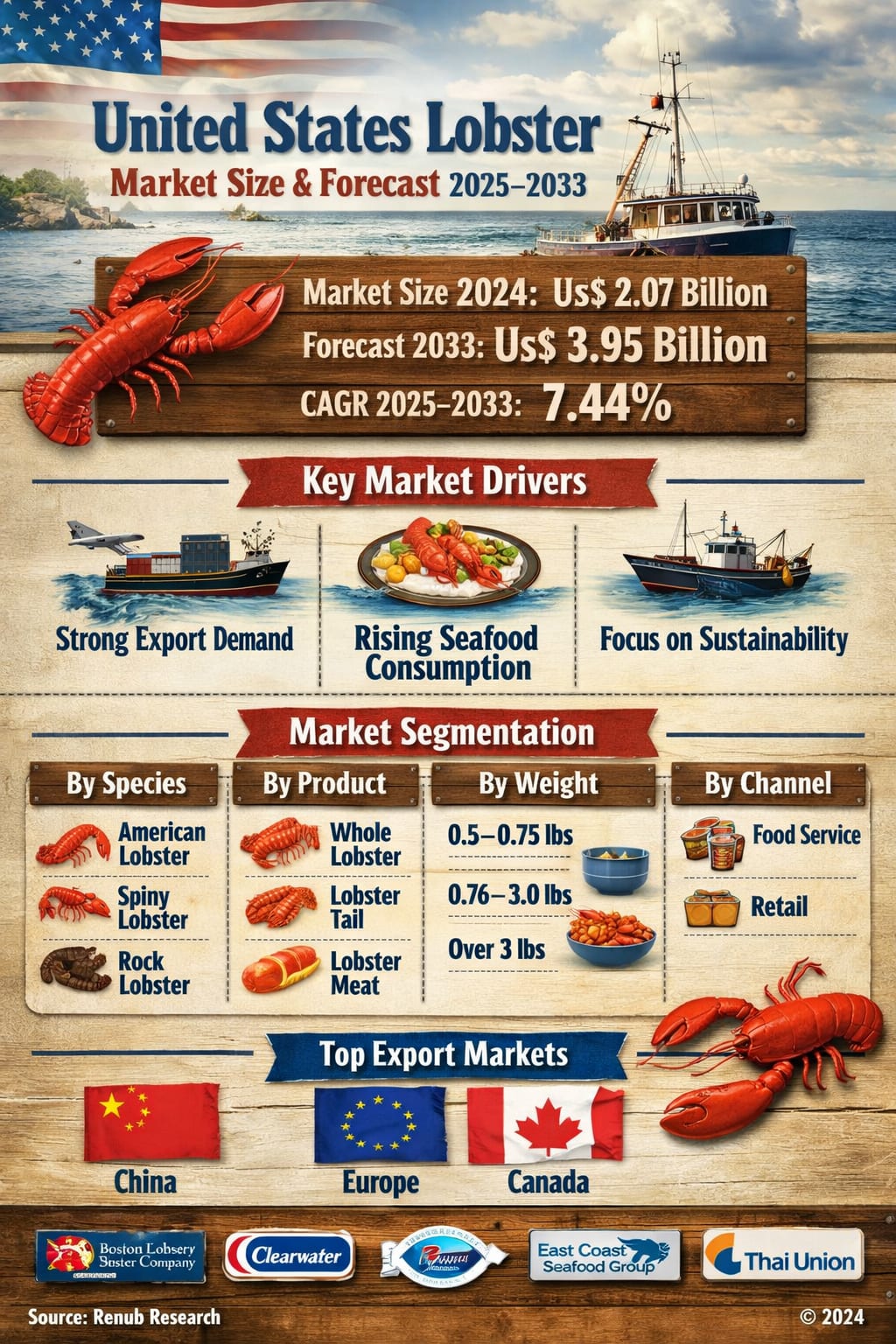
The United States lobster market is entering a dynamic phase of growth, driven by rising consumer demand for premium seafood, expanding export opportunities, and continuous improvements in cold-chain logistics and processing technologies. According to Renub Research, the United States Lobster Market is expected to reach US$ 3.95 billion by 2033, growing from US$ 2.07 billion in 2024, at a robust CAGR of 7.44% from 2025 to 2033. This growth reflects not only changing dietary preferences but also the increasing role of lobster as a symbol of premium, high-quality protein in both domestic and international markets.
Traditionally associated with fine dining and special occasions, lobster has steadily moved into mainstream consumption through retail, online platforms, and value-added product formats such as tails, frozen meat, and ready-to-cook portions. Rising disposable incomes, a growing preference for high-protein diets, and stronger interest in sustainably sourced seafood are reinforcing demand across the United States.
Macroeconomic trends also support this expansion. In December 2024, personal income in the U.S. rose by $92.0 billion (0.4%), while disposable personal income increased by $79.7 billion (0.4%), according to data from the Bureau of Economic Analysis (BEA). Personal consumption expenditures climbed by $133.6 billion (0.7%), indicating resilient consumer spending. With a personal saving rate of 3.8% and total personal savings at $843.2 billion, U.S. consumers continue to allocate more spending toward premium food experiences, including high-end seafood such as lobster.
The foodservice sector remains a major pillar of the market, with restaurants, seafood chains, and hospitality venues featuring lobster-based dishes as premium menu offerings. At the same time, retail and e-commerce channels are rapidly expanding access to fresh, frozen, and processed lobster products. Sustainability certifications, traceability initiatives, and responsible fishing practices are further strengthening consumer trust and brand value across the industry.
Technological progress in processing, storage, and transportation has significantly improved product quality and shelf life, allowing U.S. lobster to reach distant markets while maintaining freshness. In parallel, the market is witnessing a shift toward value-added products, including lobster tails, meat, and ready-to-cook offerings, which are better suited to modern lifestyles and home consumption trends.
Export Demand Remains a Powerful Growth Engine
One of the most important growth drivers for the U.S. lobster market is strong export demand, particularly from China, Europe, and Canada. As global consumers increasingly seek premium seafood, U.S. lobster continues to benefit from its reputation for quality, safety, and sustainability.
China’s expanding middle class and its rising appetite for high-end seafood have made it one of the most critical overseas markets for U.S. lobster. According to the Food and Agriculture Organization, U.S. live lobster shipments to China increased 69% in volume and 55% in value, reaching 830 tons valued at USD 16.25 million in Q2 2023 compared to the previous year. This surge highlights how sensitive the market is to demand rebounds and changing trade conditions.
Europe also represents a growing opportunity, particularly in premium dining establishments and upscale retail chains that emphasize high-quality, sustainably sourced seafood. While imports can fluctuate due to economic conditions and pricing pressures, long-term demand for premium lobster remains strong across key European markets.
Canada continues to be both a competitor and a critical trading partner for the United States in the lobster sector. Cross-border trade plays a vital role in balancing supply, processing, and distribution. Trade agreements and tariff adjustments remain crucial factors influencing export competitiveness and long-term market stability.
Despite occasional uncertainties related to trade policies, overseas demand remains a cornerstone of growth for the U.S. lobster industry. The combination of strong branding, reliable supply chains, and increasing global seafood consumption positions U.S. lobster favorably in international markets over the forecast period.
Rising Demand for Premium and Sustainable Seafood
Consumer preferences in the United States are clearly shifting toward premium, responsibly sourced seafood, and lobster stands at the center of this trend. More diners and home consumers are willing to pay a premium for products that offer both superior taste and strong sustainability credentials.
Restaurants, specialty retailers, and online platforms are increasingly highlighting sustainability certifications and traceability programs to appeal to environmentally conscious buyers. Low-impact fishing methods, regulated trap designs, and responsible harvesting practices are now key selling points rather than optional extras.
A notable example of how brands are responding to changing consumer expectations is Red Lobster’s menu refresh in November 2024, which introduced seven new dishes and brought back popular favorites like hush puppies. The revamped menu, while streamlined, continues to focus on enhancing the overall seafood dining experience and keeping lobster at the heart of premium offerings.
This trend is not limited to restaurants. Retailers and e-commerce platforms are also expanding their range of premium lobster products, including chilled, frozen, and ready-to-cook formats. For many consumers, lobster is no longer reserved only for special occasions—it is increasingly becoming part of at-home gourmet experiences.
The willingness of consumers to pay more for high-quality, ethically sourced seafood is strengthening margins across the value chain and encouraging further investment in sustainable practices, branding, and product innovation.
The E-Commerce and Direct-to-Consumer Revolution
E-commerce and direct-to-consumer (D2C) sales channels are reshaping how lobster reaches end customers in the United States. According to the U.S. Census Bureau, retail e-commerce sales reached $300.1 billion in Q3 2024, marking a 7.4% year-over-year increase and accounting for 16.2% of total retail sales for the quarter. This rapid digital shift is having a profound impact on the seafood sector, including lobster.
Online seafood platforms now allow consumers to purchase fresh, frozen, or value-added lobster products directly from producers and distributors, bypassing traditional retail intermediaries. This not only improves price transparency but also expands product choice and enhances convenience.
Advanced packaging technologies and cold-chain logistics ensure that lobster can be shipped quickly and safely, preserving quality and freshness even for long-distance deliveries. As more consumers seek restaurant-quality seafood experiences at home, the demand for premium lobster through digital channels continues to rise.
Personalized buying experiences, subscription seafood boxes, and direct communication with producers are further strengthening the appeal of D2C models. Over the forecast period, e-commerce is expected to play an increasingly central role in market expansion, particularly for value-added and premium lobster products.
Industry Developments and Strategic Expansion
Strategic investments and acquisitions are also shaping the competitive landscape of the U.S. lobster market. In March 2024, Phillips Foods, a major seafood supplier in the United States, announced the acquisition of two processing facilities in Canada located on Prince Edward Island and Nova Scotia. This move aims to strengthen the company’s lobster and snow crab operations and expand its processing capabilities.
At Seafood Expo North America, Phillips Foods also introduced new chilled pasteurized lobster meat products and a frozen crab toast appetizer, reflecting the broader industry trend toward value-added and convenience-focused seafood offerings. Such developments highlight how companies are investing in processing, product innovation, and supply chain integration to capture more value and meet evolving consumer preferences.
These strategic moves not only enhance production efficiency but also improve market reach, particularly in high-growth segments such as retail, foodservice, and online sales channels.
Challenges Facing the United States Lobster Market
Regulatory and Sustainability Pressures
While sustainability is a major growth driver, it also presents significant challenges. Stricter regulations—including fishing quotas, size limits, and seasonal restrictions—are essential for protecting lobster populations and marine ecosystems, but they can also constrain supply.
Compliance with these rules often requires substantial investment in monitoring systems, gear modifications, and operational adjustments. For smaller fishing operations, these costs can be particularly burdensome, putting pressure on profitability and long-term viability. Balancing environmental responsibility with economic sustainability remains one of the industry’s most complex challenges.
Trade Barriers and Tariffs
Despite strong global demand, trade barriers and tariffs continue to create uncertainty for U.S. lobster exporters. The impact of tariffs during the U.S.-China trade tensions, for example, demonstrated how quickly export volumes can decline when market access becomes restricted.
Although some regions have seen improvements through negotiations and revised trade agreements, the global trade environment remains unpredictable. Sudden policy changes, new tariffs, or export restrictions can disrupt long-term planning, affect pricing, and limit growth opportunities in key international markets.
Market Segmentation Overview
By Species
American Lobster
European Lobster
Spiny Lobster
Rock Lobster
By Weight
0.5 – 0.75 lbs
0.76 – 3.0 lbs
Over 3 lbs
By Product Type
Whole Lobster
Lobster Tail
Lobster Meat
By Distribution Channel
Food Service
Retail
The foodservice segment continues to account for a significant share of demand due to strong restaurant and hospitality consumption. However, the retail segment—especially through online channels—is growing rapidly, supported by changing consumer habits and the expansion of value-added product offerings.
Competitive Landscape and Company Analysis
The U.S. lobster market features a mix of established seafood processors, international suppliers, and regional specialists. Key players covered in the market include:
Boston Lobster
Clearwater Seafoods
High Liner Foods Incorporated
Thai Union Manufacturing Company Ltd
East Coast Seafood Group
Geraldton Fishermen’s Co-operative
PESCANOVA ESPAÑA SL
Supreme Lobster
Tangier Lobster
These companies compete on factors such as product quality, supply chain efficiency, sustainability practices, processing capabilities, and brand strength. Strategic partnerships, acquisitions, and product innovations are increasingly being used to strengthen market positions and expand global reach.
Outlook: What Lies Ahead for the U.S. Lobster Market?
Looking ahead to 2033, the United States lobster market is well-positioned for sustained growth. Rising global demand for premium seafood, continued expansion of e-commerce and D2C channels, and increasing consumer focus on sustainability will remain key growth pillars.
At the same time, the industry must navigate regulatory pressures, environmental concerns, and trade uncertainties. Companies that invest in sustainable practices, supply chain resilience, and product innovation are likely to be best placed to capitalize on long-term opportunities.
With the market projected to nearly double in value from 2024 to 2033, lobster will continue to strengthen its position not only as a luxury delicacy but also as a mainstream premium protein choice for consumers in the United States and around the world.
Final Thoughts
The United States lobster market is undergoing a meaningful transformation—one driven by premiumization, sustainability, digitalization, and global demand. According to Renub Research, the market’s growth from US$ 2.07 billion in 2024 to US$ 3.95 billion by 2033 underscores the strong fundamentals supporting this industry.
While challenges remain in the form of regulatory pressures and trade uncertainties, the long-term outlook is clearly positive. As consumer preferences evolve and supply chains become more sophisticated, lobster is set to remain one of the most valuable and dynamic segments within the U.S. seafood industry over the coming decade.
About the Creator
US Job Report Shows Surprising Shifts That Could Affect Your Paycheck
The US Job Report is a monthly snapshot of the labor market. The latest US Job Report reveals changes that could affect workers across the country. While many focus on the headline numbers, the full US Job Report tells a deeper story about hiring, wages, and job stability. Understanding the US Job Report helps you see trends that impact your income, career plans, and financial security. This article breaks down the key findings in simple terms and explains what they mean for you.
By hamza mirza8 days ago in Trader
Mexico Cybersecurity Solutions Market Size Growth, Trends & Outlook 2033
Mexico Cybersecurity Solutions Market Overview The Mexico Cybersecurity Solutions Market is witnessing sustained expansion as businesses and government entities strengthen digital infrastructure against evolving cyber threats. With rapid digital transformation across industries, organizations are increasingly investing in advanced security solutions to safeguard data, networks, and cloud environments.
By Kim Soo hyun4 days ago in Trader
I Don't Need My Phone... Wait, Is That Actually True?
My parents gave me my first cell phone when I was twelve years old. It wasn't a fancy iPhone or anything, not even close. Just a simple black flip phone for when I needed to call or text them after school.
By Madison "Maddy" Newton7 days ago in Humans




Comments
There are no comments for this story
Be the first to respond and start the conversation.