
Australia Agritech Market 2026: Accelerates as Tech Innovation Boosts Productivity and Sustainability
With rapid adoption of precision farming, AI, robotics, and data analytics, the Australia agritech market is projected to grow from USD 774 million in 2025 to USD 2.38 billion by 2034.

Australia Agritech Market Overview
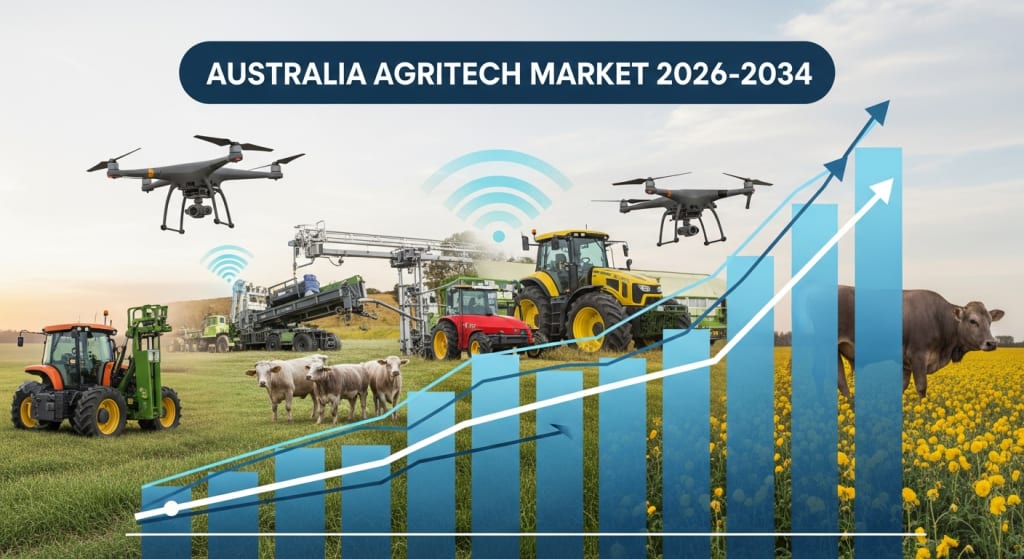
The Australia agritech market growth is experiencing strong momentum, driven by the imperative to improve agricultural productivity, address climate volatility, and meet growing food demand through technological innovation. According to IMARC Group, the market reached USD 774.0 million in 2025 and is expected to expand to USD 2,381.3 million by 2034, reflecting a robust compound annual growth rate (CAGR) of 13.30% during 2026–2034.
This growth signals a transformation in how farming and agribusiness operate — moving from traditional methods toward data-driven, automated, and highly efficient systems. Technologies such as precision agriculture, robotics, artificial intelligence (AI), and blockchain are helping farmers optimize inputs, reduce waste, and increase yields. Below, we explore the market’s growth drivers, major opportunities, and key developments that shaped the sector in 2025.
Why the Market Is Growing So Rapidly
1. Precision Agriculture Enhancing Efficiency
Precision agriculture technologies — including satellite imaging, soil moisture sensors, and data analytics platforms — are central to boosting farm productivity. These tools enable real-time monitoring of soil health, crop conditions, and environmental factors, allowing farmers to make evidence-based decisions with high precision. This results in higher yields, better resource utilization, and reduced environmental impact, all of which contribute to faster agritech adoption in Australia.
2. Addressing Labor Shortages Through Automation and Robotics
Labor shortages in rural regions are a significant challenge for the agricultural sector. Agritech solutions such as robotics and automated machinery help fill these gaps, perform repetitive tasks, and improve operational efficiency. Automation not only reduces dependency on manual labor but also accelerates adoption of advanced farming practices among producers of all scales.
3. Digital Transformation and Data Analytics Uptake
The integration of big data analytics, AI, and connected devices into farm management enhances predictive insights and operational control. By analyzing large datasets on weather, soil conditions, and crop cycles, farmers can plan interventions more effectively, improving yields and reducing risks. This digital transformation is a core driver of agritech demand.
4. Government Support and Policy Initiatives
Government funding and policies that promote research collaborations, startup growth, and technology adoption have also played a significant role. Public programs aimed at enhancing the competitiveness of the agricultural sector help lower barriers for agritech innovations and encourage partnerships between private and public research institutions.
5. Sustainability and Environmental Pressures
Sustainability imperatives — including water conservation, soil health, and climate resilience — are pushing Australian farms to adopt technologies that improve resource efficiency and reduce environmental degradation. Agritech solutions that support sustainable farming practices are increasingly valued as global consumers demand traceable and environmentally responsible produce.
Request a Sample Report with the Latest 2026 Data & Forecasts
What the Opportunities Are
1. Expansion of Precision Farming Platforms
Providers of precision agriculture solutions — such as IoT sensors, crop monitoring systems, and machine learning tools — have the opportunity to scale rapidly as farmers seek data-driven insights to optimize productivity and reduce input costs.
2. Robotics and Automation Innovation
Automation solutions designed to address labor shortages and perform complex agricultural tasks, such as autonomous weeding or harvesting, present major growth potential. Robotics developers can capture significant market share by offering scalable and affordable solutions.
3. AI-Driven Advisory Services
Artificial intelligence platforms that provide tailored crop and livestock management advice can deliver better farm outcomes. These tools can help producers anticipate issues, enhance decision-making, and boost profitability.
4. Blockchain for Supply Chain Traceability
Blockchain technologies that provide transparent and secure tracking of food products from farm to fork can enhance consumer trust and open premium markets for high-value Australian exports. These systems also support rapid recall and quality verification when necessary.
5. Digitally Enabled Financial Services for Farmers
Fintech solutions tailored for agricultural financing — such as credit scoring based on farm productivity data — can increase access to capital for technology adoption, particularly among small and mid-sized farms.
6. Climate-Smart Agritech Solutions
As climate change impacts become more pronounced, technologies that support water-efficient irrigation, drought-resistant crops, and carbon-sequestering practices will be in high demand.
7. Export-Oriented Technology Services
There is scope for agritech firms to expand beyond domestic markets by delivering services and platforms to other Asia-Pacific countries facing similar agricultural challenges and technological needs.
Recent News & Developments
• March 2025: Government-Industry Collaboration: Australian agritech startups partnered with leading universities and government research bodies to pilot advanced soil sensor networks across key grain-producing regions. These trials aim to provide granular data on soil health and moisture levels, helping farmers optimize irrigation and fertilization inputs.
• May 2025: Precision Agriculture Funding Boost: A national program allocated additional funding to support precision agriculture adoption among small and medium-scale farms, including subsidies for IoT sensors and data analytics tools, aimed at improving yield forecasting and resource efficiency.
• August 2025: Agritech Investment Milestone: Key agritech firm AgriWebb secured USD 10 million in a Series B funding round led by institutional and strategic investors. The capital is earmarked for expanding its digital livestock management platform and accelerating market reach across Australia and into Southeast Asian agriculture sectors.
Why Should You Know About Australia Agritech Market?
The Australia agritech market is emblematic of the transformation underway in modern agriculture — where technology, data, and sustainability converge to address fundamental food-security and productivity challenges. For investors, the strong CAGR and diverse opportunities across precision farming, automation, and AI represent compelling investment prospects. For farmers and agribusiness leaders, agritech solutions offer clear pathways to improve yields, reduce costs, and enhance resilience against climate volatility. For policymakers, supporting agritech innovation is vital for rural economic development and global export competitiveness. Together, these forces are shaping a future where technology ensures both productivity gains and sustainable agricultural practices across Australia and beyond.
About the Creator
Amyra Singh
Market research analyst who loves spotting patterns, digging into data, and turning insights into strategies that help brands grow and stay ahead of the curve.
Keep reading
More stories from Amyra Singh and writers in Trader and other communities.
Australia Solar Power Equipment Market 2026: Set for Triple-Digit Expansion as Renewables Surge
Australia Solar Power Equipment Market Overview The Australia solar power equipment market is experiencing one of the most dynamic growth phases in the nation’s energy sector, supported by robust government incentives, rising electricity costs, environmental imperatives, and technological innovation. According to IMARC Group, the Australia solar power equipment market size reached USD 4.5 billion in 2025 and is projected to grow to USD 14.1 billion by 2034, representing a compound annual growth rate (CAGR) of 13.44% during 2026–2034.
By Amyra Singh3 days ago in Trader
Build Your Fields Before Your Barns
“First plant your fields; then build your barn.” (Proverbs 24:27, MSG) This is one of my favorite scriptures from the Great Book. It is simple, direct, and incredibly practical. It speaks to order, patience, and wisdom, especially when it comes to how we manage our finances. It reminds us that there is a sequence to building a stable life, and that skipping steps often comes with consequences.
By Destiny S. Harris4 days ago in Trader
Australia General Insurance Market: Resilient Growth Amid Rising Risk and Innovation
The Australia general insurance market continues to gain strength as households and businesses prioritise coverage against an increasingly complex risk landscape. According to the latest IMARC Group analysis, the market was valued at USD 19,397.01 million in 2025 and is forecast to expand to USD 34,492.58 million by 2034, growing at a CAGR of 6.60% between 2026 and 2034.
By Rashi Sharma3 days ago in Trader




Comments
There are no comments for this story
Be the first to respond and start the conversation.