
Australia Agricultural Robots Market: Smart Farming, Precision Tech & Robotics Revolution
How automation demand, labour challenges and tech innovation are driving agricultural robot adoption in Australia

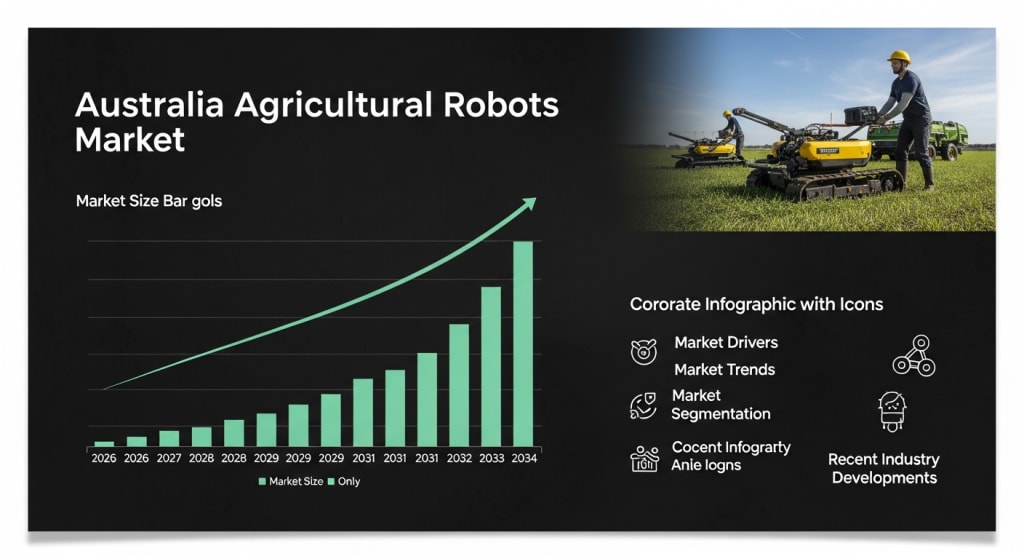
The Australia agricultural robots market is charting rapid expansion as farmers, agribusinesses and technology partners adopt automation and smart machinery to boost productivity, reduce labour shortages and increase precision in farm operations. According to market estimates, the Australia agricultural robots market size reached USD 208.60 Million in 2025 and is projected to grow to USD 755.35 Million by 2034, exhibiting a strong CAGR of 15.37% during 2026–2034. Agricultural robots — autonomous or semi-autonomous machines capable of performing tasks like planting, harvesting, spraying, monitoring, and crop handling — are transforming traditional farming practices into data-driven, efficient systems.
Agricultural robotics integrates advanced technologies such as artificial intelligence (AI), machine vision, sensors, GPS navigation and robotics control systems. These innovations help farmers optimise outputs, reduce input costs, conserve resources and make smarter decisions about crop management — all of which align with sustainability goals, operational efficiency and the demands of a modern agricultural economy.
What’s Driving Market Growth?
Australia’s agricultural industry is experiencing ongoing labour shortages, particularly during critical planting and harvesting periods. Agricultural robots provide a method to automate tedious and labor-heavy tasks, lessen dependence on seasonal labor, and manage increasing labor expenses while ensuring efficiency and productivity.
The adoption of precision agriculture, which involves utilizing data analytics, real-time sensing, and automation, is becoming more popular among Australian farmers. Robotic systems integrated with crop sensors, imaging technology, and AI algorithms provide precise fertilization, accurate spraying, and disease identification, leading to minimized waste, reduced chemical application, and enhanced crop well-being.
Growing Demand for Output Efficiency With global food demand on the rise, farmers are prioritising yield optimisation and quality improvement. Robots capable of performing operations such as automated weeding, fruit picking, soil monitoring and autonomous spraying help increase operational throughput, reduce crop losses and improve overall farm performance.
Technological Advances & Innovation Increased availability of rugged, farm-ready robots and supportive technologies like IoT connectivity, cloud analytics and farm management software enhances system functionality. These technologies allow producers to monitor crop conditions remotely, deploy bots for specific tasks, and integrate robotics data into broader farm planning.
Sustainability & Resource Management Pressure to use water, energy and chemicals more sustainably encourages adoption of precision robotics. Agricultural robots can significantly reduce input waste, target resources only where needed, and help farmers meet environmental stewardship goals while optimising cost and yield.
Market Segmentation & Key Insights
By Type The agricultural robots market includes autonomous tractors and field robots, seeding & planting robots, harvesting robots, weeding and spraying robots, drone-based robotic systems, milking & livestock robots, soil and crop monitoring robots, and robotic harvest assistants. Harvesting and monitoring robots are rapidly gaining adoption due to direct linkages with yield optimisation and labour savings.
By Application Robotics systems are deployed across crop cultivation, precision spraying, harvesting & picking, weeding & soil control, harvest handling, livestock operations, irrigation support, yield monitoring, and agronomic planning. Crop cultivation and harvesting applications drive significant revenue due to high frequency of use.
By End Use User Farmers and growers, agribusiness enterprises, commercial farms, horticultural producers, viticulture and orchard operations, dairy and livestock farms, contract service providers, and agriculture technology integrators represent key market participants. Large-scale farms and contractors tend to adopt robotics earliest due to capital capacity and return-on-investment focus.
By Distribution Channel Agricultural robots are distributed through equipment manufacturers, agricultural automation solution providers, robotics OEMs, tech integration partners, agri-equipment dealers, digital marketplaces and direct farm sales channels. Increasing digital sales channels help smaller farms access robotic solutions with leasing and subscription models.
What the Opportunities Are?
Autonomous Field Robots & Robotic Platforms There is a strong opportunity for multi-functional autonomous robots that perform combined tasks — such as weed control, planting, and crop scouting — improving operational versatility and lowering equipment costs while enhancing productivity.
AI-Driven Decision Support & Farm Analytics Integrating robotics data with farm analytics dashboards, AI-based insights and predictive modelling supports precision decisions related to irrigation, nutrient applications and crop scheduling — helping farms boost efficiency and yield.
Drone Robotics & Aerial Monitoring Use of robotic drones for crop health monitoring, spraying, topographic mapping and environmental assessment provides a scalable, cost-effective approach to precision agriculture — especially for large or dispersed properties.
Robotics as a Service (RaaS) & Flexible Payment Models Adopting RaaS models, leasing options or pay-per-use systems can make agricultural robots financially accessible for mid-sized and smaller farms, expanding the customer base and accelerating adoption rates.
Recent News and Developments in Australia Agricultural Robots Market
Jul 2025: A consortium of agri-tech firms and robotics startups announced collaborations to field-test autonomous weeding and crop-scouting robots in commercial vegetable and orchard operations — underscoring tech validation in real farm environments.
Aug 2025: Reports highlighted increased interest in drone-based robotic spraying solutions among broadacre and horticulture growers, reflecting farmer demand for precision pest and nutrient applications with reduced chemical use.
Oct 2025: Agriculture innovation forums in Australia emphasised robotics integration for small-goods growers, focusing on user-friendly autonomous platforms that require minimal operator training — expanding appeal beyond large commercial farms.
Why Should You Know About Australia Agricultural Robots Market?
Awareness of this market is important as it highlights the intersection of automation, agricultural productivity, and innovation in assisting farmers to tackle essential issues like labor shortages, precise input utilization, and yield fluctuations. Agricultural robots are swiftly transforming the future of agriculture, converting labor-intensive tasks into efficient, data-oriented systems that provide tangible economic and sustainability advantages.
For investors, the agricultural robots sector provides access to a rapidly expanding technology market with significant future potential and broad applicability—rooted in precision farming, automation trends, data connectivity, and sustainability needs. The remarkable anticipated CAGR of 15.37% indicates robust faith in robotics as a pivotal force in enhancing agricultural productivity and economic stability.
For farmers, agribusiness executives, and technology innovators, grasping robotics categorization, application scenarios, implementation frameworks, and return on investment possibilities aids in developing strategies for embracing technology, financial investment, and long-term farm planning. Synchronizing investments in robotics with agricultural objectives — such as enhancing yields, managing costs, or promoting environmental responsibility — offers a competitive advantage in an evolving farming environment.
In essence, the Australia agricultural robots market captures how technology, agriculture and productivity priorities intersect — making it a compelling area for innovators, investors and farming communities alike who are shaping the future of precision farming and automated agriculture.
About the Creator
Thomas
Market Research Analyst | Industry Trends & Forecasting | Turning market data into clear, actionable business insights across global sectors.
Meter Data Management System Market is Expected to Grow USD 1,207.2 Million by 2033 | CAGR 15.7%
Meter Data Management System Market Overview A Meter Data Management System (MDMS) is a critical software platform that collects, validates, stores, and analyzes meter data from smart meters across electricity, gas, and water utilities. These systems support accurate billing, grid monitoring, outage management, and analytics, enabling utilities to convert large volumes of metering data into actionable insights. MDMS platforms are central to modern utility operations, especially in smart grid and advanced metering infrastructure (AMI) environments.
By James Smith6 days ago in Trader
Ceramics Market: Trends, Innovations, and Industry Growth
Overview The ceramics market is a dynamic and expansive sector that spans a wide range of applications, from traditional pottery and tiles to cutting-edge industrial ceramics used in electronics, aerospace, and medical devices. Ceramics are prized for their durability, heat resistance, and insulating properties, making them essential in various high-tech and manufacturing applications. The market is being influenced by technological advancements, growing demand for eco-friendly products, and innovations in smart ceramics. This industry is experiencing significant growth, particularly in emerging markets, driven by infrastructure development and rising consumer interest in ceramic products for both functional and aesthetic purposes.
By James Smith3 days ago in Trader



Comments
There are no comments for this story
Be the first to respond and start the conversation.