
ASML Shares Drop 16% After Early Earnings Release and Weaker China Outlook
ASML’s stock tumbles 16% after an early earnings release reveals weaker-than-expected sales forecasts, impacted by China’s export restrictions and a sluggish recovery in key markets, raising concerns across the semiconductor industry.
Shares of ASML, the Dutch semiconductor equipment maker, plunged 16% after the company accidentally published its financial results early. This came with a grim forecast for 2025, which led to a significant sell-off. ASML, a key player in the semiconductor industry, expects net sales for 2025 to be between €30 billion and €35 billion ($32.7 billion to $38.1 billion), falling on the lower side of its previous estimates. This forecast disappointed investors, pulling down other major chip stocks like Nvidia, AMD, and Broadcom.
One of the main concerns driving the drop is ASML’s outlook on its China business, which has faced mounting challenges due to geopolitical tensions and export restrictions. CFO Roger Dassen revealed that China is expected to contribute around 20% of the company’s total revenue next year. This is a notable decrease from 49% in the June quarter, largely due to restrictions imposed by the U.S. and Dutch governments on exporting advanced chipmaking tools to China. These restrictions have made it more difficult for ASML to sell its extreme ultraviolet (EUV) lithography machines, which are critical to making advanced chips for tech giants like Nvidia and Taiwan Semiconductor Manufacturing Company (TSMC).
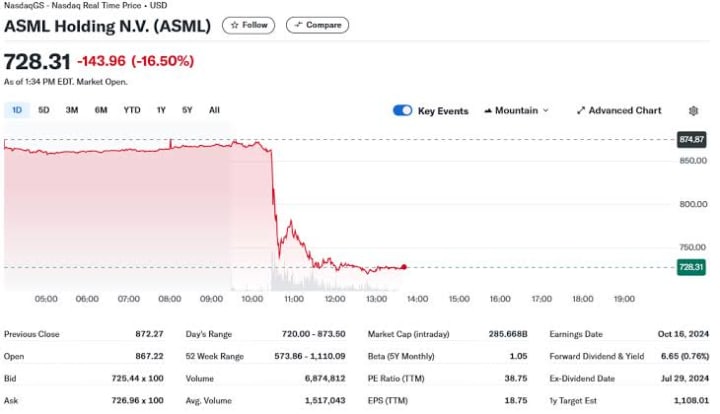
ASML’s Q3 net bookings also fell significantly short of expectations, with only €2.6 billion ($2.83 billion) in orders, compared to the €5.6 billion ($6.1 billion) forecast by analysts. Despite this, net sales came in strong at €7.5 billion, exceeding projections. CEO Christophe Fouquet acknowledged that while there are promising developments in artificial intelligence (AI), other markets are slower to recover. This gradual recovery was slower than anticipated, further contributing to the lowered forecast for 2025.
ASML’s early release of its results, caused by a technical error, added to the surprise. The results were briefly posted on a part of the company’s website before the scheduled announcement, leading to an unexpected market reaction. This early publication exacerbated concerns that had already been brewing, especially around the semiconductor industry's exposure to China.
The company’s lowered outlook for 2025 has triggered caution among investors, especially given the semiconductor industry's dependence on China. The reduced guidance highlighted the challenges of a delayed cyclical recovery and specific difficulties with customers, such as those in China facing export controls.
However, some analysts believe that while the 2025 outlook is disappointing, the long-term growth potential, particularly in AI, remains intact. ASML plays a crucial role in the global chip supply chain, and its machines are indispensable for manufacturing the most advanced semiconductors. Cantor analysts, while noting the disappointing outlook, emphasized that ASML’s lowered forecast does not suggest any change in the strong growth prospects for AI-related demand.
The U.S. and Dutch governments’ export controls on sensitive technologies, especially advanced chipmaking tools, are designed to limit China’s ability to develop its semiconductor capabilities. These restrictions have forced ASML to adjust its expectations for China, which previously represented a significant portion of its business. Dassen remarked that the company’s revenue from China will normalize to around 20% of its total revenue, aligning with its backlog of orders.
Despite these challenges, ASML’s role as a key supplier to major chipmakers like Nvidia, TSMC, and others keeps it in a strong position, even amid shifting geopolitical landscapes. Its extreme ultraviolet (EUV) lithography machines are vital for producing advanced chips, giving the company a competitive edge, though restrictions on sales to China could slow growth in the near term.
In the broader market, ASML’s disappointing results dragged down other major semiconductor stocks. Nvidia, AMD, and Broadcom all experienced declines following the news. This signals broader concerns about the semiconductor industry, particularly as companies navigate ongoing supply chain issues, geopolitical tensions, and fluctuating demand across various sectors.
As ASML looks toward 2025, it faces a mixed outlook. While AI and advanced technology sectors offer promising opportunities, the challenges posed by slower market recoveries and export restrictions, particularly in China, remain significant hurdles. Investors will be watching closely to see how ASML adapts to these shifting conditions and whether the broader semiconductor industry can recover its momentum.



Comments
There are no comments for this story
Be the first to respond and start the conversation.