
Asia Pacific Sleep Apnea Devices Market Size and Forecast 2025–2033
Rising awareness, aging populations, and home-based diagnostics are reshaping the future of sleep healthcare across Asia Pacific

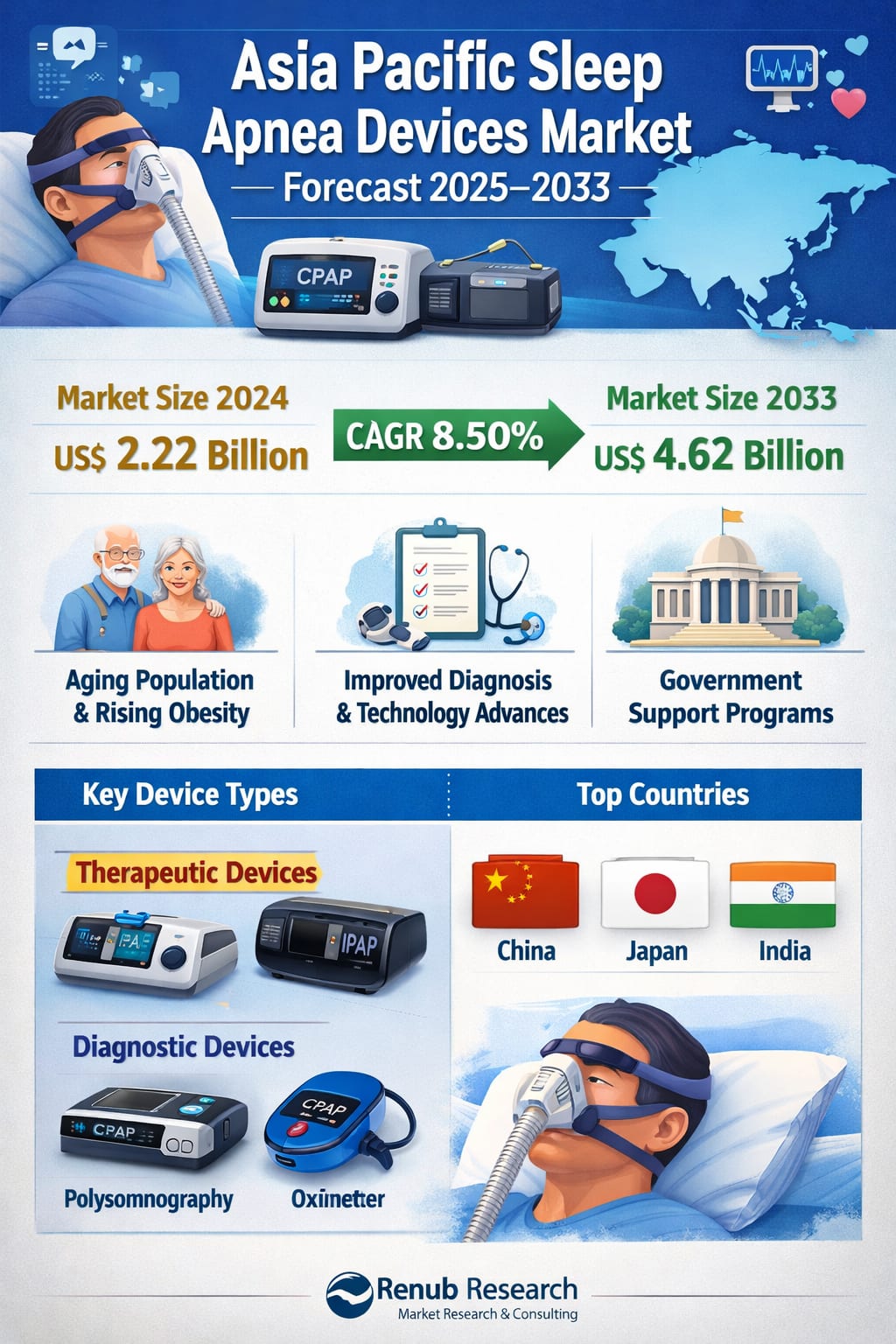
Asia Pacific Sleep Apnea Devices Market: A Region Waking Up to Sleep Health
The Asia Pacific sleep apnea devices market is entering a phase of accelerated growth as healthcare systems, patients, and policymakers begin to take sleep health more seriously. According to Renub Research, the Asia Pacific Sleep Apnea Devices Market is expected to reach US$ 4.62 billion by 2033, up from US$ 2.22 billion in 2024, expanding at a compound annual growth rate (CAGR) of 8.50% from 2025 to 2033.
This growth trajectory reflects more than just rising sales of medical equipment. It signals a broader transformation in how sleep disorders are diagnosed, treated, and perceived across the region. Once dismissed as a minor lifestyle issue or an inconvenience marked by loud snoring, sleep apnea is now widely recognized as a serious medical condition linked to cardiovascular disease, diabetes, workplace accidents, and reduced quality of life.
Across Asia Pacific, a powerful combination of aging populations, increasing obesity rates, greater public awareness, technological innovation, expanding healthcare infrastructure, and supportive government initiatives is pushing sleep apnea from the margins of healthcare into the mainstream. As a result, both therapeutic and diagnostic devices are seeing strong demand, not only in hospitals and sleep laboratories but increasingly in home care settings as well.
Understanding Sleep Apnea and the Role of Medical Devices
Sleep apnea, often grouped under the broader category of sleep-disordered breathing (SDB), is a condition in which breathing repeatedly stops and starts during sleep. The most common form, obstructive sleep apnea (OSA), occurs when throat muscles relax and block the airway, leading to loud snoring, gasping for air, and fragmented sleep cycles.
Left untreated, sleep apnea can significantly increase the risk of hypertension, heart disease, stroke, diabetes, and daytime fatigue-related accidents. This makes accurate diagnosis and consistent treatment not just a matter of comfort, but a critical public health priority.
Medical devices play a central role across the entire care pathway. On the diagnostic side, tools such as polysomnography systems, oximeters, actigraphy monitors, respiratory polygraphs, and sleep apnea screening devices help clinicians identify the presence and severity of the disorder. On the therapeutic side, devices like CPAP (Continuous Positive Airway Pressure), Auto CPAP, BiPAP (Bilevel Positive Airway Pressure), and Adaptive Servo-Ventilation (ASV) systems are used to keep airways open during sleep, preventing breathing interruptions and restoring healthy sleep patterns.
In addition, oral appliances such as mandibular advancement devices (MADs) and tongue-retaining devices are used in mild to moderate cases, offering alternatives for patients who struggle with traditional mask-based therapies.
Market Growth Drivers: Why Demand Is Rising Across Asia Pacific
Rising Prevalence of Sleep Apnea
One of the strongest drivers of market growth is the increasing prevalence of sleep apnea itself. Better screening tools and growing medical awareness have revealed that the condition is far more widespread than previously assumed. In several Asia Pacific countries, urbanization, sedentary lifestyles, changing diets, and rising obesity rates are all contributing to higher risk profiles.
For example, studies indicate that in Japan alone, a significant portion of the adult population shows signs of obstructive sleep apnea, highlighting how deeply the condition has penetrated even highly developed healthcare systems. Similar trends are emerging across China, India, South Korea, and Southeast Asia, where lifestyle changes and demographic shifts are reshaping disease patterns.
As more patients are diagnosed, the need for both diagnostic and therapeutic devices naturally increases, fueling steady and long-term market expansion.
Technological Advancements in Devices and Digital Health
Technology is another major catalyst. The sleep apnea devices of today are quieter, smaller, more comfortable, and more connected than ever before. Auto-adjusting CPAP machines, wearable sleep monitors, and cloud-based data platforms are transforming both patient experience and clinical workflows.
The integration of digital health, artificial intelligence, and remote monitoring is particularly important in a region as vast and diverse as Asia Pacific. Portable diagnostic systems and home-based testing kits are making sleep studies more accessible, especially in areas where specialized sleep laboratories are limited.
Meanwhile, smart CPAP and BiPAP devices that track usage, mask fit, and breathing patterns are improving therapy adherence—one of the long-standing challenges in sleep apnea treatment. These innovations are not only expanding the market but also deepening its impact on long-term patient outcomes.
Growing Awareness and Early Diagnosis
Public awareness campaigns, improved medical education, and broader media coverage are helping sleep apnea shed its image as a “minor” problem. More people are now seeking medical advice for chronic snoring, daytime fatigue, and poor sleep quality, leading to earlier diagnosis and earlier intervention.
This cultural shift is crucial. The earlier sleep apnea is detected, the more effective treatment tends to be—and the longer patients remain on therapy. As awareness rises, so does the demand for screening devices, diagnostic tools, and long-term therapeutic equipment, creating a virtuous cycle of market growth.
Expanding Healthcare Infrastructure and Policy Support
Many Asia Pacific countries are investing heavily in healthcare infrastructure, including hospitals, diagnostic centers, and digital health platforms. Governments are also increasingly recognizing the economic and social costs of untreated chronic conditions, including sleep disorders.
Supportive policies, insurance expansion, and public health programs aimed at early diagnosis and preventive care are making sleep apnea devices more accessible to a broader segment of the population. In large markets such as China and India, even small improvements in access can translate into millions of new potential patients.
Challenges That Still Restrain the Market
High Cost of Devices
Despite strong growth prospects, cost remains a major barrier. CPAP, BiPAP, and advanced diagnostic systems can be expensive, and in many Asia Pacific countries, reimbursement coverage is limited or inconsistent. This forces a large portion of patients to pay out of pocket, which delays diagnosis and reduces long-term therapy adherence—especially in low- and middle-income populations.
Regulatory Complexity Across Countries
Asia Pacific is not a single, unified regulatory market. Each country has its own approval processes, compliance standards, and medical device regulations. For manufacturers, this means longer timelines, higher costs, and more complex market entry strategies. These regulatory hurdles can slow the introduction of innovative devices and limit patient access to the latest technologies.
Country-Level Highlights
China: A High-Potential, High-Volume Market
China’s sleep apnea devices market is being driven by a combination of rapid aging, rising obesity rates, and expanding healthcare investment. With a growing middle class and increased focus on chronic disease management, demand for both diagnostic and therapeutic devices is rising steadily.
Government healthcare initiatives and long-term development plans are also improving access to medical equipment, while international and domestic companies are introducing more portable, user-friendly, and digitally integrated devices. Given China’s population size, even moderate increases in diagnosis rates can have a massive impact on overall market volumes.
India: Awareness and Home Testing Changing the Landscape
In India, the market is shaped by growing awareness, rising obesity prevalence, and expanding private healthcare infrastructure. One notable trend is the increasing popularity of home sleep testing (HST), which offers a more affordable and convenient alternative to in-lab studies.
Technological improvements—such as quieter machines, better masks, and enhanced data tracking—are also helping improve patient acceptance and compliance. Regional differences remain, with urban and more developed areas leading adoption, but the long-term growth potential is substantial.
Japan: Technology, Aging, and High Standards of Care
Japan’s rapidly aging population makes it one of the most important markets for sleep apnea devices in the region. Older adults are more susceptible to sleep-disordered breathing, and Japan’s healthcare system places a strong emphasis on early diagnosis, technological quality, and long-term disease management.
High adoption of advanced diagnostic systems, combined with patient-friendly therapeutic devices, is supporting steady market growth. Government healthcare initiatives and a strong domestic medical technology sector further reinforce Japan’s position as a key regional market.
Market Segmentation Snapshot
By Type:
Therapeutic Devices
Diagnostic Devices
Therapeutic Devices Include:
CPAP Sleep Apnea Therapeutic Devices
Auto CPAP Sleep Apnea Therapeutic Devices
BiPAP Sleep Apnea Therapeutic Devices
Adaptive Servo-Ventilation (ASV)
Diagnostic Devices Include:
Polysomnography Devices (PSG)
Oximeters
Actigraphy Monitoring Devices
Respiratory Polygraphs
Sleep Apnea Screening Devices
By End User:
Sleep Laboratories, Clinics & Hospitals
Home Care Settings / Individuals
By Countries:
China
Japan
India
South Korea
Thailand
Malaysia
Indonesia
Australia
New Zealand
Rest of Asia Pacific
Competitive Landscape: Innovation and Global-Local Competition
The Asia Pacific sleep apnea devices market features a mix of global leaders and strong regional players, all competing on technology, comfort, connectivity, and cost-effectiveness. Key companies include:
ResMed Inc
Koninklijke Philips NV
Fisher & Paykel Healthcare Corporation Ltd
Nihon Kohden Corp
Wellell Inc
BMC Medical Co Ltd
Compumedics Ltd
Inspire Medical Systems Inc
These companies are focusing on product innovation, digital integration, strategic partnerships, and regional expansion. From cloud-connected CPAP systems to advanced sleep diagnostics software, competition is increasingly centered on delivering not just devices, but complete sleep health ecosystems.
The Road to 2033: A Market Built on Better Sleep
Looking ahead, the Asia Pacific sleep apnea devices market is well positioned for sustained growth. The Renub Research forecast of US$ 4.62 billion by 2033 at a CAGR of 8.50% reflects deep, structural changes in healthcare delivery, patient awareness, and technology adoption.
More diagnoses, better devices, stronger healthcare systems, and wider acceptance of home-based care will continue to expand the market’s reach. At the same time, addressing challenges such as cost barriers and regulatory complexity will be crucial for ensuring that growth is both inclusive and sustainable.
Final Thoughts
Sleep is no longer being treated as a luxury—it is increasingly recognized as a cornerstone of long-term health. The rapid evolution of the Asia Pacific sleep apnea devices market shows how seriously the region is beginning to take sleep disorders and their broader health impacts.
From high-tech sleep labs in Japan to home-based testing solutions in India and large-scale healthcare expansion in China, the region is embracing a future where better sleep means better health outcomes. If current trends continue, sleep apnea devices will not just be a fast-growing market segment—they will become a standard part of modern healthcare across Asia Pacific.
About the Creator
JPMorgan Equity Income Fund Class R6: A Comprehensive Guide for Income-Focused Investors
Overview of JPMorgan Equity Income Fund Class R6 The JPMorgan Equity Income Fund Class R6 is a professionally managed mutual fund designed for investors who want a balance between regular income and long-term capital appreciation. Offered by JPMorgan Asset Management, this fund primarily invests in U.S. equity securities with a strong emphasis on dividend-paying companies. Class R6 shares are typically available through institutional platforms and employer-sponsored retirement plans, making them a cost-efficient option for long-term investors.
By Hammad Nawaz6 days ago in Trader
Crypto News: Latest Updates Every Smart Investor Should Know
Crypto News is constantly evolving, and keeping up with it can make a huge difference for your investments. Whether you are new to digital currencies or have experience, knowing the latest updates helps you protect your money and spot opportunities before others. In this article, we cover essential Crypto News that could affect your portfolio today.
By John.doe7985 days ago in Trader
If You Write A Book, Don’t Tell Anyone
There are days when I’m grateful Amazon doesn’t tell me specifically who has bought my book and who hasn’t. If they did, I would be heartbroken when I read the list and noticed all the important names in my life were not on my list of customers.
By Ellen Frances7 days ago in Writers



Comments
There are no comments for this story
Be the first to respond and start the conversation.