
Asia Pacific Ice Cream Market Size and Forecast 2025–2033
How Urban Lifestyles, Premium Flavors, and Innovation Are Reshaping the Asia Pacific Ice Cream Market

Asia Pacific Ice Cream Market Overview
Ice cream is far more than just a frozen dessert. Across the Asia Pacific region, it has become a symbol of indulgence, comfort, celebration, and even lifestyle aspiration. Made from ingredients such as milk, cream, fruits, chocolate, and various flavorings, ice cream today exists in countless forms—sticks, cones, cups, tubs, artisanal scoops, and innovative plant-based versions. Its smooth texture, rich taste, and refreshing nature make it one of the most loved desserts worldwide, especially in regions experiencing warm climates and rising urban lifestyles.
Beyond simple enjoyment, ice cream plays a role in social gatherings, family outings, and everyday treats. It is used in desserts like sundaes, ice cream sandwiches, pies, milkshakes, and floats, making it a versatile product in both retail and foodservice. Some varieties, especially those containing real fruits and nuts, also provide nutrients such as vitamin A, vitamin C, and potassium—though indulgence remains its primary appeal.
In countries like Japan, India, China, and across Southeast Asia, ice cream consumption is increasingly seen not just as an occasional treat, but as a regular lifestyle product. Hot climates, growing café culture, and the influence of Western eating habits have all helped normalize frequent consumption.
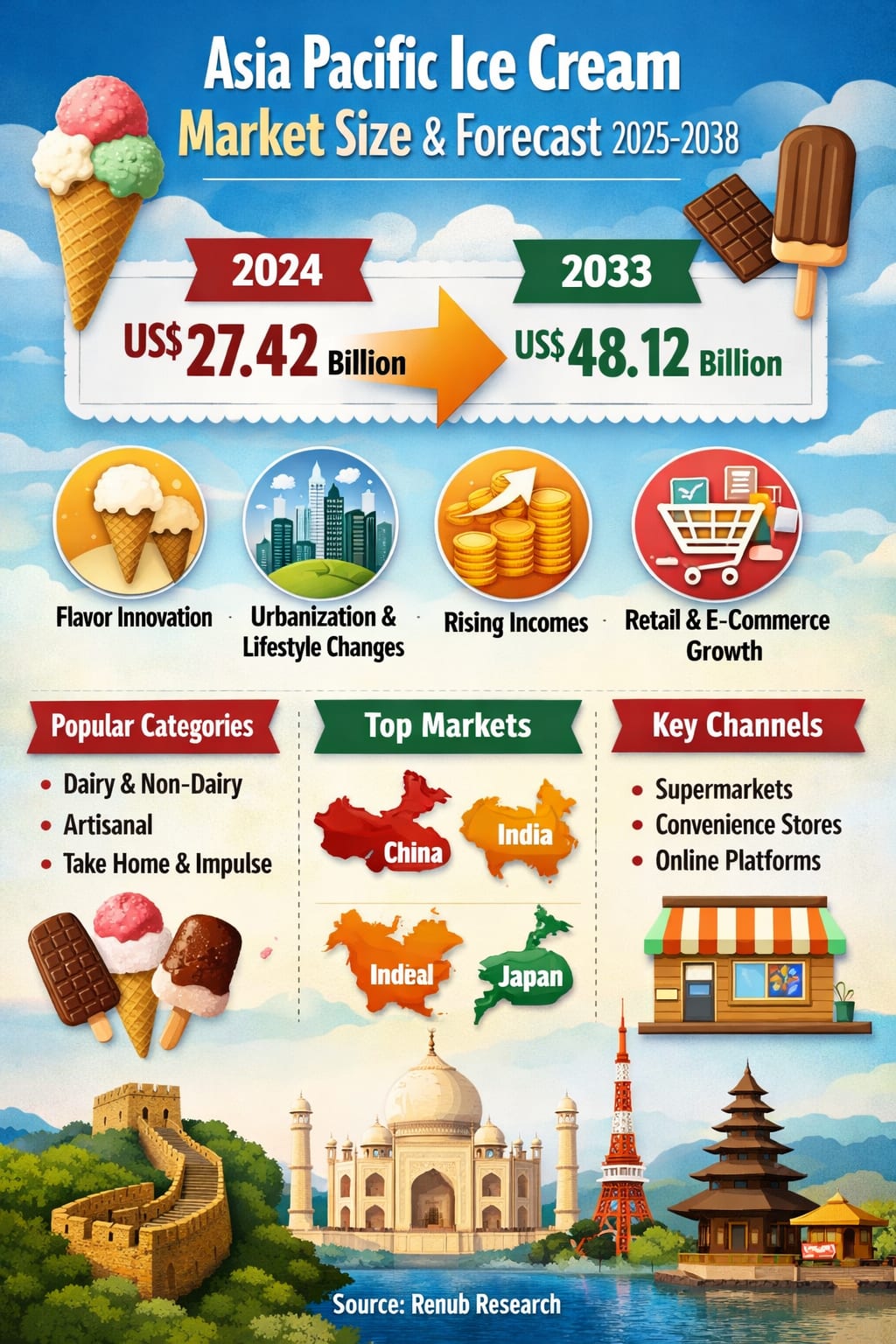
According to Renub Research, the Asia Pacific Ice Cream Market is expected to grow from US$ 27.42 billion in 2024 to US$ 48.12 billion by 2033, expanding at a CAGR of 6.45% from 2025 to 2033. This impressive growth reflects a powerful mix of demographic, economic, and cultural shifts sweeping across the region.
Urbanization, rising disposable incomes, changing food habits, and the growing appetite for premium and innovative flavors are key forces behind this expansion. At the same time, wider retail penetration, e-commerce growth, and improvements in cold-chain infrastructure are making ice cream more accessible than ever before.
What’s Driving the Asia Pacific Ice Cream Boom?
1. Flavor Innovation: Where Tradition Meets Experimentation
One of the strongest growth engines in the Asia Pacific ice cream market is flavor innovation. Today’s consumers are no longer satisfied with just vanilla or chocolate. They want unique, exciting, and culturally relevant taste experiences. This has pushed brands to experiment with regional ingredients, fusion flavors, and limited-edition launches.
Across the region, companies are blending traditional local tastes with global dessert trends—think matcha, black sesame, mango, lychee, coconut, red bean, saffron, and even savory-inspired notes. This constant reinvention keeps consumers curious and encourages repeat purchases.
In April 2024, for instance, Havmor (owned by LOTTE Wellfood Co. Ltd.) launched several new flavors ahead of the summer season, mixing classic favorites with innovative combinations to capture seasonal demand. Similarly, in March 2023, health-focused brand NOTO introduced new gelato flavors inspired by Indian cuisine, offering products with significantly lower fat and sugar while maintaining a rich, creamy texture. These kinds of launches show how brands are balancing indulgence with health-conscious innovation.
Flavor creativity is no longer just a marketing tool—it has become a core competitive strategy in a crowded marketplace.
2. Urbanization and Changing Lifestyles
Rapid urbanization across Asia Pacific is reshaping how people eat, shop, and treat themselves. As more people move to cities, lifestyles become faster, busier, and more convenience-driven. This naturally boosts demand for ready-to-eat, portable, and indulgent products like ice cream.
The rise of nuclear families, dual-income households, and long working hours has changed food consumption patterns. Snacks and desserts that require no preparation and offer instant satisfaction fit perfectly into modern urban routines. Ice cream, with its wide availability and variety of formats, benefits directly from this shift.
At the same time, growing disposable incomes mean consumers are more willing to spend on small luxuries. Premium cones, artisanal tubs, and specialty flavors are no longer niche—they are becoming mainstream in many urban markets. Western food culture, café culture, and social media trends further reinforce ice cream as a lifestyle product rather than just a seasonal treat.
3. Expanding Distribution Channels
Another critical growth driver is the expansion of distribution channels. Ice cream is no longer limited to neighborhood stores or traditional parlors. Today, it is widely available through:
Supermarkets and hypermarkets
Convenience stores
Specialty dessert outlets
Online platforms and quick-commerce apps
Modern retail formats offer better storage, improved visibility, and greater product variety. Meanwhile, e-commerce and food delivery apps are making ice cream accessible even in smaller cities and semi-urban areas.
A notable example is China’s Mengniu dairy company, which completed the largest smart ice cream factory in Southeast Asia in March 2023 through its subsidiary Aice Group in the Philippines. This facility significantly boosts local production capacity and improves supply chain efficiency, helping brands meet rising demand more effectively.
As cold-chain logistics continue to improve across the region, distribution reach is expected to expand even further, unlocking new customer segments.
Key Challenges in the Asia Pacific Ice Cream Market
1. Intense Competition
The Asia Pacific ice cream market is highly competitive, with global giants, strong regional players, and numerous local brands all fighting for shelf space and consumer attention. This intense rivalry leads to frequent product launches, aggressive promotions, and price competition.
While this benefits consumers through greater choice and innovation, it also puts pressure on company margins. Smaller brands, in particular, often struggle to keep up with the marketing budgets, distribution networks, and R&D investments of larger players. As a result, maintaining profitability while staying relevant is a constant challenge.
2. Cold Chain Infrastructure Limitations
Ice cream is extremely sensitive to temperature. Maintaining quality requires a reliable cold chain across manufacturing, storage, transportation, and retail. In many parts of Asia Pacific—especially rural or developing areas—this remains a major hurdle.
Unstable electricity supply, limited refrigeration facilities, and high logistics costs can lead to product spoilage, reduced shelf life, and inconsistent quality. These challenges restrict market penetration in certain regions and increase operational costs for manufacturers and distributors.
Although infrastructure is improving, cold chain reliability will remain a critical factor shaping the pace and reach of market growth.
Country Spotlight: Major Markets in Focus
China Ice Cream Market
China is one of the largest and fastest-growing ice cream markets in the Asia Pacific region. Rising disposable incomes, rapid urbanization, and evolving consumer tastes are driving strong demand, especially for premium and health-oriented products.
Chinese consumers are increasingly interested in low-sugar, functional, and high-quality ice creams. Reflecting this trend, Yili Group introduced new low-sugar and functional ice cream variants in October 2023 aimed at health-conscious buyers. Meanwhile, Mengniu Dairy announced a joint venture in August 2023 to adopt advanced production technologies, improving both efficiency and product quality.
China’s strong e-commerce ecosystem and improving cold-chain infrastructure have also made ice cream more accessible across different regions. The market continues to evolve rapidly, offering significant opportunities for both domestic and international brands.
India Ice Cream Market
India’s ice cream market is growing quickly, supported by changing lifestyles, rising incomes, and a growing appetite for premium and innovative products. The expansion of organized retail, food delivery platforms, and modern cafés has made ice cream more accessible than ever.
In February 2024, NIC Honestly Crafted Ice Creams launched NIC Waffle Cones—vacuum-packed to maintain crunch and freshness—highlighting the shift toward premium, experience-driven consumption. Indian consumers today are open to both indulgent treats and healthier alternatives, pushing brands to diversify their portfolios.
With a young population, hot climate, and rapidly modernizing retail landscape, India is expected to remain one of the most dynamic growth markets in the region.
Japan Ice Cream Market
Japan’s ice cream market is known for its creativity, seasonality, and deep connection to local flavors. According to the Japan Ice Cream Association, consumers are highly receptive to new and limited-edition products, making innovation a constant feature of the market.
Popular flavors include matcha, black sesame, cherry blossom, and hojicha, alongside more adventurous options like wasabi or squid ink. Brands like Häagen-Dazs have successfully blended traditional Japanese ingredients with premium ice cream concepts, offering products such as Hanamochi Kinako Kuromitsu and Hojicha Latte.
In March 2024, plant-based ice cream brand Eclipse Foods launched “eclipseco” in Japan through Family Mart stores in Tokyo, with flavors like Cookie Butter Crumble, Classic Chocolate, and Mango Passion Fruit. This reflects the growing interest in non-dairy and alternative options among Japanese consumers.
Asia Pacific Ice Cream Market Segmentation
By Product:
Sticks/Bars
Cones & Cups
Tubs & Bricks
Others
By Category:
Dairy Based
Non-Dairy Based
By Type:
Impulse
Take Home
Artisanal
By Flavor:
Chocolate
Vanilla
Fruit
Others
By Distribution Channel:
Supermarkets and Hypermarkets
Convenience Stores
Specialty Stores
Online Sales Channel
By Countries:
China
Japan
India
South Korea
Thailand
Malaysia
Indonesia
Australia
New Zealand
Rest of Asia Pacific
Competitive Landscape
Major players operating in the Asia Pacific ice cream market include:
Meiji Co. Ltd.
General Mills
Yili Group
Unilever Group
Mondelez International, Inc.
Nestlé SA
Bright Dairy & Food Co. Ltd.
Danone S.A.
These companies are competing through product innovation, premiumization, health-focused offerings, and expansion of distribution networks. Each is analyzed across four key dimensions: Overview, Key Persons, Recent Developments, and Financial Insights.
Final Thoughts: A Market with Plenty of Room to Grow
The Asia Pacific ice cream market is entering a golden phase of growth. With the market projected by Renub Research to rise from US$ 27.42 billion in 2024 to US$ 48.12 billion by 2033 at a CAGR of 6.45%, the opportunities are clear and compelling.
Urban lifestyles, rising incomes, flavor innovation, premiumization, and expanding retail and digital channels are reshaping how consumers across the region experience ice cream. At the same time, challenges such as intense competition and cold chain limitations will continue to test the industry’s resilience and adaptability.
For brands that can balance indulgence with health trends, tradition with innovation, and scale with quality, the Asia Pacific ice cream market offers a future that looks not just sweet—but exceptionally promising.
About the Creator
There's Nothing Sexy About Long-Term Investing, But It WORKS
There are infinite ways to build wealth, and when you find the right one, you can accelerate your rate of return exponentially. The challenge is that the best opportunities are not always obvious at the beginning. Before wealth accelerates, you have to find the right deals, strategies, or systems that align with your goals, timeline, and risk tolerance. Most people never reach this stage because they quit too early or spend too much time chasing shortcuts.
By Destiny S. Harris7 days ago in Trader
CBA Shares Jump as Profit Beats Market Expectations
CBA Shares Jump as Profit Beats Market Expectations Shares of Commonwealth Bank of Australia (CBA) recorded a strong upward move after the country’s largest lender posted profits that exceeded market expectations. The better-than-expected financial performance boosted investor confidence and pushed CBA shares higher in early trading, reinforcing the bank’s position as one of the most resilient players in Australia’s financial sector.
By Hammad Nawaz3 days ago in Trader
Bartender
On the heels of grief, pain bears down hard. On the heels of death, pain awakens the quiet place between the end of our own life and now. Feeling anything is like seeing a film and in black and white, slow motion, all sound turned off. Just watching. Gritting teeth, awkward smiles and bloody red eyes move around, scanning the others who are feeling something I don't want to feel, but I do. Escapism is all I have ever known. ~
By ROCK aka Andrea Polla (Simmons)3 days ago in Poets


Comments
There are no comments for this story
Be the first to respond and start the conversation.