
Artificial Intelligence in Diagnostics Market Size and Forecast 2025–2033
How AI Is Redefining Medical Diagnosis, Accelerating Clinical Decisions, and Reshaping Global Healthcare Systems

Introduction: The New Era of Intelligent Diagnostics
Artificial intelligence (AI) is no longer a futuristic concept in healthcare—it is rapidly becoming a foundational pillar of modern medical diagnostics. From reading radiology scans and analyzing pathology slides to predicting disease risks and assisting physicians in clinical decision-making, AI is transforming how diseases are detected, interpreted, and managed. As healthcare systems across the world struggle with rising patient volumes, workforce shortages, and the growing burden of chronic diseases, AI-powered diagnostic tools are emerging as a powerful solution to improve accuracy, speed, and efficiency.
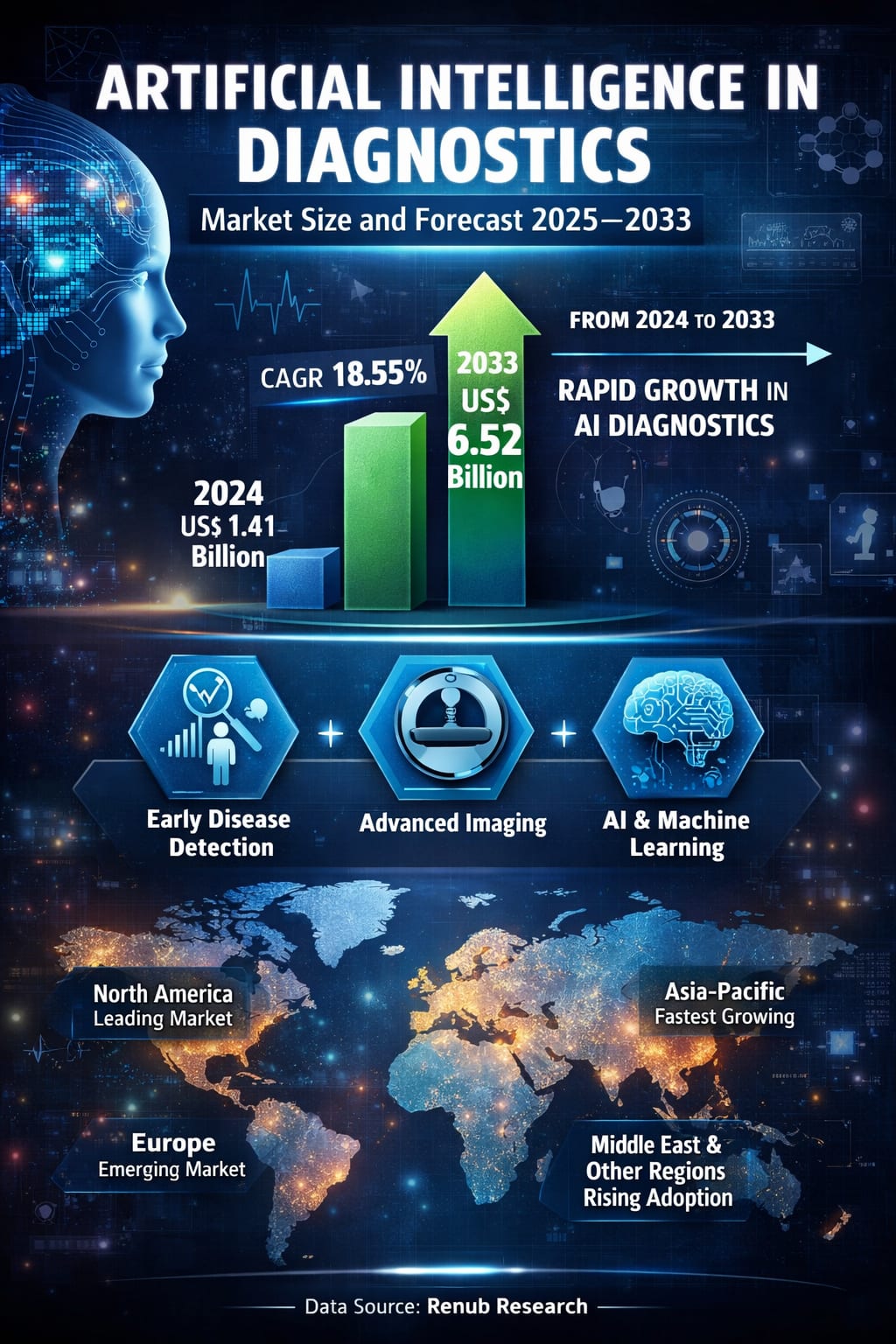
According to Renub Research, the Artificial Intelligence in Diagnostics Market is expected to grow from US$ 1.41 billion in 2024 to US$ 6.52 billion by 2033, registering a robust compound annual growth rate (CAGR) of 18.55% from 2025 to 2033. This strong growth trajectory reflects not only technological progress but also the increasing trust that healthcare providers, regulators, and patients are placing in AI-driven medical tools.
While the broader technology narrative often focuses on automation and digital transformation, the story of AI in diagnostics is fundamentally about better patient outcomes—earlier detection of diseases, more personalized treatments, and fewer diagnostic errors. As this market evolves, it is set to redefine the very foundations of clinical practice across hospitals, diagnostic laboratories, and imaging centers worldwide.
Global Artificial Intelligence in Diagnostics Industry Overview
The global AI in diagnostics industry is being shaped by rapid advances in machine learning, deep learning, big data analytics, and medical imaging technologies. These innovations are enabling AI systems to analyze complex medical data—such as CT scans, MRI images, pathology slides, ECG signals, and genomic information—with a level of speed and consistency that is difficult to achieve through traditional methods alone.
AI is already proving its value in high-impact areas such as radiology, pathology, oncology, cardiology, neurology, and chest & lung diagnostics. In these fields, AI algorithms assist clinicians by highlighting suspicious regions in images, prioritizing urgent cases, and reducing the likelihood of human oversight. This not only improves diagnostic accuracy but also helps optimize workflow efficiency in overstretched healthcare systems.
North America currently dominates the global market, supported by strong research infrastructure, high healthcare spending, and early adoption of advanced technologies. However, the Asia-Pacific region is emerging as the fastest-growing market, driven by large patient populations, expanding healthcare access, and significant government investments in digital health. Europe, meanwhile, continues to integrate AI into public healthcare systems, particularly in imaging and screening programs.
Major industry players such as Siemens Healthineers, GE Healthcare, AliveCor, Aidoc, and other AI-focused innovators are actively expanding their portfolios, often through partnerships, acquisitions, and regulatory approvals. At the same time, healthcare startups are injecting fresh momentum into the sector by developing highly specialized AI tools for specific diagnostic challenges.
For instance, the industry saw increased investment activity when Arterys raised USD 28 million in Series C funding in May 2020, while Aidoc secured USD 20 million in Series B funding in September 2020 to accelerate the development of AI-driven diagnostic solutions. These funding milestones highlight the strong investor confidence in AI’s long-term role in healthcare.
Market Growth Drivers
1. Rising Demand for Early and Accurate Diagnosis
One of the most powerful drivers of the AI in diagnostics market is the global rise in chronic and life-threatening diseases, including cancer, cardiovascular disorders, neurological conditions, and respiratory illnesses. Early and accurate diagnosis is often the difference between effective treatment and poor clinical outcomes.
AI systems excel at analyzing large volumes of complex medical data, enabling them to detect subtle patterns and anomalies that may be difficult for the human eye to spot consistently. By supporting clinicians with data-driven insights, AI reduces diagnostic errors, shortens decision-making timelines, and improves the overall quality of care. As healthcare systems increasingly focus on precision medicine and preventive care, the demand for AI-enabled diagnostic tools continues to rise.
2. Advancements in AI and Machine Learning Technologies
The rapid evolution of deep learning models, neural networks, and natural language processing is significantly expanding the capabilities of AI in diagnostics. These technologies allow systems to continuously learn from new data, improving their performance over time and adapting to diverse patient populations.
In medical imaging, for example, deep learning has revolutionized the detection of tumors, fractures, cardiovascular abnormalities, and lung diseases. Similar progress is being seen in pathology and genomics, where AI can analyze thousands of data points simultaneously, providing insights that would otherwise require extensive manual effort. These advancements not only enhance diagnostic accuracy but also help automate repetitive tasks, easing the workload on healthcare professionals.
3. Explosion of Healthcare Data
The digital transformation of healthcare has led to an unprecedented increase in data generated from electronic health records (EHRs), wearable devices, imaging systems, and laboratory tests. While this data holds enormous clinical value, it is simply too vast and complex for traditional analytical methods to handle efficiently.
AI thrives in this data-rich environment. By integrating structured and unstructured data from multiple sources, AI systems can uncover hidden patterns, predict disease progression, and support more informed clinical decisions. As healthcare continues to digitize, the need for intelligent systems capable of managing, interpreting, and applying large-scale medical data will remain a key growth driver for the market.
Challenges Facing the Market
1. High Development and Implementation Costs
Despite its promise, the adoption of AI in diagnostics comes with significant financial and technical challenges. Developing reliable AI models requires access to high-quality datasets, advanced computing infrastructure, and highly skilled talent. In addition, extensive clinical validation and regulatory compliance add to the overall cost.
For many small and mid-sized healthcare providers—especially in developing regions—these high upfront investments can be a major barrier. Ongoing costs related to system maintenance, software updates, staff training, and cybersecurity further increase the total cost of ownership, slowing down widespread adoption.
2. Resistance to Change Among Healthcare Professionals
Another important challenge is the hesitation among some healthcare professionals to fully embrace AI-based diagnostic tools. Concerns often revolve around trust, transparency, and the fear of over-reliance on automated systems. Many AI models operate as “black boxes,” making it difficult for clinicians to understand how specific conclusions are reached.
There are also worries about potential deskilling and the impact on clinical judgment. Overcoming these concerns requires transparent AI systems, strong clinical evidence, continuous training, and clear demonstrations of improved patient outcomes. Building trust between technology and medical professionals remains a critical success factor for the industry.
Regional Market Insights
United States
The United States remains at the forefront of AI in diagnostics, supported by advanced healthcare infrastructure, strong investment in research and development, and a favorable innovation ecosystem. AI is increasingly used across radiology, pathology, cardiology, and genomics, particularly for early detection of cancer and cardiovascular diseases.
In October 2024, Invenio Imaging announced that its NIO Lung Cancer Reveal module received Breakthrough Device Designation from the U.S. FDA, highlighting the growing regulatory acceptance of AI-powered diagnostic tools. Despite challenges related to data privacy and clinical validation, the U.S. market continues to expand rapidly, reinforcing AI’s role in shaping the future of healthcare.
United Kingdom
The UK is actively integrating AI into its healthcare system, particularly through the National Health Service (NHS), to address workforce shortages and rising patient demand. AI is being used to improve diagnostic efficiency in medical imaging, reduce waiting times, and enhance early detection programs, such as breast cancer screening initiatives.
In October 2024, Optellum secured major funding under a new cancer program supported by the Office for Life Sciences and the National Institute for Health and Care Research, aimed at evaluating its AI solution for early lung cancer detection. These initiatives reflect the UK’s commitment to using AI as a strategic tool for healthcare modernization.
China
China’s AI in diagnostics market is growing rapidly due to strong government support, a vast patient base, and aggressive investment in digital health. Leading technology companies are developing AI tools for radiology, pathology, and genomics, while national strategies such as “Internet + Healthcare” are accelerating adoption across the healthcare system.
In July 2023, a Hong Kong-based project received USD 5 million to combine genomics and AI for improved mental health diagnosis, showcasing the country’s shift toward data-driven, precision medicine approaches. Although regulatory and data privacy challenges remain, China is positioning itself as a global leader in AI-driven healthcare innovation.
United Arab Emirates
The UAE is emerging as a regional hub for healthcare innovation, driven by initiatives like the UAE Strategy for Artificial Intelligence 2031. The country is actively integrating AI into diagnostics through supportive regulations, strong digital infrastructure, and public-private partnerships.
The Dubai Health Authority has established frameworks to ensure the safe and effective use of AI in healthcare, while investments in telemedicine and electronic health records further support AI adoption. These efforts are expected to result in more accurate diagnoses, personalized treatment plans, and improved patient outcomes across the UAE’s healthcare system.
Recent Industry Developments
The AI in diagnostics industry continues to evolve rapidly through strategic collaborations and technology expansion:
In September 2024, Roche announced the expansion of its digital pathology platform by integrating over 20 advanced AI algorithms from multiple partners, aiming to enhance cancer research and diagnostic accuracy.
In July 2024, AWS and GE HealthCare partnered to develop industry-specific AI foundation models, unlocking healthcare data and enabling next-generation diagnostic and wellness solutions.
These developments highlight the industry’s strong focus on ecosystem partnerships, platform-based innovation, and scalable AI solutions.
Market Segmentation Overview
By Component:
Software
Services
Hardware
By Application:
Neurology
Radiology
Chest & Lung
Oncology
Cardiology
Pathology
Others
By End Use:
Hospitals & Clinics
Diagnostic Laboratories
Imaging Centers
Other End Users
By Region:
North America (United States, Canada)
Europe (France, Germany, Italy, Spain, United Kingdom, Belgium, Netherlands, Turkey)
Asia Pacific (China, Japan, India, Australia, South Korea, Thailand, Malaysia, Indonesia, New Zealand)
Latin America (Brazil, Mexico, Argentina)
Middle East & Africa (South Africa, Saudi Arabia, United Arab Emirates)
Competitive Landscape
The competitive environment includes established healthcare technology leaders and fast-growing AI specialists. Key players such as Siemens Healthineers, GE Healthcare, AliveCor, Aidoc, Riverain Technologies, Vuno, Neural Analytics, and Imagen Technologies are competing across software platforms, imaging solutions, and clinical decision-support tools. Companies are increasingly focusing on product innovation, regulatory approvals, strategic partnerships, and global expansion to strengthen their market positions.
Final Thoughts
The Artificial Intelligence in Diagnostics Market is entering a decisive growth phase, driven by rising healthcare demands, technological breakthroughs, and the urgent need for more accurate and efficient diagnostic solutions. With the market projected to grow from US$ 1.41 billion in 2024 to US$ 6.52 billion by 2033 at a CAGR of 18.55%, AI is set to become an indispensable part of global healthcare systems.
While challenges such as high costs, regulatory complexity, and resistance to change remain, the long-term benefits—earlier disease detection, improved patient outcomes, reduced clinical workload, and more efficient healthcare delivery—far outweigh the obstacles. As AI continues to mature, its role in diagnostics will shift from supportive technology to a core pillar of modern medicine, fundamentally reshaping how healthcare is delivered across the world.
About the Creator
Vertiv Earnings Surge as AI Data Center Boom Drives Record Orders and Profit Growth
Company Vertiv Holdings (VRT), a key player in the data center and AI infrastructure ecosystem, delivered a standout performance in the fourth quarter of 2025, reporting exceptionally strong organic order growth and earnings gains that underscore growing demand for digital infrastructure solutions. Many analysts were surprised by the company's most recent results, which were enhanced by its strategic position in the developing artificial intelligence (AI) and hyperscale data center markets.
By Raviha Imran6 days ago in Trader


Comments
There are no comments for this story
Be the first to respond and start the conversation.