
AI-Powered Forex Trading
How Machine Learning is Reshaping the Market in 2025


Forex trading has come a long way. In the past, traders relied heavily on charts, gut feeling, and the news. Fast forward to 2025, and the forex market—a $7.5 trillion-a-day beast—is no longer just a playground for human traders hunched over screens, chasing patterns. Today, artificial intelligence (AI) is leading a new era of smart trading. What once took hours of manual work is now done in seconds by powerful algorithms. This shift is more than just a trend. It’s changing how people trade, make decisions, and manage risks. If you want to stay ahead, it’s important to understand how machine learning is playing a major role in the forex market.
2. Understanding the Basics of AI and Machine Learning in Forex
2.1 What is Artificial Intelligence in Trading?
AI in trading isn’t sci-fi—it’s real, and it’s practical. In the financial world, AI refers to systems that mimic human smarts: spotting trends, crunching numbers, and making decisions, all without a coffee break. Unlike traditional automated systems—think basic scripts that execute trades when the RSI hits 70—AI learns, adapts, and gets smarter over time. It’s the difference between a wind-up toy and a self-driving car. In forex, this means AI can sift through decades of price data or global news feeds and decide, “Yep, it’s time to buy EUR/USD.”
2.2 Machine Learning vs. Manual Analysis
Machine learning, the brainy cousin of AI, takes this further. ML models don’t just follow rules—they learn from data. Imagine feeding a model 20 years of GBP/USD price action, economic reports, and interest rate changes. Over time, it figures out what works and what doesn’t, refining its predictions with every new tick. Backtesting? It’s lightning-fast, testing strategies across millions of data points in seconds. Humans, meanwhile, rely on experience and gut—valuable, but slow and prone to bias. ML adapts in real-time; we don’t.
2.3 Common ML Techniques Used in Forex
Here’s the toolkit powering this revolution:
- Supervised Learning: Feed it labeled data—like past price movements—and it predicts the future. Regression models might forecast USD/JPY’s next move, while decision trees classify whether a trend is bullish or bearish.
- Unsupervised Learning: No labels needed. Clustering algorithms dig into raw data, uncovering hidden patterns—like how certain candlestick formations cluster before a breakout.
- Reinforcement Learning: The wild card. These models learn by trial and error, tweaking strategies to maximize profits. It’s like a digital trader earning its stripes in a simulated market.
3. How AI is Changing the Forex Trading Landscape
3.1 Enhanced Market Prediction Accuracy
AI’s superpower? Prediction. By chewing through historical data, real-time news, and even Twitter chatter, AI models can call market moves with jaw-dropping accuracy. Sentiment analysis, for instance, scans headlines like “Fed Signals Rate Hike” and predicts USD strength before the market catches on. A 2023 study by BIS found AI-driven forex predictions outperformed human analysts by 15% in volatile conditions. In 2025, that gap’s only widening.
3.2 Reduced Emotional Trading
Humans are messy. Panic sell-offs, revenge trades, FOMO buys—we’ve all been there. AI? It doesn’t care. It sticks to backtested logic, executing trades without a shred of fear or greed. A trader I know, Mark from London, saw his win rate climb from 45% to 68% after switching to an AI bot. Why? No more late-night “I’ve got a hunch” trades.
3.3 Scalability and 24/7 Monitoring
Forex never sleeps, but you do. AI doesn’t. Picture a bot watching AUD/USD, EUR/GBP, and 10 other pairs across every timezone, pouncing on opportunities you’d miss while snoring. It’s not just about stamina—it’s scale. One trader can now manage dozens of strategies simultaneously, something impossible without tech.
4. Real-World Applications of AI in Forex
4.1 AI Trading Bots and Expert Advisors (EAs)
AI bots, or Expert Advisors (EAs), are the foot soldiers of this revolution. Platforms like MetaTrader 5 and cTrader let you deploy these bots to trade automatically. Take Sarah, a part-time trader from Sydney. Before using an EA, she averaged $200 a month in profits. After tweaking an AI bot on MetaTrader, she hit $600—consistently. These tools don’t just follow rules; they evolve with the market.
4.2 Sentiment Analysis Tools
Natural Language Processing (NLP) is the secret sauce here. By scanning news, Reddit threads, or X posts, sentiment tools gauge market mood. Example: During 2024’s Middle East tensions, an NLP tool flagged rising fear in trader chatter, predicting a USD surge 12 hours before it hit. That’s an edge you can’t buy with a candlestick chart.
4.3 Pattern Recognition and Technical Analysis
Humans spot head-and-shoulders patterns; AI sees the invisible. ML algorithms analyze thousands of charts, catching micro-trends—like a subtle RSI divergence signaling a reversal—that human eyes skip. In 2025, top traders lean on this tech to stay ahead of the curve.
5. Benefits of AI in Forex Trading
5.1 Speed and Efficiency
In forex, milliseconds matter. AI powers high-frequency trading (HFT), executing trades faster than you can blink. Retail traders now tap into this speed with tools once reserved for hedge funds, leveling the playing field.
5.2 Personalization
AI isn’t one-size-fits-all. It learns your style. Scalper? It’ll tweak for quick trades. Swing trader? It’ll suggest longer holds. Your past trades become its playbook, crafting custom strategies that feel like they’re made just for you.
5.3 Data-Driven Decision Making
Forget staring at three indicators. AI processes thousands—price data, GDP releases, even weather patterns affecting commodity currencies—in real-time. Decisions aren’t guesses; they’re evidence.
6. Challenges and Limitations of AI Forex Systems
6.1 Overfitting and False Confidence
AI can be too clever. Overfitting happens when a model nails historical data but flops live. It’s like acing a practice test then bombing the real exam. Traders must test models rigorously to avoid this trap.
6.2 Black Box Problem
Some AI models are mysteries—even to their creators. This “black box” issue spooks regulators and traders alike. If you can’t explain why a bot sold 10 lots of USD/CAD, can you trust it? Transparency’s a hurdle in 2025.
6.3 Data Quality and Latency
AI thrives on data, but bad data kills it. “Garbage in, garbage out” isn’t just a saying—it’s a $10,000 loss waiting to happen. And in HFT, a split-second delay can turn a win into a wipeout. Quality and speed aren’t cheap.
7. Getting Started: How to Use AI in Your Own Forex Strategy
7.1 Choosing the Right Platform
New to AI trading? MetaTrader 5’s EA marketplace is a goldmine—user-friendly and packed with options. TradingView’s ML integrations are slick too, perfect for visual learners. Start with a demo account to test the waters.
7.2 Training Your Own Model
DIY fan? Grab free historical data from sites like Dukascopy, then fire up Python. Libraries like scikit-learn or TensorFlow let you build a basic model—say, predicting EUR/USD with regression. It’s a grind, but the payoff’s yours.
7.3 Using Pre-Built AI Tools
No coding skills? No problem. In 2025, top EAs like Forex Fury or Centobot offer plug-and-play solutions. Subscriptions run $50–$200/month, or you can buy custom bots outright. Test them first—your wallet will thank you.
If you're new to this, consider exploring online trading courses taught by seasoned experts that cover every step—from AI basics to real-world applications in forex.
8. Ethical Considerations and Future Outlook
8.1 Ethical Trading with AI
AI’s power raises questions. Are bots rigging markets? Is it fair that tech-savvy traders dominate? Regulators are watching, and debates are raging. AI can democratize trading—or widen the gap. It’s a tightrope.
8.2 The Future of AI in Forex (2025–2030)
By 2030, AI might predict elections or earthquakes and their forex fallout. Replace humans? Doubtful. The winners will pair human gut with AI’s brain—think Batman and Robin, not Skynet.
Conclusion
AI-powered forex trading in 2025 is a game-changer—faster, smarter, and colder than human traders alone. It’s not perfect; overfitting and data woes lurk. But the potential? Massive. Blend your instincts with AI’s precision, and you’re not just trading—you’re thriving. Embrace it, master it, and watch the market bend.
About the Creator
Silvia James
Silvia James was born in Denver, Colorado, and works as a contract author. She graduated from the College of Colorado, Denver with a bachelor's degree in English. Writing is her best form of networking and expressing herself.
Keep reading
More stories from Silvia James and writers in Trader and other communities.
Climate Change and Your Home: Adapting to Rising Temperatures
Climate change is no longer a distant issue; it's impacting us right now. As global temperatures rise and extreme weather events become more frequent, it's essential to understand how these changes affect our homes. Rising temperatures can strain home systems and increase energy costs. This blog post will explore how to adapt your home to these new realities, ensuring comfort and efficiency in a warming world.
By Silvia Jamesabout a year ago in Journal
Australia Wealth Management Market Set for Strong Expansion as Digital Platforms and HNWI Demand Surge
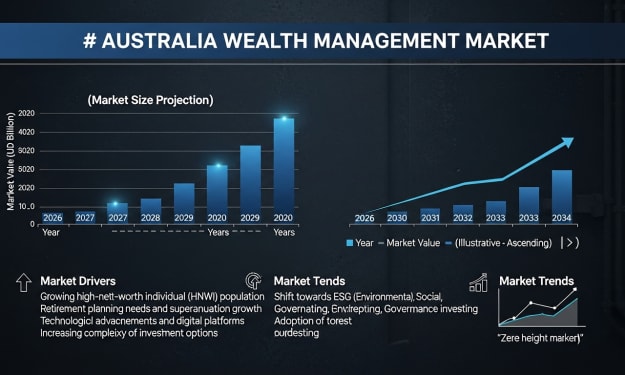
The Australia wealth management market is experiencing robust growth as affluent individuals, corporates, and savers increasingly seek expert financial planning, personalized investment strategies, and digital advisory solutions. According to IMARC Group, the market was valued at USD 110.3 Million in 2024 and is expected to reach USD 213.2 Million by 2033, registering a compound annual growth rate (CAGR) of 7.60% between 2025 and 2033.
By Rashi Sharma4 days ago in Trader
Ludacris and Nelly draw backlash over bookings at MAGA-coded music festival
Ludacris and Nelly headlining a mostly right-wing event is good for them. It’s also great for the genre of hip hop. The two rap veterans have showcased their talents on other stages. Why can’t they perform for mostly MAGA folks and grab that bag?
By Skyler Saunders4 days ago in Beat


Comments (1)
AI's changing forex big time. It's way faster than manual work. Machine learning's even better, learning from data. Supervised learning's part of the toolkit driving this revolution. It's amazing how quickly AI and ML are taking over forex trading. They're making things more efficient and less prone to human error. Can't wait to see what else they'll do.