
A World in Motion: How Global Affairs Are Redefining Power and Peace
Why international events today matter more than ever before

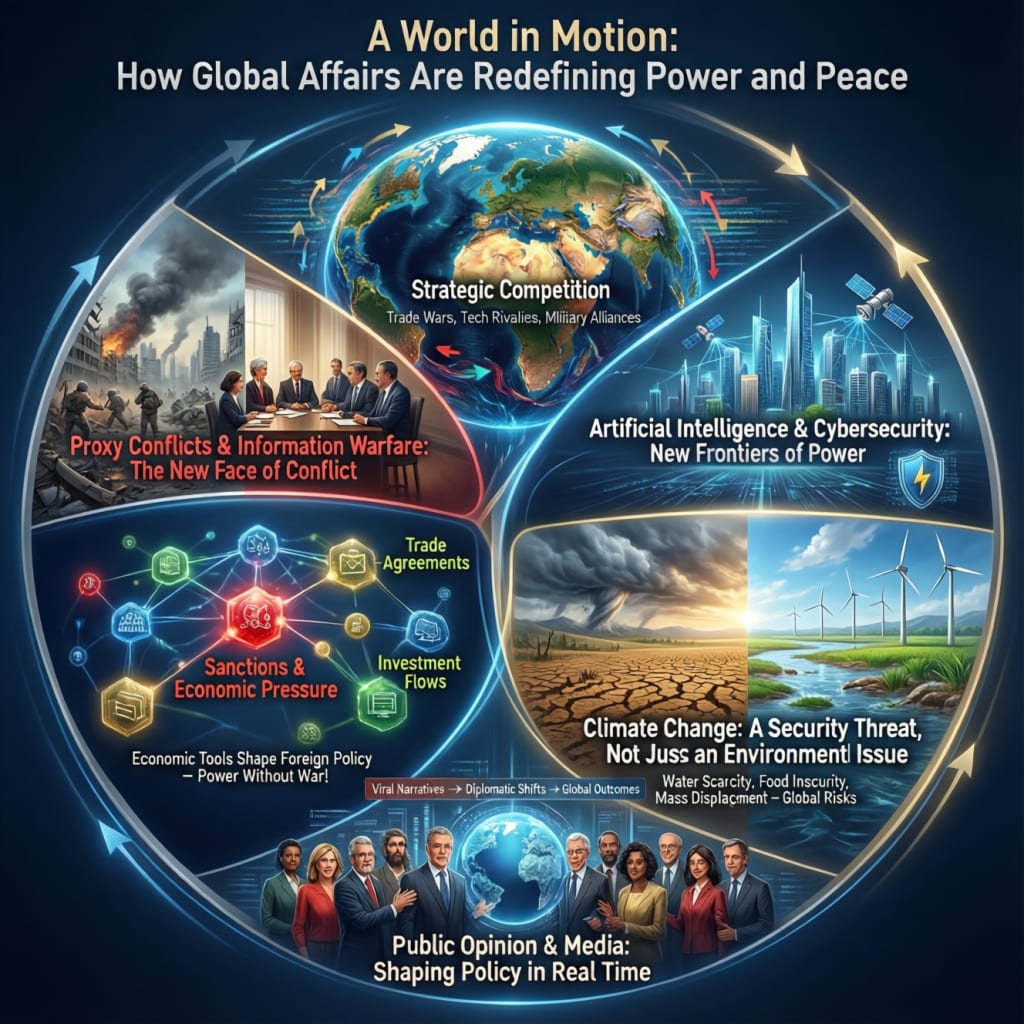
A World in Motion: How Global Affairs Are Redefining Power and Peace
The world is living through a period of constant change, where global affairs influence not only governments but the everyday lives of ordinary people. From economic tensions and political rivalries to climate challenges and technological competition, international events are reshaping how nations interact and how power is defined. World affairs are no longer distant headlines; they are forces that directly affect jobs, security, and stability across continents.
At the heart of global affairs lies the struggle for influence. Countries seek to protect their interests while expanding their reach through diplomacy, trade, alliances, and sometimes confrontation. Major powers use economic strength, military capability, and political networks to shape global outcomes. Smaller nations, meanwhile, often find themselves navigating between competing interests, trying to maintain sovereignty while depending on larger economies or security partners.
One of the most visible elements of modern world affairs is strategic competition. Rivalries between powerful states affect global markets, technology development, and regional stability. Trade disputes can disrupt supply chains, raise prices, and slow economic growth. Technological competition—especially in areas like artificial intelligence, cybersecurity, and space exploration—has become a new frontier where dominance can shape the future balance of power.
Conflict remains a defining feature of global affairs, though its nature has evolved. Traditional wars between states are now accompanied by proxy conflicts, cyber warfare, and information battles. Many conflicts today involve indirect engagement, where global powers support opposing sides without direct confrontation. This approach reduces the risk of full-scale war but prolongs instability in affected regions, often at great human cost.
Diplomacy continues to play a crucial role in managing global tensions. International summits, negotiations, and back-channel communications help prevent disagreements from turning into open conflict. Diplomatic efforts may appear slow or ineffective, but their absence often leads to escalation. History repeatedly shows that dialogue, even between rivals, is essential for maintaining global balance.
Economic influence has become one of the most powerful tools in world affairs. Sanctions, trade agreements, investment policies, and financial institutions are used to reward cooperation or punish defiance. While governments present economic measures as alternatives to military action, their consequences are complex. Sanctions can pressure political leadership, but they can also strain economies and affect vulnerable populations. This raises ethical questions about how power should be exercised in a globalized economy.
Another major factor shaping world affairs is global interdependence. Nations are deeply connected through trade, energy networks, digital infrastructure, and environmental systems. A crisis in one region can quickly spread worldwide. Financial instability, pandemics, or climate disasters do not remain local. This interconnectedness forces countries to cooperate, even when political relationships are tense or competitive.
Climate change has emerged as one of the most urgent issues in global affairs. Rising temperatures, extreme weather, and resource scarcity are creating new security risks. Water shortages, food insecurity, and displacement are increasing tensions within and between nations. Addressing these challenges requires global cooperation, yet political divisions often slow collective action. The way countries respond to climate threats will shape international relations for decades to come.
Public opinion and media now play a larger role in shaping world affairs than ever before. Information spreads instantly, and public reactions can influence foreign policy decisions. Leaders must balance domestic expectations with international responsibilities. Miscommunication or aggressive rhetoric can escalate tensions, while careful messaging can create opportunities for dialogue.
Despite the challenges, world affairs also highlight humanity’s capacity for cooperation. International organizations, humanitarian efforts, and peace initiatives continue to address global problems. Collaborative responses to disasters, health crises, and development challenges show that cooperation is possible even in a divided world.
Ultimately, world affairs are about choices. Nations must decide whether to pursue dominance or dialogue, isolation or cooperation. These decisions will determine whether the future is shaped by conflict or stability. In a world defined by shared challenges, understanding global affairs is no longer optional—it is essential for building a more secure and balanced future.
About the Creator
Wings of Time
I'm Wings of Time—a storyteller from Swat, Pakistan. I write immersive, researched tales of war, aviation, and history that bring the past roaring back to life
Keep reading
More stories from Wings of Time and writers in Trader and other communities.
Sanctions, Strategy, and Silence: The U.S.–Pakistan Equation
Sanctions, Strategy, and Silence: The U.S.–Pakistan Equation The relationship between the United States and Pakistan has never been simple. It has moved through phases of close cooperation, deep mistrust, strategic partnership, and long periods of silence. Unlike some international relationships that are clearly friendly or openly hostile, the U.S.–Pakistan equation exists in a gray zone shaped by security concerns, regional politics, and global strategy.
By Wings of Time 2 months ago in Trader
India Fertilizer Market Size and Forecast 2026–2034
The India fertilizer market is poised for steady and sustainable growth over the next decade, driven by the country’s rising population, increasing food consumption, and the urgent need to enhance agricultural productivity. According to Renub Research, the market is projected to grow from US$ 44.62 Billion in 2025 to US$ 75.96 Billion by 2034, expanding at a Compound Annual Growth Rate (CAGR) of 6.09% during 2026–2034.
By Sakshi Sharma3 days ago in Trader
Why Didn't Anyone Tell Us
Men, move along. This is not for you. This is for the women. I was forty-five when I began menopause. It is pretty young for that to be going on in a woman’s life, but I had undiagnosed PCOS, my entire life. Thank you to all the gynecologists I had seen my entire life. That in itself should encourage women to keep seeking second opinions, especially when you are not getting correct answers or any at all.
By Alexandra Grant2 days ago in Humans



Comments
There are no comments for this story
Be the first to respond and start the conversation.