
Sanctions, Strategy, and Silence: The U.S.–Pakistan Equation
How quiet diplomacy, selective pressure, and shifting priorities define a complex relationship


Sanctions, Strategy, and Silence: The U.S.–Pakistan Equation
The relationship between the United States and Pakistan has never been simple. It has moved through phases of close cooperation, deep mistrust, strategic partnership, and long periods of silence. Unlike some international relationships that are clearly friendly or openly hostile, the U.S.–Pakistan equation exists in a gray zone shaped by security concerns, regional politics, and global strategy.
One common misunderstanding is that Pakistan is either fully sanctioned or fully supported by the United States. In reality, neither is true. Pakistan is not under broad, country-wide U.S. sanctions, but it is also not treated as a close ally in the way it once was. Instead, Washington uses a selective and cautious approach, applying pressure in some areas while keeping channels open in others.
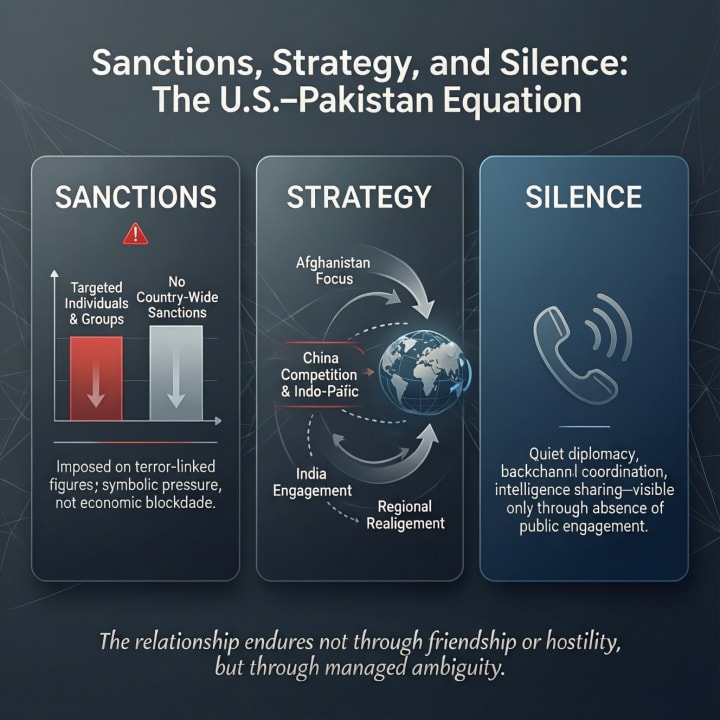
Sanctions have played a role, but mostly in a targeted way. The United States has imposed sanctions on specific individuals and groups linked to terrorism or regional instability. These measures are not aimed at Pakistan’s economy as a whole, but they send a political message. From Washington’s perspective, sanctions are tools to influence behavior without cutting ties completely. From Pakistan’s perspective, they often feel one-sided and dismissive of its own security challenges.
Strategy is the second key factor shaping this relationship. For decades, Pakistan was important to U.S. policy in South Asia because of Afghanistan. After the U.S. withdrawal from Afghanistan, Pakistan’s strategic value changed. Washington’s focus shifted toward competition with China, the Indo-Pacific region, and strengthening ties with India. As priorities changed, Pakistan moved closer to the margins of U.S. foreign policy.
This shift does not mean Pakistan no longer matters. Its geographic position, nuclear status, and influence in regional security still make it important. However, importance does not always translate into attention. Much of today’s relationship happens quietly, through military communication, intelligence coordination, and diplomatic backchannels rather than public announcements or major agreements.

Silence has become a defining feature. Unlike earlier periods when U.S.–Pakistan relations were marked by frequent visits, aid packages, and public statements, today there is less visible engagement. This silence creates uncertainty. When there is no clear message, rumors fill the gap. Some interpret silence as punishment, others as neglect. In reality, it often reflects caution on both sides.
Economic relations also reflect this careful distance. The United States remains an important trading partner for Pakistan, but economic engagement is largely market-driven rather than strategic. Unlike past decades, large-scale aid or military assistance is limited. Washington emphasizes financial transparency, counterterrorism commitments, and economic reforms, often linking cooperation to measurable actions rather than political alignment.
Pakistan, meanwhile, has diversified its foreign relationships. It has strengthened ties with China, deepened engagement with regional partners, and pursued a more independent foreign policy. This diversification reduces dependence on any single power but also complicates relations with the United States. Washington views some of these partnerships with concern, especially in the context of global power competition.
Trust remains the biggest challenge. The U.S. often questions Pakistan’s long-term intentions, particularly on security issues. Pakistan, on the other hand, feels it has paid a high price for past cooperation without receiving lasting support. These mutual doubts shape every decision, making bold moves unlikely and incremental steps more common.
Yet despite tensions, complete disengagement is unlikely. Both countries have reasons to avoid confrontation. Regional stability, counterterrorism, nuclear security, and economic interests require some level of cooperation. This is why the relationship continues—not loudly, but persistently.
The U.S.–Pakistan equation today is not about friendship or hostility. It is about management. Sanctions are used carefully, strategy is recalibrated quietly, and silence fills the space where trust once existed. For global observers, this relationship is a reminder that modern diplomacy often happens out of sight, driven less by ideology and more by calculation.
In a world shaped by shifting alliances and rising uncertainty, the future of U.S.–Pakistan relations will depend on whether both sides choose engagement over distance. Silence can maintain stability for a time—but without dialogue, it cannot build trust.
About the Creator
Wings of Time
I'm Wings of Time—a storyteller from Swat, Pakistan. I write immersive, researched tales of war, aviation, and history that bring the past roaring back to life
Keep reading
More stories from Wings of Time and writers in Trader and other communities.
How AI and Directed Energy Could Trigger Miscalculations
How AI and Directed Energy Could Trigger Miscalculations Modern warfare is entering a phase where speed, automation, and precision are becoming more important than sheer firepower. Artificial Intelligence (AI) and directed-energy weapons—such as laser defense systems—are often presented as tools that will reduce human error and make war more controllable. Paradoxically, these same technologies may increase the risk of miscalculation, escalation, and even unintended large-scale conflict.
By Wings of Time 20 days ago in Trader
ST Engineering Share Price: Performance and Investment Outlook
Understanding ST Engineering Share Price ST Engineering share price reflects the market value of ST Engineering, a diversified engineering firm operating across aerospace, electronics, land systems, and marine solutions. As a leading company in Singapore, ST Engineering’s share price serves as a key indicator of investor confidence and operational performance.
By Hammad Nawaz4 days ago in Trader
The USD 185.1 Billion Opportunity: How the Biosimilar Market Is Transforming Global Healthcare
Imagine a world where life-saving biologic treatments for cancer, autoimmune disorders, and chronic diseases are no longer limited by high costs. That transformation is already underway — and it has a name: the Biosimilar Market.
By James Smith6 days ago in Trader



Comments
There are no comments for this story
Be the first to respond and start the conversation.