
9 Steps to Make Your First $100K
Without Guessing or "Getting Motivated"


Most people treat $100K like a mystical milestone. Something reserved for high earners, lucky investors, or people who "started early." That framing is wrong - and it's why most people never get there.
Your first $100K is not a wealth milestone.
It's a systems milestone.
Before $100K, progress mostly comes from your paycheck. After $100K, consistency and time start doing real work for you. That shift only happens if you stop improvising and start running a machine.
This article is built directly from the system I created.
Math, discipline, and execution.
Step One: Make the Identity Shift
Before anything changes financially, something has to change internally.
You stop seeing yourself as "someone trying to save money" and start operating as someone who builds.
Builders don't negotiate with themselves every day. They don't rely on motivation. They run systems even when they're bored, tired, or uninspired.
This is the first real shift. If you skip it, everything else becomes fragile.
Your job before $100K is not to be perfect. It's to be consistent through boredom.
Step Two: Give Every Dollar an Assignment
This is the single rule that governs the entire system:
If you don't assign your money, the world will.
Impulse, ego, convenience, and social pressure will happily spend it for you.
The goal isn't restrictive budgeting. It's removing decision fatigue. Money should know where it's going before it hits your account.
That's why the system uses two accounts:
Bills account (boring on purpose)
A freedom account (protected savings and investing)
On payday, money moves automatically. Bills get covered. Savings get protected. What's left is guilt-free spending.
No willpower required.
Step Three: Do the $100K Math (No Vague Goals Allowed)
Vague goals don't get executed. Numbers do.
You pick a timeline - 24, 36, 48, or 60 months - and calculate your monthly target based on your current savings. That number becomes non-negotiable.
Then you set two numbers:
A floor (what you save even in chaos)
A stretch (what you save when things are smooth)
If you only have one number, you'll quit the first time life gets messy. Floors prevent relapse.
This is where most people fail - not because the math is hard, but because they never define it clearly.
Step Four: Stop the Bleeding Before You Chase Growth
Most people think they're bad with money. They're not. They're leaking money in 20 places.
The system forces a 30-day audit where every transaction gets labeled: survival, stability, growth, noise, ego, or convenience. That's when reality hits.
You don't need to cut everything. You need to cut what actually moves the needle:
Housing
Transportation
Food systems
Lifestyle noise
Everything else is marginal.
Cutting isn't about suffering. It's about buying freedom faster.
Step Five: Use Income as Your Fastest Accelerator
There's a hard limit to cutting. There is no limit to income.
If you want speed, income is the lever.
The system breaks income into three lanes:
Increasing your primary income
Adding secondary income
Building scalable income over time
You don't do all of them at once. You start where leverage is highest.
There's also a rule most people miss:
Every extra dollar splits before you see it. Half goes to stability. Half goes to freedom.
That prevents the "I made more and still have nothing" trap.
Step Six: Handle Debt and Investing in the Right Order
You don't freestyle this.
You cover minimums, build a small buffer, then attack high-interest debt first. No drama. No emotional math.
Then you invest automatically and boringly.
You don't need to be an expert. You need to stop interrupting the process. Automation beats motivation every time.
Investing starts before you feel ready. Habit comes first. Optimization comes later.
Step Seven: Run the 20-Minute Weekly Money Meeting
This is the separator.
Once a week, you review balances, check for drift, confirm automation ran, and fix one leak. Not everything. Just one.
Wealth isn't built through giant breakthroughs. It's built through consistent review and adjustment.
You don't restart when you mess up. You resume.
Step Eight: Prepare for Emotional Sabotage
The enemy isn't math. It's emotion.
"I deserve it."
"I'm bored."
"I need to keep up."
"All-or-nothing thinking."
The system accounts for this. Bad months don't mean failure. They trigger a protocol: drop to your floor, protect automation, cut temporarily, then rebuild.
If your system doesn't work during chaos, it's not a system.
Step Nine: Understand the Milestones
Each number changes how you think:
$1K–$2K: minor emergencies stop wrecking you
$10K: fear drops
$25K: momentum builds
$50K: identity shifts
$100K: compounding becomes obvious
This is why the first $100K matters. Not because it's impressive - but because it proves you can build.
Your Steps From Here
Your first $100K doesn't require genius. It requires structure.
You don't need perfect months, insane returns, ormotivation.
You need a system that runs when you don't feel like it.
That's how $100K stops being a dream and becomes inevitable.
-
Disclaimer: This content is for informational and educational purposes only. It is not financial, investment, tax, legal, or professional advice. Past performance does not guarantee future results. Always do your own research or consult a licensed financial advisor before making financial decisions.
About the Creator
Destiny S. Harris
Writing since 11. Investing and Lifting since 14.
destinyh.com
Keep reading
More stories from Destiny S. Harris and writers in Trader and other communities.
India Commercial Air Conditioning Market Size and Forecast 2026–2034
Introduction India’s commercial infrastructure is expanding at an unprecedented pace, and with it comes a growing need for advanced climate control systems. From modern office complexes and sprawling shopping malls to hospitals, hotels, airports, and data centers, efficient cooling solutions have become essential for operational efficiency and occupant comfort.
By Sakshi Sharma3 days ago in Trader
Carpet Market Size and Forecast 2025–2033
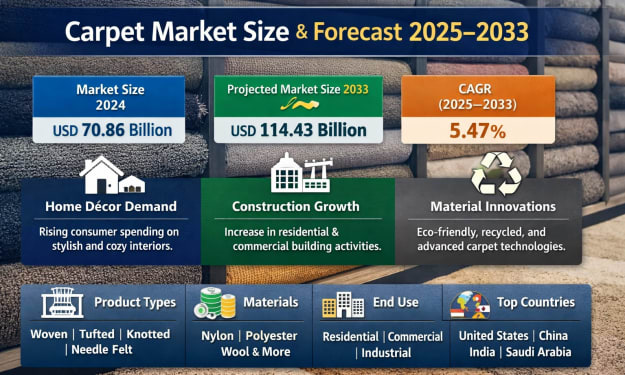
The global carpet market is witnessing steady expansion as consumer demand for comfortable, stylish, and energy-efficient flooring solutions increases worldwide. According to Renub Research, the global carpets market was valued at USD 70.86 billion in 2024 and is projected to grow from USD 74.73 billion in 2025 to USD 114.43 billion by 2033, registering a compound annual growth rate (CAGR) of 5.47% during 2025–2033.
By Sakshi Sharmaabout 2 hours ago in Trader



Comments
There are no comments for this story
Be the first to respond and start the conversation.