
3D Printed Shoes: Gimmick or Mainstream Trend?
New trends in footwear


1. Introduction: From Concept to Retail Shelf
In the summer of 2025, when Nike officially announced the launch of the Air Max 1000 in collaboration with Zellerfeld, the sneaker world felt a tremor it hadn't experienced in years. This wasn't just another limited-edition drop; it marked the moment Additive Manufacturing Footwear finally stepped out of the laboratory "concept cabinet" and onto the mass-market "retail shelf."

Simultaneously, Zellerfeld concluded its long Beta phase, opening its platform to all designers, aiming to become the "App Store" of footwear. Across the ocean, Adidas moved beyond just printing midsoles, exploring mass production solutions for fully printed shoes.
Standing at the juncture of 2025, we ask: Is 3D printed shoes a high-end gimmick, or a mainstream trend poised to disrupt a century-old industry?
2. The Case for Mainstream Trend
The argument for 3D printing becoming mainstream rests on three pillars: technological singularity, physical performance advantages, and a supply chain revolution.
2.1 Technological Singularity: AI HALS Revolution
For years, 3D printed shoes faced two bottlenecks: slow printing speeds and weak interlayer bonding. However, with the maturation of next-gen technologies like AI HALS (AI Hindered Asynchronous Light Synthesis), these barriers are crumbling.

- Speed Revolution: Compared to early DLS technology, brands like ARKKY use AI-driven processes to adjust light intensity in real-time, increasing printing speeds by 20-100 times. This slashes production time from hours to minutes Wwd.
- Isotropic Physics: New technologies achieve "isotropic" properties, meaning the sole's tensile strength is consistent vertically and horizontally, finally meeting professional athletic durability standards.
2.2 Physical Performance: The Lattice Advantage
Why does your foot need 3D printing? The answer lies in the Lattice Structure.

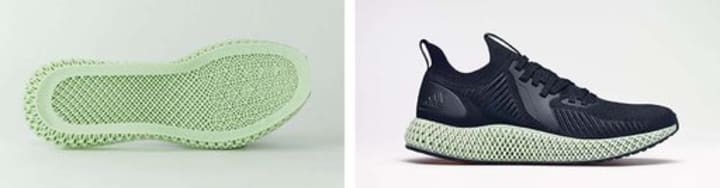
- Beyond Foam: Traditional EVA midsoles have uniform density. But your foot needs zoned support. 3D printing allows for precise "zoned mechanical performance" in a single sole. Adidas's 4DFWD series uses a Bowtie lattice to convert vertical pressure into forward momentum—a physical property impossible with traditional molds.
2.3 Supply Chain Revolution: Killing Inventory
For brands, the allure lies in On-Demand Production.

- Zero Inventory: Zellerfeld's model proves "zero inventory" is viable—user orders, printer starts, shoe ships. This eliminates the cost of deadstock.
- Market Growth: The global 3D printed footwear market is projected to grow at a CAGR of 18.9% to 19.5%, potentially exceeding $5.38 billion by 2030.
3. The Case for High-End Gimmick
Despite the promise, the skepticism is deafening.
- The Cost Barrier: At high volumes, injection molding costs just $0.78 per part, while 3D printing remains at $5.6. This 7x difference keeps 3D printed shoes as luxury items ($200-$400).
- User Experience Flaws: Issues like lack of breathability (sweaty feet), debris getting stuck in lattices, and "plastic-like" feel are common complaints on Reddit.
- Energy Consumption: Studies by AMGTA suggest that the high electricity usage of 3D printing can sometimes negate its material-saving benefits compared to efficient traditional manufacturing.
4. Conclusion: Hybrid is the Endgame
The future is Hybrid Manufacturing. Combining traditional breathable uppers with 3D printed performance midsoles offers the best of both worlds. With innovations like Nike's "Direct printing to fabric" patent Google, 3D printing is evolving from a novelty into an integrated manufacturing tool.
About the Creator
3DPrinting
I am a technician in the 3D printing industry, and I am interested in the application of 3D printing in various fields.
Keep reading
More stories from 3DPrinting and writers in Trader and other communities.
Innovative Designs: The Future of 3D Printed Shoes
The world of footwear is on the brink of a revolution. With the advent of 3D printing technology, shoes are no longer just about fashion and function; they are becoming a fusion of art, science, and technology. This transformation is not only reshaping how shoes are made but also redefining what they can be. From 3D printed pointe shoes to bespoke designs like Arkky 3D printed shoes, the future of footwear is exciting and full of possibilities. These innovations promise not only to enhance performance and aesthetics but also to address sustainability issues that have long plagued the industry.
By 3DPrinting4 months ago in Styled
Dow Jones Insights: How to Spot Early Market Trends Before They Explode
Dow Jones is one of the most important market indicators in the world. Every day, investors watch Dow Jones to see how big U.S. companies are performing. Most people only notice the daily gains or losses. But hidden inside Dow Jones are early trends that reveal opportunities long before the news catches up. They will explore these Dow Jones insights, show why they matter, and explain simple ways to track early market trends. For more beginner-friendly strategies, check out our guide on Stock Market Tips for Beginners.
By hamza mirza6 days ago in Trader
Review of 'Man on the Run'
My wife and I saw Man on the Run, a nearly 2-hour documentary on Amazon Prime, about Wings, Paul McCartney's group that flew around the world from shortly after The Beatles broke up in early 1970 to shortly after John Lennon was murdered at the end of 1980, making a Beatles reunion forever impossible.
By Paul Levinsonabout 24 hours ago in Beat


Comments
There are no comments for this story
Be the first to respond and start the conversation.