
Workforce Management Market Size & Forecast (2026–2034)
AI-Driven Workforce Optimization, Cloud Adoption, and Compliance Pressures Reshape Global Labor Management

Introduction
The workforce management (WFM) market is entering a decisive phase of transformation as organizations worldwide adapt to evolving labor structures, digital HR ecosystems, and regulatory complexity. According to Renub Research, the global workforce management market, valued at US$ 11.43 billion in 2025, is projected to reach US$ 22.51 billion by 2034, expanding at a compound annual growth rate (CAGR) of 7.82% from 2026 to 2034.
This steady growth trajectory reflects a structural shift in how enterprises manage labor productivity, compliance, and employee engagement. Rising labor costs, persistent talent shortages, hybrid work models, and growing expectations for flexibility are compelling organizations to move beyond manual workforce processes. In response, workforce management platforms have evolved into intelligent, cloud-based systems that integrate analytics, automation, and real-time decision-making.
As workforce dynamics become more complex across industries such as retail, healthcare, manufacturing, logistics, and education, WFM solutions are emerging as a mission-critical layer of enterprise digital infrastructure.
Workforce Management Market Outlook
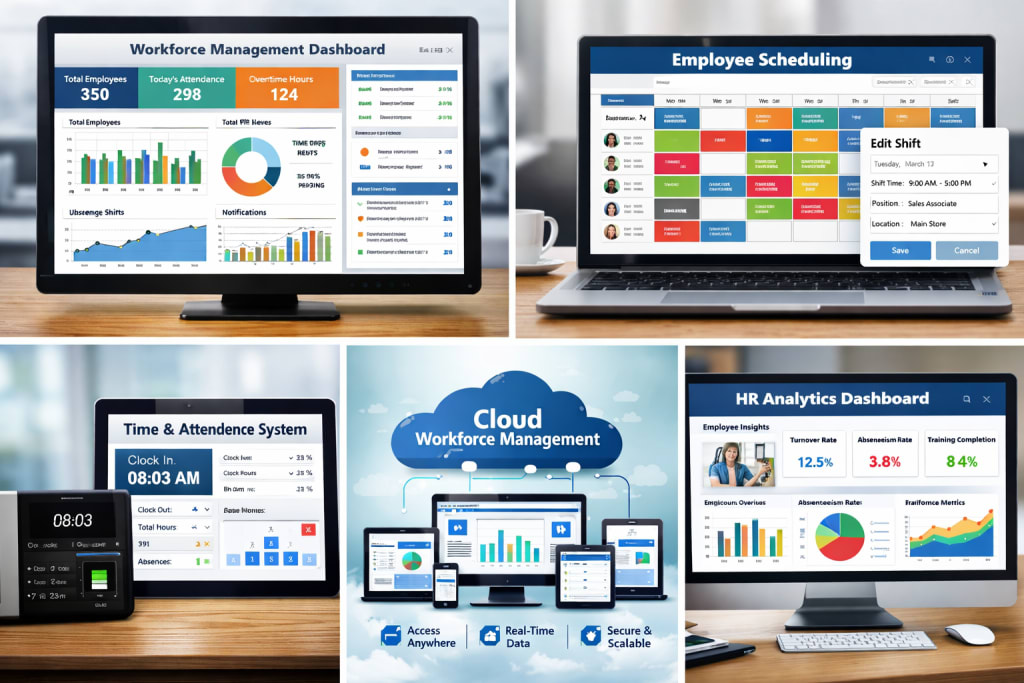
Workforce management refers to the processes, software, and analytical tools used by organizations to plan, monitor, and optimize employee productivity while ensuring regulatory compliance. Core functions include time and attendance tracking, workforce scheduling, labor forecasting, payroll integration, absence management, performance measurement, and compliance reporting.
Modern workforce management platforms are predominantly cloud-based, allowing organizations to monitor labor operations in real time across multiple locations. These systems help align staffing levels with operational demand, reduce unnecessary labor costs, minimize overtime risks, and improve service quality.
Beyond operational efficiency, workforce management has become a strategic capability. Enterprises increasingly rely on workforce analytics to guide decisions related to staffing models, workforce planning, employee engagement, and cost optimization. As organizations prioritize agility and data-driven operations, WFM solutions are no longer optional—they are foundational.
Growth Drivers in the Workforce Management Market
AI & Automation-Enabled Productivity Gains
Artificial intelligence and automation are redefining workforce management by replacing manual, rule-based processes with predictive and self-learning systems. AI-powered platforms automate routine tasks such as scheduling, payroll validation, exception handling, and compliance checks, significantly reducing administrative workloads.
Advanced forecasting algorithms align labor schedules with demand predictions, helping organizations eliminate overstaffing, minimize overtime, and avoid service disruptions caused by understaffing. Predictive analytics also assess absenteeism risk, labor fatigue, and workforce utilization, enabling proactive interventions.
Natural-language interfaces and chatbots further enhance usability by allowing employees to submit shift swap requests, request time off, or inquire about policies without managerial intervention. As organizations increasingly demand measurable ROI from HR technology investments, AI-driven workforce management solutions are gaining strong adoption momentum.
Mobile & Employee Self-Service Adoption
The widespread availability of smartphones has accelerated the shift toward mobile-first workforce management. Employees now expect consumer-grade digital experiences at work, particularly frontline and hourly workers.
Mobile workforce management applications allow employees to view schedules, clock in and out, accept open shifts, request leave, and swap shifts in real time. This self-service functionality reduces scheduling friction, improves transparency, and increases workforce satisfaction.
From an employer’s perspective, mobile tools provide near-real-time visibility into attendance, location, and schedule adherence. These insights enable faster operational responses, especially in industries with dynamic staffing needs such as retail and healthcare. The growing emphasis on employee experience makes mobile accessibility a critical competitive differentiator in the workforce management market.
Regulatory Complexity & Compliance Demands
Labor regulations across regions are becoming more complex, covering overtime rules, predictive scheduling mandates, paid leave requirements, and sector-specific workforce protections. Manual compliance processes expose organizations to significant financial and legal risk.
Advanced workforce management platforms embed regulatory rule engines that automatically enforce compliance, generate audit trails, and adapt to jurisdiction-specific labor laws. This capability is particularly vital for multinational organizations and highly regulated industries such as healthcare, transportation, and public services.
As governments tighten labor oversight, organizations increasingly rely on automated compliance tools to reduce exposure to penalties while maintaining workforce flexibility.
Challenges in the Workforce Management Market
Integration with Legacy Systems and Payroll Complexity
Despite technological advancements, integration remains a major hurdle. Many organizations operate customized payroll engines and legacy ERP systems that require complex, bi-directional data synchronization.
Discrepancies in time zones, pay rules, union agreements, and employee identifiers increase integration complexity. Payroll inaccuracies can directly impact employee trust and operational costs, making reliable integration essential. Successful workforce management deployments require robust APIs, audit-ready data flows, and extensive system testing.
Change Management & Employee Adoption Resistance
Technology adoption alone does not guarantee success. Workforce management systems often disrupt long-standing habits related to scheduling, timekeeping, and managerial discretion.
Employees may perceive automation as increased surveillance or reduced flexibility, while managers may resist algorithm-driven scheduling. Without effective change management, training, and transparent communication, organizations risk underutilizing even the most advanced WFM platforms.
Workforce Scheduling Management Market
The workforce scheduling segment focuses on aligning labor supply with demand forecasts while respecting labor regulations and employee preferences. Modern scheduling solutions integrate historical demand patterns, real-time operational data, worker skills, and compliance rules to generate optimized schedules.
Advanced features such as open shift marketplaces, rule-based scheduling engines, and scenario modeling help organizations respond quickly to demand fluctuations. Increasingly, scheduling tools emphasize fairness and employee choice, improving retention in high-turnover industries.
Workforce Time & Attendance Management Market
Time and attendance solutions capture when and where work is performed and feed accurate data into payroll systems. The market has shifted from traditional punch clocks to multi-modal systems incorporating biometric authentication, geofencing, kiosks, and mobile check-ins.
Automated overtime calculations, exception reporting, and audit trails simplify payroll reconciliation and compliance. Industries such as manufacturing and healthcare require advanced configurations to accommodate certifications, break policies, and union agreements, driving continued demand for sophisticated timekeeping solutions.
Workforce Management Service Market
As workforce management platforms grow more complex, many organizations rely on specialized service providers for implementation, configuration, and ongoing optimization. Workforce management services include consulting, system integration, data migration, managed services, and compliance optimization.
Managed services are especially attractive to organizations with limited internal HR or IT resources or complex regulatory environments. Continuous optimization services ensure forecasting models, schedules, and compliance rules remain aligned with evolving business needs.
Workforce Management Cloud Market
Cloud-based workforce management has become the dominant deployment model due to scalability, lower upfront costs, and continuous innovation. SaaS platforms provide centralized policy enforcement, rapid compliance updates, and seamless integrations across distributed workforces.
Cloud deployment supports seasonal scaling, remote teams, and multi-site operations while enabling real-time analytics and faster feature rollouts. Hybrid architectures and configurable security controls address data residency and integration concerns, further accelerating cloud adoption.
Industry-Specific Workforce Management Trends
Retail Workforce Management Market
Retail workforce management addresses high demand variability driven by promotions, holidays, and omni-channel fulfillment. Solutions integrate POS, inventory, and e-commerce systems to align labor with both in-store and online demand.
Mobile apps enable shift trading and rapid response to demand spikes, while compliance tools manage youth labor laws and complex pay premiums. The growth of click-and-collect models has intensified the need for real-time workforce visibility.
Healthcare Workforce Management Market
Healthcare workforce management prioritizes patient safety, regulatory compliance, and clinician well-being. Scheduling tools must account for certifications, shift limits, recovery periods, and specialty coverage.
Predictive models forecast demand using admissions data and seasonality, while time and attendance systems track overtime and on-call pay. Advanced analytics increasingly address clinician burnout by improving schedule equity and flexibility.
Education Workforce Management Market
Educational institutions face unique scheduling challenges involving academic calendars, adjunct faculty, substitutes, and student workers. Workforce management solutions integrate course scheduling, classroom utilization, and funding constraints.
K-12 systems manage substitute pools and transportation schedules, while higher education balances salaried faculty and hourly labor. Seasonal staffing forecasting further drives adoption.
Regional Market Insights
United States Workforce Management Market
The U.S. workforce management market is among the most mature globally. Organizations across retail, healthcare, manufacturing, and logistics adopt advanced WFM solutions to manage labor shortages, rising wages, and complex regulations.
AI-driven forecasting, mobile self-service, and automated compliance are increasingly standard, with employee experience playing a central role in retention strategies.
United Kingdom Workforce Management Market
The UK market emphasizes compliance with working time regulations, flexible working practices, and data protection. Cloud-based solutions dominate, particularly among mid-sized organizations seeking rapid deployment and cost efficiency.
Retail, healthcare, and public sector adoption remains strong, driven by labor cost control and service quality improvement initiatives.
China Workforce Management Market
China’s workforce management market is expanding rapidly due to large-scale manufacturing, logistics, and service workforces. Mobile-first platforms and real-time analytics are critical, given high smartphone penetration and shift-based labor structures.
Local compliance requirements and regional labor policies drive demand for configurable, scalable WFM solutions.
Brazil Workforce Management Market
Brazil’s market growth is fueled by increasing digital HR adoption across retail, logistics, and customer service sectors. Compliance with labor laws is a major driver, as penalties for non-compliance can be severe.
Cloud-based and mobile solutions are gaining traction, although budget constraints remain a challenge for smaller organizations.
Saudi Arabia Workforce Management Market
Saudi Arabia’s workforce management market is expanding alongside economic diversification and workforce modernization initiatives. Industries such as construction, healthcare, tourism, and government services increasingly adopt digital WFM platforms.
Managing diverse, multi-site workforces and complying with localization policies drive demand for scalable, cloud-based solutions with strong compliance capabilities.
Market Segmentation Overview
By Solution:
Time & Attendance Management, Workforce Scheduling, Embedded Analytics, Absence Management, Others
By Component:
Software, Services
By Deployment:
On-Premises, Cloud, Hybrid
By End Use:
IT & Telecom, BFSI, Government, Retail, Healthcare, Education, Manufacturing, Others
By Geography:
North America, Europe, Asia Pacific, Latin America, Middle East & Africa
Final Thoughts
The workforce management market is transitioning from operational support to strategic intelligence. As organizations navigate hybrid work models, regulatory pressures, and labor cost volatility, WFM platforms are becoming essential decision-making tools.
With strong growth projected through 2034, driven by AI, mobile self-service, and cloud adoption, workforce management solutions will play a central role in shaping the future of work. Organizations that invest early in intelligent, employee-centric workforce management systems will be best positioned to achieve sustainable productivity, compliance, and workforce resilience in the years ahead.
About the Creator
Tom Shane
Tom Shane is a content writer specializing in SEO-driven blogs, product descriptions, and thought leadership. He crafts engaging, research-backed content that connects with audiences and drives results.
“Storm on Ice: Why the U.S. Deployment of ICE Agents to the Winter Olympics Has Sparked Italian Fury”
the 2026 Winter Olympics in Milan and Cortina d’Ampezzo draw near, an unexpected diplomatic storm has erupted — not over medals or weather, but over the proposed involvement of U.S. federal agents from Immigration and Customs Enforcement (ICE) in security operations on Italian soil. What began as a technical announcement of logistical support has swiftly spiraled into one of the most contentious pre‑Games controversies yet, triggering sharp criticism from political leaders, civil society, and ordinary Italians who see the move as deeply incompatible with Italian values and Olympic ideals. �
By Ayesha Lashari7 days ago in The Swamp




Comments
There are no comments for this story
Be the first to respond and start the conversation.