
Why Your Phone Battery Drops Faster When You’re Not Using It
Standby Drain Explained Without Technical Confusion

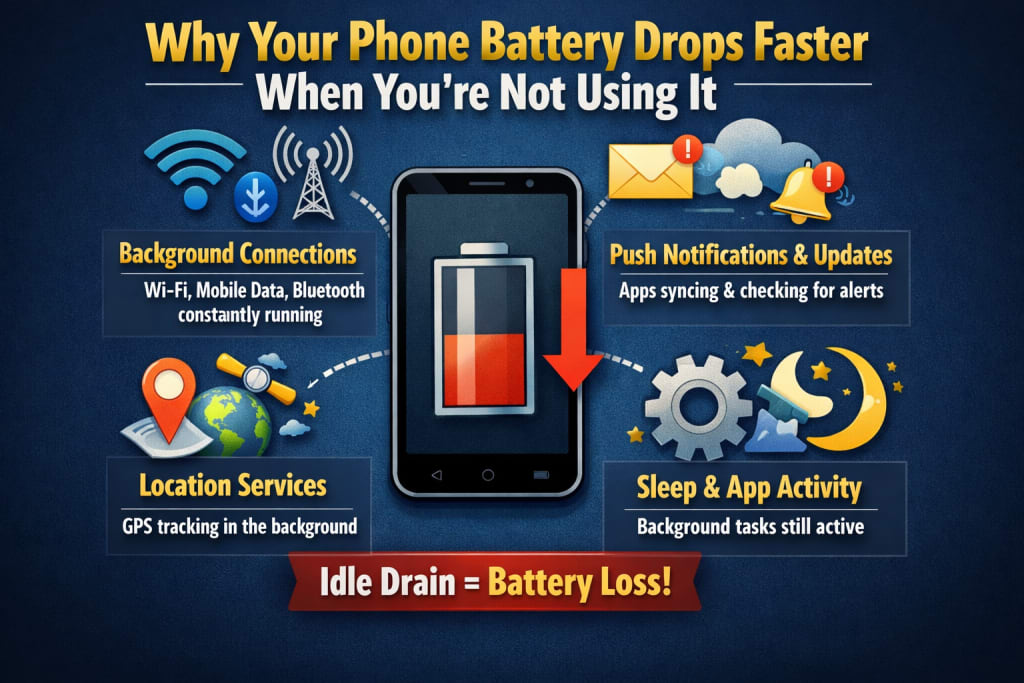
Few things feel more bothersome than this.
You charge your phone.
You put it down.
You don’t use it much.
Later, you take it up—and the battery is already down.
No gaming.
No videos.
No heavy applications.
Just battery loss when doing “nothing.”
Most people assume:
the battery is damaged
the phone is old
something is secretly incorrect
In actuality, standby battery drain is one of the most misunderstood phone behaviors—and it has very little to do with active usage.
“Idle” Phones Are Not Actually Idle
When you’re not using your phone, it doesn’t shut off.
It remains vigilant.
In standby mode, your phone still:
listens for calls and texts
maintains network connections
syncs data softly
tracks location changes
prepares notifications
This low-level activity is normal—but when it adds up, battery diminishes quicker than anticipated.
Network Signal Is the Biggest Standby Drainer
Poor or unreliable signal eats more battery than screen use.
When signal is poor, your phone:
improves antenna power
retries connections
changes between towers
keeps radios active longer
This occurs even when the screen is off.
That’s why phones lose more battery:
indoors
at work
while travel
in elevators or basements
Your phone isn’t squandering power—it’s trying to remain connected.
Background Sync Happens When You’re Not Looking
Apps pick standby time to work.
While the phone is idle, apps:
upload pictures
sync messages
refresh content
back up data
check for updates
These duties are spaced out to prevent bothering you—but battery still pays the penalty.
Some days, more synchronization occurs than others.
That’s why standby drain seems erratic.
Notifications Wake the Phone More Than You Think
Each notification:
awakens the processor
activates network radios
illuminates the screen temporarily
causes system animations
Even if you don’t touch the phone.
More alerts = more wake-ups = greater drain.
Phones with significant notification traffic lose power quicker in standby.
Location Services Don’t Fully Sleep
Many applications seek background location access.
Even when you’re not utilizing them, they:
check movement
record location changes
update geofenced triggers
These modest inspections pile up over hours.
Location utilization is one of the quietest yet most persistent standby drains.
Updates and Maintenance Prefer Idle Time
Phones conduct maintenance while you’re not using them.
This includes:
system optimization
app updates
security checks
file re-indexing
Idle time seems like “free time” to the system.
Battery drain rises not because anything is wrong—but because work is being done.
Why Standby Drain Feels Worse Overnight
At night:
phones are idle longer
backups and updates run
charging heat may linger
network circumstances change
If the phone remains warm or problems with signal, standby drain rises.
That’s why battery declines more overnight than during vigorous daily usage.
Why Battery Saver Doesn’t Always Help
Battery saver restricts visible behavior.
It doesn’t stop:
network struggle
background sync
system maintenance
signal retries
So standby drain may persist even with battery saver engaged.
The reason isn’t usage—it’s environment and background demand.
What Actually Reduces Standby Drain
You don’t need drastic measures.
These instructions assist most users:
minimize unwanted notifications
restrict background location access
prohibit background activity for unused applications
utilize steady Wi-Fi where feasible
avoid poor signal areas overnight
The aim isn’t silence—it’s stability.
Why This Doesn’t Mean Your Battery Is “Bad”
Battery health diminishes gradually.
Sudden standby drain changes are usually always behavioral, not physical.
If your phone still:
charges usually
lasts while active usage
doesn’t overheat
The battery is likely OK.
The Mental Trap of Watching Percentages
Constantly monitoring battery percentages causes anxiety.
Standby drain feels worse when watched attentively.
Understanding why it occurs decreases irritation more than monitoring statistics ever would.
Final Reflection
Your phone isn’t depleting battery because it’s idle.
It’s eating battery since idle time is when phones conduct their silent job.
Once you understand it, standby drain stops seeming mysterious—and begins feeling manageable.
Phones don’t waste energy.
They squander it while you’re not looking.
Disclaimer
This article represents my observations and general smartphone standby behavior. Battery performance may vary based on device, software version, network circumstances, and app use.

About the Creator
abualyaanart
I write thoughtful, experience-driven stories about technology, digital life, and how modern tools quietly shape the way we think, work, and live.
I believe good technology should support life
Abualyaanart
Keep reading
More stories from abualyaanart and writers in The Swamp and other communities.
Trump Pushes for a 1-Year, 10% Cap on Credit Card Interest Rates — and Banks Push Back
In a move that has reignited debate over consumer protection and financial regulation, former U.S. President Donald Trump has floated a proposal to cap credit card interest rates at 10% for one year. The idea is simple on its surface: provide immediate relief to millions of Americans struggling under high-interest debt. But the reaction from banks and financial institutions has been swift and hostile, revealing deep divisions over how the U.S. credit system should function. At a time when credit card interest rates in the United States routinely exceed 20% and, in some cases, climb above 30%, Trump’s proposal strikes a populist chord. Yet critics argue that such a cap could disrupt lending markets, reduce credit availability, and create unintended economic consequences. So why is Trump pushing this plan, why are banks balking, and what could it mean for consumers? Why Credit Card Interest Rates Are Under the Spotlight Over the past few years, American households have increasingly relied on credit cards to cope with inflation, rising rent, and higher everyday expenses. As the Federal Reserve raised benchmark interest rates to fight inflation, credit card APRs surged alongside them. For many consumers, this has meant: Growing balances that are harder to pay down Monthly interest charges that exceed minimum payments A cycle of debt that feels nearly impossible to escape Against this backdrop, Trump’s proposal taps into widespread frustration. By capping interest rates at 10% for a limited, one-year period, the plan aims to give borrowers breathing room and slow the growth of household debt. The Political Strategy Behind the Proposal Trump has long positioned himself as a champion of “forgotten” or financially stressed Americans. This proposal fits neatly into that narrative, allowing him to argue that he is standing up to powerful banks on behalf of everyday consumers. Politically, the idea is strategic: It appeals to working-class voters burdened by debt It contrasts sharply with what many see as Wall Street-friendly policies It reframes economic debate around fairness rather than market efficiency Even though the proposal is temporary, its symbolism is powerful. A one-year cap suggests urgency without committing to a permanent overhaul of the credit system, making it easier to sell to voters while still appearing bold. Why Banks Are Pushing Back Hard Financial institutions wasted no time expressing concern. From their perspective, a 10% cap—especially one imposed quickly—poses serious risks. Banks’ main arguments include: 1. Reduced profitability Credit cards are one of the most profitable products for banks. Interest revenue helps offset defaults, fraud, and operational costs. A sharp cap would significantly reduce margins. 2. Higher risk, lower reward Banks argue that high interest rates compensate for lending to higher-risk borrowers. If rates are capped, they may simply stop offering credit to those consumers. 3. Less access to credit Rather than lowering rates, banks could tighten approval standards, leaving many Americans—especially those with lower credit scores—without access to credit at all. 4. Market interference concerns The banking industry maintains that interest rates should reflect market conditions, not political decisions. They warn that government-imposed caps distort lending behavior. In short, banks claim the proposal could hurt the very people it intends to help. Would Consumers Actually Benefit? For consumers carrying balances, the immediate benefits are obvious. A 10% cap could: Dramatically reduce monthly interest charges Help borrowers pay down principal faster Prevent balances from ballooning However, the longer-term impact is less clear. If banks respond by: Cutting credit limits Closing accounts Rejecting new applicants Then access to short-term credit could become more limited, particularly for lower-income households. Still, supporters argue that the current system already fails many consumers. With interest rates exceeding 25%, critics say the credit card market borders on exploitative, especially when borrowers are already financially vulnerable. How This Fits Into the Broader Economic Debate Trump’s proposal revives a long-standing debate in U.S. politics: Should there be a legal limit on how much lenders can charge? Historically, usury laws capped interest rates at the state level. Over time, deregulation and federal preemption weakened those limits, allowing banks to charge far higher rates nationwide. The proposal also intersects with broader questions about: Corporate responsibility Income inequality The role of government in regulating financial markets Supporters see the cap as overdue consumer protection. Opponents see it as economic overreach with potentially destabilizing effects. Is the Proposal Likely to Become Law? Realistically, the chances of this policy being enacted in its current form are slim—at least in the short term. Implementing a nationwide cap would require congressional support and face intense lobbying from the financial industry. However, even if it never becomes law, the proposal serves another purpose: shifting the conversation. By putting credit card interest rates front and center, Trump has forced policymakers, banks, and the public to confront an issue that often receives little attention. In that sense, the plan may already be achieving one of its goals. What Happens Next? As banks continue to push back and economists debate the consequences, consumers are watching closely. Whether through legislation or public pressure, calls for relief from high credit card interest rates are unlikely to fade. Trump’s proposal may be temporary, controversial, and politically charged—but it highlights a reality many Americans live with every day: debt is expensive, and the system often feels stacked against borrowers. Even if the 10% cap never materializes, the question remains: how long can sky-high interest rates persist before meaningful reform becomes unavoidable?
By Muhammad Hassanabout 18 hours ago in The Swamp
The steps to losing a child
Step One: Lose a child. Not what anyone wants to happen and nothing you can do to change it, but you can go through steps to becoming happy again. You can go through steps to loving again. You can go through steps to become a new you because after losing a child you will never be the same person you once were.
By Tabitha Hinkley3 days ago in Fiction


Comments
There are no comments for this story
Be the first to respond and start the conversation.