
Why Trump Happened
The True Issue Behind the Rise of Trump
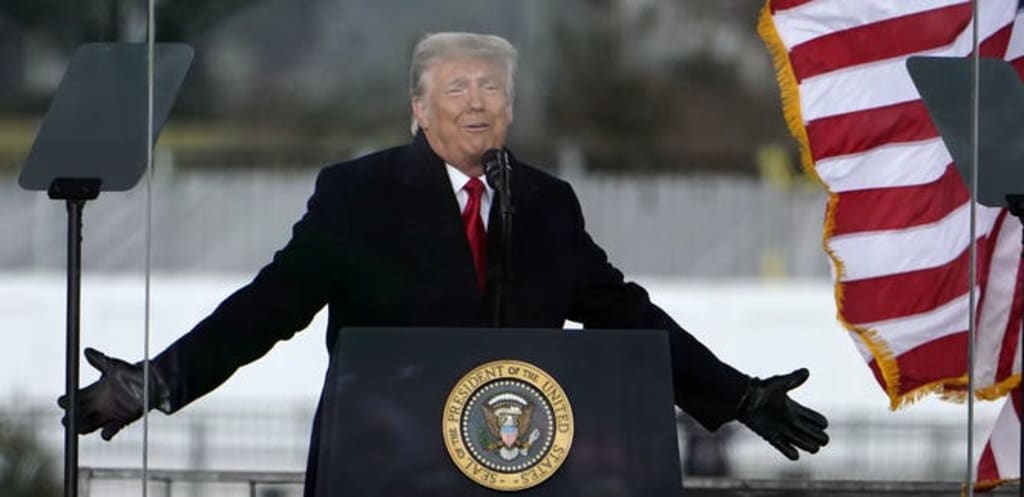
Love him or hate him, it is undeniable that President Trump has dominated the United States political landscape like few politicians before him. More than Ronald Reagan. More than JFK. More than every President since FDR. But why? What allowed for Donald J. Trump to rise to power?
To understand the Trump Movement we need to understand the broader context of how governments are formed and evolve.
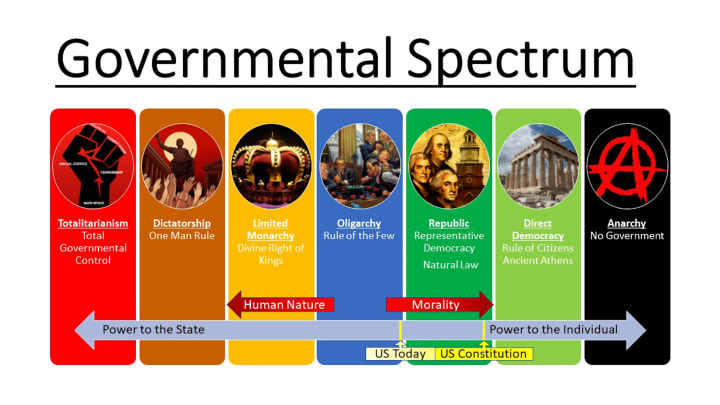
While there are many subtypes, there are 7 base forms of government that humans have employed throughout history: Anarchy, Direct Democracy, Republics, Oligarchy, Monarchy, Dictatorships, and Totalitarianism. In essence, they range from No One Rules Anything (Anarchy) to One Man Rules Everything (Totalitarianism). And nations have evolved and devolved moving from one form to another for centuries.
The Founding Fathers studied these types of governments while writing the US Constitution. They looked at the Direct Democracy of the Ancient Greeks in Athens, but found that an Athens-style democracy can easily be transformed into a totalitarian state through a "tyranny of the majority." The Founders understood this and looked for a better way.
They created a Republic that would both protect the minority from the majority through the 7 Basic Principles of the Constitution: Popular Sovereignty, Limited Government, Separation of Powers, Checks and Balances, Judicial Review, Federalism, and Republicanism.
Popular Sovereignty is the idea that the government draws its power from the people.
Limited Government is important because the Founding Fathers believed a smaller government has less risk of becoming a tyranny.
Separation of Powers is the idea that a Government's power should be split up between different branches so as to not give one central leader too much power.
Checks and Balances work hand-in-hand with the Separation of Powers to prevent the accumulation of power in only one branch.
Judicial Review is the idea that is an exertion of the Checks and Balances where the actions of the Legislative and Executive branches are subject to review from the Judicial branch.
Federalism is the concept where many smaller bodies are bound by some sort of agreement with a government to keep them together. This was to counteract the biggest defect of The Articles of Confederation, the document that the US Constitution was replacing (the 'more perfect union' statement in the preamble is referencing document).
Republicanism is the idea that the people have the power in government through Representatives, who represent the people's opinions in the law-making process so that the government cannot reign with tyrannical power.
Looking at the chart above, you can see where the US Constitution resides. It, as written, is on the individual side of a republic. However, over the last 100 years or so, the United States has drifted away from the principles behind the Constitution and has drifted into Oligarchy. Most of this drift has been for seemingly good causes: social safety nets, social justice, and income equality.
However, about half of the population has felt this drift into Oligarchy. They do not like where it has taken the country. To them, we were abandoning the Founding Fathers and the US Constitution. Furthermore, the party that they thought represented them, The Republican Party, had become part of the problem (part of the oligarchy) and turned a blind eye.
Trump sensed this. He did not call it an oligarchy. He called it "the Swamp." He was outside the Swamp and he promised to "drain the Swamp." This group turned to Trump in 2016 and remained with him in 2020 no matter how he behaved.
And he acted on their concerns. He rolled back the governmental power over the economy by reducing regulations and the economy boomed. He appointed Originalist Judges to strengthen the Constitution in the court system. He even curtailed one of the centers of power in Washington DC, the State Department, as well as the Pentagon by pulling us out of many military engagements. Additionally, Trump is the first President since Coolidge to not get us involved in a new war during his term. These are things that even liberal Americans have been asking for for years.
And this entrenched him with the group of Americans who feel the US Constitution is slipping away. So even after the events of January 6th, 2021, where protesters stormed the US Capital, this problem is not going away. We must address the drift away from the US Constitution. Are the social safety nets and social justice reforms worth the increased power of the government and the increased chance of tyranny? What are ways to maintain these social reforms while preserving the US Constitution?
We need this discussion to happen. The alternative is continued divide in the country.
About the Creator
Keep reading
More stories from writers in The Swamp and other communities.
The Forsyth House Fire
Since 1851, Forsyth House has stood on the corner of Union Street and Gordon Street in the heart of Glasgow. Its iconic, or was... because on Sunday 8th of March, 2026, a fire broke out in a small, seemingly un-named shop in the building and tore all that history down. As I write, the rubble is still unsettled and the street is still blocked off. Central Station is quiet on the upper level, and around 30 small businesses have quite literally gone up in smoke.
By S. A. Crawford2 days ago in The Swamp



Comments
There are no comments for this story
Be the first to respond and start the conversation.