
Why Notifications Feel More Stressful Than Useful Now
The Ping That Never Stops
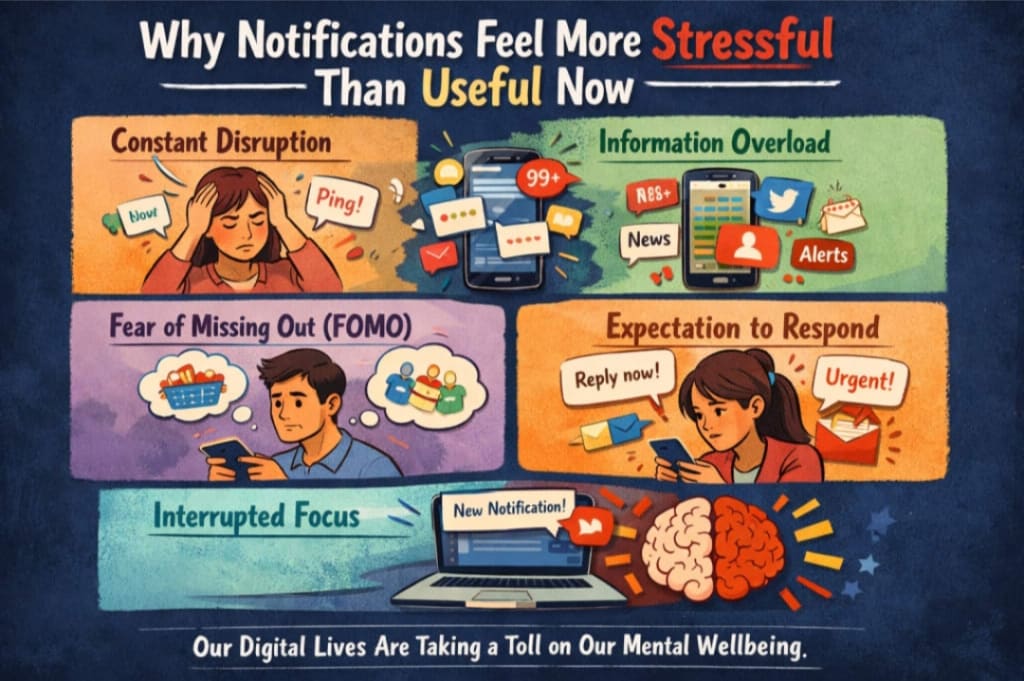
Once upon a time, notifications were helpful. A message alert meant someone needed us. A calendar reminder kept us organized. A breaking news alert informed us of something important. Today, however, notifications feel less like assistance and more like intrusion.
The constant buzzing, pinging, and flashing of our devices has transformed attention into a battlefield. What was designed to help us stay connected now often leaves us overwhelmed, distracted, and stressed.
From Convenience to Cognitive Overload
Notifications were created to reduce friction in communication. Instead of checking apps repeatedly, information came to us. But as platforms multiplied, so did alerts. Emails, messages, social media, work tools, fitness apps, shopping apps, and even household devices now compete for our attention.
Each notification may seem minor, but together they create cognitive overload. Our brains are forced to switch contexts repeatedly, interrupting focus and increasing mental fatigue. Over time, this constant disruption wears us down.
The Illusion of Urgency
Most notifications are framed as urgent—even when they are not. Red badges, vibration patterns, and alert tones are carefully designed to trigger immediate responses. This creates a sense of constant pressure, as if every message demands action right now.
In reality, few notifications are truly time-sensitive. Yet our bodies react as if they are. Stress hormones spike, attention narrows, and relaxation becomes difficult. We remain in a low-level state of alert, even during moments meant for rest.
Designed to Capture Attention
Notifications are not accidental. They are a core feature of the attention economy. Apps are engineered to pull users back in, increase engagement, and maximize screen time. Notifications serve as digital hooks, reminding us of unfinished conversations, unread updates, or potential rewards.
This design exploits basic human psychology—our desire for connection, validation, and novelty. Over time, we become conditioned to respond reflexively, often without conscious choice.
Blurring Work and Personal Life
One major reason notifications feel more stressful today is the collapse of boundaries between work and personal life. Emails, work chats, and project updates now follow us home, into evenings and weekends.
There is no clear “off” switch. Even when we are not actively working, the possibility of interruption lingers. This constant availability erodes recovery time, contributing to burnout and chronic stress.
Notifications turn rest into a fragile state, easily broken by a single buzz.
The Cost to Focus and Creativity
Deep focus requires uninterrupted time. Yet notifications fracture attention into fragments too small for sustained thinking. Each interruption carries a cost—not only in lost time but in mental energy required to refocus.
Studies show that even ignored notifications reduce performance. The mere presence of alerts divides attention, lowering productivity and creativity. Over time, this makes tasks feel harder and more exhausting than they should be.
Emotional Weight of Digital Noise
Notifications are not neutral. They often carry emotional weight—expectations, comparisons, and judgments. Social media alerts can trigger anxiety, envy, or fear of missing out. News notifications often deliver crises and conflict without context or resolution.
When negative or emotionally charged information arrives constantly, it amplifies stress and emotional fatigue. The result is a sense of being perpetually “on edge,” even when nothing immediate is wrong.
Quantity Over Quality
Another issue is volume. We receive far more notifications than we can meaningfully process. This abundance reduces their value. When everything is highlighted, nothing truly stands out.
Important messages get lost among promotional alerts, reminders, and algorithmic nudges. Instead of clarity, we experience noise. Instead of usefulness, we feel drained.
Reclaiming Control
Despite the stress notifications cause, they are not inherently harmful. The problem lies in imbalance. Reclaiming control begins with intentional choices: disabling nonessential alerts, setting quiet hours, and separating work notifications from personal ones.
Curating notifications transforms them from constant interruptions into selective tools. Fewer alerts mean greater clarity—and a stronger sense of agency over one’s attention.
A Cultural Shift in Progress
On a broader level, our relationship with notifications reflects a cultural shift. Productivity, responsiveness, and availability are often valued more than presence and well-being. Until these priorities change, digital stress will remain a common experience.
Recognizing that attention is a finite resource is a crucial step. Protecting it is not laziness—it is necessary for mental health, creativity, and meaningful connection.
Conclusion
Notifications were meant to serve us. Today, many feel like they control us instead. Their constant presence fragments attention, heightens stress, and erodes boundaries between work, rest, and life.
The solution is not total disconnection but intentional engagement. By choosing which notifications deserve our attention—and when—we can restore balance.
In a world that constantly calls for our focus, learning when not to respond may be the most valuable skill of all.
About the Creator
Keep reading
More stories from Aarif Lashari and writers in The Swamp and other communities.
An Interview With the President Inside the Oval Conversation: Power, Pressure, and the Path Forward
The Oval Office is more than a workspace. It is a symbol of authority, responsibility, and the immense weight of decision-making. Every conversation held inside its curved walls carries echoes of history, power, and consequence. An interview with the president in this setting is not merely a dialogue—it is an encounter with the realities of leadership under constant pressure.
By Aarif Lasharia day ago in The Swamp
Kianna Underwood
In an entertainment industry that often defines young talent by a single platform or breakout moment, Kianna Underwood represents a refreshing shift. Rather than being boxed into one label, she is steadily shaping a multifaceted identity built on creativity, adaptability, and authenticity. While many audiences first associate Kianna Underwood with Nickelodeon, her journey reflects far more than a network credit—it highlights the evolving path of modern entertainers who balance visibility with personal growth. From early exposure to mainstream media to her expanding presence beyond traditional television, Kianna Underwood’s story mirrors the changing landscape of youth entertainment. Early Ambitions and Creative Foundations Like many performers drawn to acting and media at a young age, Kianna Underwood’s passion didn’t emerge overnight. Her early interest in storytelling, performance, and self-expression laid the groundwork for future opportunities. Rather than chasing fame, she focused on learning how to communicate emotion, connect with audiences, and adapt to different creative environments. These formative years helped her develop discipline—an often overlooked quality in young performers. Whether through acting, creative collaboration, or on-camera experience, Kianna learned that consistency and preparation matter just as much as natural talent. Kianna Underwood and Nickelodeon: A Defining Chapter For many viewers, Kianna Underwood Nickelodeon is the phrase that first brings recognition. Nickelodeon has long served as a launchpad for young performers, offering not only visibility but also structured environments where emerging talent can learn the mechanics of television production. Being associated with Nickelodeon places Kianna Underwood within a legacy network known for shaping cultural moments for younger audiences. The experience exposed her to fast-paced production schedules, collaborative storytelling, and the responsibility of creating content that resonates with families and children alike. However, what sets Kianna apart is her understanding that Nickelodeon is a chapter—not the entire book. Rather than relying solely on network recognition, she has used the experience as a stepping stone toward broader creative goals. Navigating Life After the Spotlight One of the biggest challenges young actors face is transitioning beyond early exposure. The entertainment industry moves quickly, and staying relevant requires adaptability. Kianna Underwood’s approach reflects maturity beyond her years—she recognizes the importance of growth, reinvention, and long-term vision. Instead of chasing immediate validation, she has shown interest in expanding her skills. This includes exploring creative avenues that allow more personal expression, whether through digital platforms, collaborative projects, or behind-the-scenes learning. In today’s media ecosystem, versatility is power, and Kianna seems aware of that reality. Her journey highlights an important truth: success is not always loud. Sometimes it unfolds quietly through deliberate choices and steady progress. Representation and Relatability Audiences today connect most strongly with individuals who feel genuine. Kianna Underwood’s appeal lies in her relatability—she doesn’t present herself as untouchable or overly curated. This authenticity is especially important for younger viewers who look to public figures as examples rather than idols. By staying grounded, Kianna contributes to a healthier representation of young talent in media. She demonstrates that it’s possible to participate in major platforms like Nickelodeon while still maintaining individuality and balance. This grounded presence helps her stand out in an industry that often prioritizes image over substance. The Influence of Nickelodeon on Career Development Working with Nickelodeon provides more than screen time—it offers mentorship, structure, and exposure to industry standards. For Kianna Underwood, this experience likely played a key role in shaping her professionalism and creative confidence. Nickelodeon alumni often speak about the importance of teamwork and discipline learned during their time with the network. These lessons tend to carry forward, influencing how performers approach future opportunities. Kianna Underwood’s association with Nickelodeon places her within that tradition of growth-focused development rather than short-term stardom. Looking Toward the Future As Kianna Underwood continues to evolve, her career path remains open-ended—and that’s a strength. In a world where entertainers are no longer limited to television alone, she has the opportunity to explore acting, digital media, advocacy, or creative entrepreneurship. What matters most is intention. Rather than being defined solely by “Kianna Underwood Nickelodeon,” she has the chance to redefine what success looks like on her own terms. Whether she chooses to remain in front of the camera or expand into other creative roles, her foundation positions her well for sustainable growth. A New Model for Young Talent Kianna Underwood represents a new generation of entertainers—one that values balance, authenticity, and purpose. Her journey reminds audiences that early recognition doesn’t have to dictate an entire career. With thoughtful choices and continued self-discovery, she exemplifies how young creatives can navigate fame without losing themselves in it. As the entertainment industry continues to change, stories like Kianna Underwood’s offer a hopeful perspective. They show that talent, when paired with self-awareness and patience, can lead to meaningful and lasting impact. In the end, Kianna Underwood is more than a name associated with Nickelodeon. She is a developing creative voice—one that reflects where youth entertainment is headed, and why authenticity matters more than ever
By Saboor Brohi about 7 hours ago in The Swamp




Comments
There are no comments for this story
Be the first to respond and start the conversation.