
Why Is Maryland Powering Virginia’s Data Centers Instead of Building a Smarter Grid?
While Europe and Asia invest in sodium-ion batteries and micro nuclear reactors, U.S. regulators stall innovation—and Marylanders foot the bill.

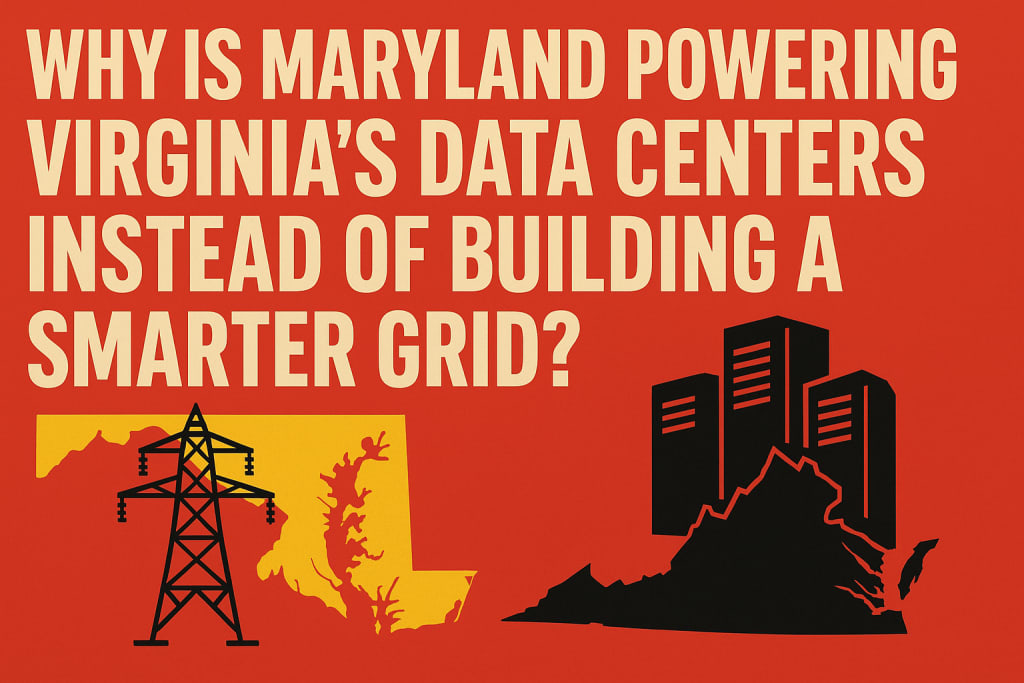
The story is as maddening as it is predictable: Marylanders could end up paying $800 million to power Virginia's data center boom—a surge of AI-driven server farms whose insatiable appetite for electricity is pushing our grid to its limits. Meanwhile, cutting-edge solutions like sodium-ion batteries and micro nuclear reactors, widely adopted in Europe and Asia, remain frustratingly sidelined here in the United States.
The question isn't just why Marylanders are paying for someone else’s growth. The real question is this: Why aren’t we exploring the most advanced, scalable energy technologies available to meet our own needs?
The Data Center Dilemma
Let’s be clear: data centers are here to stay. They’re critical to everything from Google search results to medical AI. Maryland wants in on the action, especially after Governor Wes Moore passed the Critical Infrastructure Streamlining Act to attract investment. But with fossil fuel plants like Brandon Shores closing, the state’s infrastructure is being pushed to the brink.
Rather than innovate, policymakers have defaulted to an outdated, inefficient, and inequitable solution: build long-distance transmission lines to funnel electricity into the region—sometimes from hundreds of miles away. In the case of the Maryland Piedmont Reliability Project, that means 70 miles of high-voltage lines cutting across Frederick, Carroll, and Baltimore Counties. And who pays? You do—even if the juice flows straight to Virginia.
Europe and Asia: Innovating Past Us
Across the Atlantic and Pacific, nations are doing the opposite. Sweden’s Northvolt and China’s BYD are scaling sodium-ion batteries—a cheaper, more sustainable alternative to lithium-ion. These batteries are non-toxic, abundant, and already being deployed for grid-scale energy storage.
Meanwhile, China, the UK, and even tiny Sweden are racing ahead with micro nuclear reactors—safe, modular power generators that can produce energy 24/7 without emissions. These reactors can sit on-site at data centers, military bases, or remote communities—no massive power lines needed, no $800 million ratepayer gift required.
China even hit a milestone in April 2025 by refueling a thorium reactor without shutting it down, showing just how far the global innovation gap has widened.
Why Is the U.S. So Far Behind?
Let’s talk brass tacks.
- Regulatory Paralysis: In the U.S., new nuclear technology must crawl through a labyrinth of outdated NRC regulations designed for 1970s-era plants. Microreactors are treated with the same suspicion as full-scale fission monsters.
- Energy Policy Tunnel Vision: Politicians keep pumping tax credits into wind and solar while ignoring nuclear and sodium-ion technologies that are more reliable, scalable, and safer long-term.
- Lithium Lobby: Let’s not pretend big money isn’t part of the problem. The lithium-ion battery market is deeply entrenched and resistant to disruption—even when alternatives are better for the grid and the environment.
- Cultural Fear: Thanks to a half-century of anti-nuclear propaganda, the public still associates anything with “nuclear” in the name with meltdowns, not modern, clean, closed-loop reactors.
Maryland’s Missed Opportunity
Maryland has all the ingredients to lead in energy innovation: a strong tech corridor, proximity to federal R&D, and a history of leadership in public infrastructure. But instead of pushing for on-site micro nuclear units or next-gen battery storage at our new data centers, we’re cutting checks to support Northern Virginia’s grid expansion.
This isn’t just bad policy—it’s a betrayal of Maryland’s energy independence and economic future.
Worse, it undercuts our own environmental goals. Backup diesel generators—still used by many data centers thanks to red tape around cleaner solutions—are emitting more pollutants under the guise of “green progress.”
The Right Path Forward
A right-of-center energy strategy wouldn’t throw the baby out with the clean energy bathwater. It would say:
- Let’s decouple innovation from ideology.
- Let’s fast-track microreactor permitting and pilot deployments in data-heavy corridors.
- Let’s expand battery storage beyond lithium, and start producing sodium-ion solutions domestically.
- Let’s stop subsidizing out-of-state growth and instead power our own future.
It’s time for Maryland—and America—to stop being the middleman in someone else’s energy deal. We can do better than paying to light up Virginia’s server farms. We can power our own innovation economy—if we stop playing defense and start leading with technology.
About the Creator
Michael Phillips
Michael Phillips | Rebuilder & Truth Teller
Writing raw, real stories about fatherhood, family court, trauma, disabilities, technology, sports, politics, and starting over.
Keep reading
More stories from Michael Phillips and writers in The Swamp and other communities.
Maryland’s Family Courts Are Failing Families
In theory, Maryland’s family courts are supposed to be the guardians of justice for families in crisis—handling divorce, custody, support, and domestic violence with impartiality and compassion. But in reality, they’ve become a bureaucratic maze riddled with inefficiencies, financial hurdles, and questionable practices that harm the very families they claim to protect. And despite the glossy brochures and polished websites, Maryland’s Judiciary continues to ignore the warning signs.
By Michael Phillips6 months ago in The Swamp
Time to Dump Trump? Europeans Whisper Last-Resort Options to Save Greenland
In diplomatic circles across Europe, a phrase once unthinkable is now being whispered behind closed doors: What if the alliance can’t hold? As renewed pressure from former U.S. President Donald Trump resurfaces over Greenland, European officials are reportedly discussing last-resort options to safeguard the strategically vital Arctic territory — even if it means distancing themselves from Washington. While public statements remain carefully measured, private conversations suggest a growing anxiety: Greenland has become a geopolitical fault line, testing NATO solidarity, transatlantic trust, and Europe’s ability to defend its own interests. Why Greenland Is Suddenly at the Center of Global Power Politics Greenland is not just the world’s largest island. It is a strategic prize. Located between North America and Europe, Greenland sits at the crossroads of Arctic shipping lanes, missile defense routes, and untapped reserves of rare earth minerals. As climate change melts Arctic ice, access to these routes and resources is expanding — turning the region into a global competition zone. The United States already maintains a military presence in Greenland through Thule Air Base, vital to missile warning and space surveillance. But Trump’s earlier proposal to buy Greenland outright shocked European capitals and Denmark alike, reframing the island not as a partner but as a commodity. Now, with Trump once again influencing U.S. foreign policy discourse, European leaders fear that economic pressure, security leverage, or political coercion could return. Denmark’s Dilemma and Europe’s Unease Greenland is an autonomous territory within the Kingdom of Denmark, and Copenhagen has repeatedly stated that it is not for sale. Yet Denmark alone lacks the political and military weight to counter sustained pressure from Washington. That’s where Europe enters the picture. Behind the scenes, diplomats from Germany, France, and Nordic countries are reportedly discussing how to shield Denmark and Greenland from unilateral U.S. moves. These discussions are not about confrontation — at least not yet — but about contingency planning. The uncomfortable truth is this: Europe has long relied on the U.S. for Arctic security, and challenging Washington risks exposing Europe’s own strategic weaknesses. What Are the “Last-Resort Options”? European officials are careful not to spell out these ideas publicly, but analysts point to several possibilities under quiet consideration. 1. Deepening EU Involvement in Greenland One option is stronger European Union engagement with Greenland — economically, politically, and diplomatically. This could include increased investment in infrastructure, climate research, and sustainable mining projects to reduce Greenland’s reliance on external powers. By anchoring Greenland more firmly within Europe’s economic orbit, the EU could make any U.S. attempt at leverage far more complicated. 2. Expanded European Security Presence Another option involves enhancing European defense cooperation in the Arctic, potentially through joint patrols, surveillance missions, or NATO-aligned European initiatives that do not rely solely on U.S. leadership. This would be a delicate move, as NATO cohesion depends heavily on U.S. participation. Still, some European officials believe greater autonomy is overdue. 3. Legal and Diplomatic Shields Europe could also pursue stronger legal frameworks affirming Greenland’s right to self-determination and Denmark’s sovereignty. While largely symbolic, such measures would raise the diplomatic cost of any aggressive maneuver. In extreme scenarios, coordinated diplomatic resistance — even sanctions or formal rebukes — could be considered, though most officials view this as a true last resort. Why Trump Changes the Equation European leaders are accustomed to managing disagreements with Washington. What makes Trump different is unpredictability. During his presidency, Trump repeatedly questioned NATO commitments, framed alliances as transactional, and blurred the line between negotiation and coercion. His interest in Greenland was not just strategic — it was personal, public, and disruptive. The fear in Europe is not necessarily that Trump would “take” Greenland, but that he might use U.S. security guarantees as leverage, forcing concessions through pressure rather than partnership. For European capitals already dealing with Ukraine, energy insecurity, and domestic political shifts, another transatlantic crisis is the last thing they want. Greenland’s Own Voice Amid the power politics, Greenlanders themselves are increasingly vocal. Many in Greenland support greater autonomy or eventual independence — but not annexation. Local leaders have emphasized that Greenland’s future must be decided by its people, not foreign governments. European officials privately acknowledge that ignoring Greenlandic voices would undermine their moral position. Any European strategy, they argue, must prioritize economic development, environmental protection, and self-governance, not just strategic defense. A Test for Transatlantic Relations At its core, the Greenland issue is about more than territory. It raises uncomfortable questions: Can Europe protect its interests without U.S. backing? Is NATO flexible enough to survive internal disagreements? What happens when allies no longer trust each other’s intentions? For now, European leaders are trying to avoid open confrontation, hoping that diplomacy and quiet deterrence will keep tensions from escalating. But the whispers themselves are revealing. They suggest that Europe is, for the first time in decades, seriously contemplating a future where American leadership is not guaranteed. Why This Moment Matters The Arctic is warming faster than any other region on Earth — physically and politically. What happens in Greenland could set a precedent for how global powers compete in newly accessible regions. If Europe fails to act, it risks appearing passive and divided. If it acts too forcefully, it risks fracturing the transatlantic alliance that has underpinned its security since World War II. It is a narrow path — and one that demands strategic clarity Europe has often postponed. Final Thoughts “Time to dump Trump?” may sound dramatic, but it captures a deeper unease spreading across European capitals. Greenland has become a symbol of a shifting world — one where alliances are tested, assumptions are challenged, and old guarantees no longer feel automatic. Europe is not eager for a break with Washington. But the quiet conversations suggest a realization that preparation is not betrayal. Whether these whispered last-resort options remain theoretical — or become policy — will depend on how the next phase of U.S. politics unfolds. For Greenland, Europe, and the Arctic, the stakes could not be higher.
By Muhammad Hassan2 days ago in The Swamp



Comments
There are no comments for this story
Be the first to respond and start the conversation.