
When Missiles Speak Louder Than Diplomacy
Trump’s Iran strikes, Russia and China’s WW3 warnings, and how one decision can shake the entire global balance

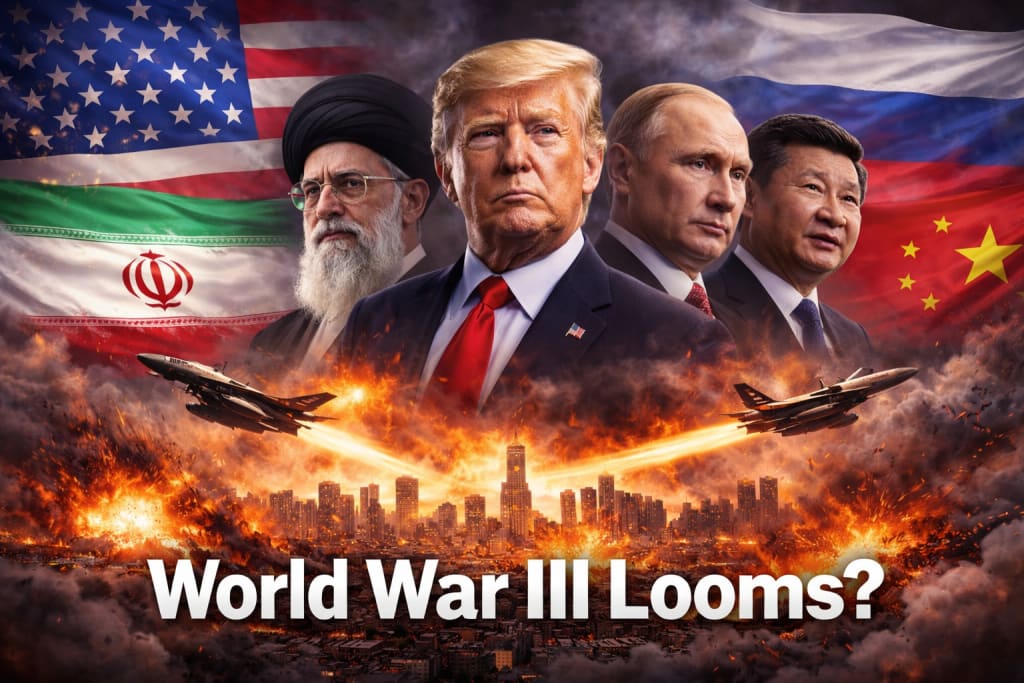
Some moments in history feel unreal while they’re happening.
Headlines move fast. Statements get sharper. Markets react. Social media explodes. And somewhere in the middle of it all, the world quietly holds its breath.
That’s the kind of moment we’re in.
When U.S. President Donald Trump ordered joint U.S.–Israel strikes on Iran, the move didn’t just target military infrastructure — it sent a message. Especially after reports linked the operation to the killing of Iran’s Supreme Leader Ayatollah Ali Khamenei. Whether framed as strategy, deterrence, or regime pressure, the political shockwaves were immediate.
Trump described the strikes as an opportunity for change inside Iran. His tone suggested confidence, even defiance. But geopolitics rarely unfolds in a vacuum. Every action triggers reaction.
And reactions came fast.
Moscow’s Warning: A Line in the Sand
Russia did not choose soft language. Senior Russian official Dmitry Medvedev warned that continued regime-change efforts could push the world toward World War III.
That phrase carries weight. It’s not used casually in diplomatic circles.
Russia’s concern isn’t just about Iran. It’s about precedent and power balance. If Washington openly pursues regime change through force, Moscow sees it as destabilizing — not just regionally, but globally. From Russia’s perspective, Iran is part of a broader strategic equation where U.S. dominance must be countered.
When nuclear-armed states start talking in absolutes, the tension shifts from regional to systemic.
Beijing’s Position: Stability Over Shockwaves
China took a more measured but equally firm approach. Chinese Foreign Minister Wang Yi condemned the strikes as violations of sovereignty and called for immediate de-escalation.
China’s stance is consistent with its long-standing foreign policy principles — non-interference and territorial integrity. But beyond principle lies practicality.
The Middle East is deeply tied to global energy flows. Any prolonged instability threatens oil markets, trade routes, and supply chains. For Beijing, chaos isn’t just political — it’s economic risk.
China doesn’t benefit from regional collapse. It benefits from predictability.
Iran’s Crossroads
Inside Iran, the leadership now faces a difficult choice.
Respond forcefully and risk full-scale confrontation with the United States and Israel — or respond cautiously and risk appearing weak domestically.
Reports of retaliatory strikes on U.S. bases in the Middle East show that escalation is already in motion. But full conventional war would be devastating for all sides.
There’s also the nuclear question. Pressure and isolation can sometimes accelerate exactly what they aim to prevent. If Iran feels existentially threatened, the incentive to strengthen deterrence increases.
History has shown this pattern before.
The Bigger Picture: Blocs Hardening
What makes this crisis especially dangerous isn’t just the strikes. It’s the alignment.
Washington and Tel Aviv appear tightly coordinated. Moscow and Beijing publicly stand behind Tehran’s sovereignty. That alignment begins to resemble bloc politics — not identical to the Cold War, but uncomfortably familiar.
When major powers anchor themselves behind opposing sides, even limited conflicts carry wider risk. Miscalculations become harder to contain.
The phrase “World War III” may sound dramatic, but history reminds us that global wars often begin with regional sparks.
Power, Perception, and Pride
Beyond military strategy lies something less tangible but equally powerful: perception.
Leaders must project strength. Nations guard credibility. Backing down can look like weakness. Escalation can look like resolve.
This psychological layer complicates diplomacy. When rhetoric escalates publicly, quiet compromise becomes politically harder.
And yet, history also shows that backchannel diplomacy often works beneath the noise. Public threats can coexist with private negotiations.
So, Are We on the Brink?
Not necessarily.
Nuclear deterrence still acts as a brake on direct superpower confrontation. Economic interdependence raises the cost of total war. And none of the major players truly benefit from global catastrophe.
But the margin for error is thinner than it looks.
Regime-change language. Retaliation threats. Nuclear undertones. Great-power rivalry.
It’s a volatile mix.
The coming weeks will likely define whether this moment becomes a turning point toward broader confrontation — or a sharp spike that eventually levels out.
For now, the world watches carefully.
Because in geopolitics, it’s rarely the first strike that determines history.
It’s the response.
About the Creator
Amanullah
✨ “I share mysteries 🔍, stories 📖, and the wonders of the modern world 🌍 — all in a way that keeps you hooked!”
A Gathering of Evil Bosses
“I’m the queen of chin jutting while I smooth my hair, attacking, insulting, and deflecting to protect my appointer.” “Oh, please, Blondi, my hair is curled, highlighted, and longer than yours. I feature television commercials telling immigrants that we will give them a free plane ride home, and if they voluntarily turn themselves in, they will be allowed to legally apply for re-entry. It runs everywhere, and I look good in it! You can’t compete because of your blond hair. Mine is nicer, and my lips are prettier than yours.”
By Andrea Corwin 13 days ago in The Swamp



Comments
There are no comments for this story
Be the first to respond and start the conversation.