
What If World War 3 Starts Between Pakistan and India—or Even the U.S.?
A terrifying exploration of nuclear warfare, shifting alliances, and the global chaos that could erupt from a war no one truly wants.

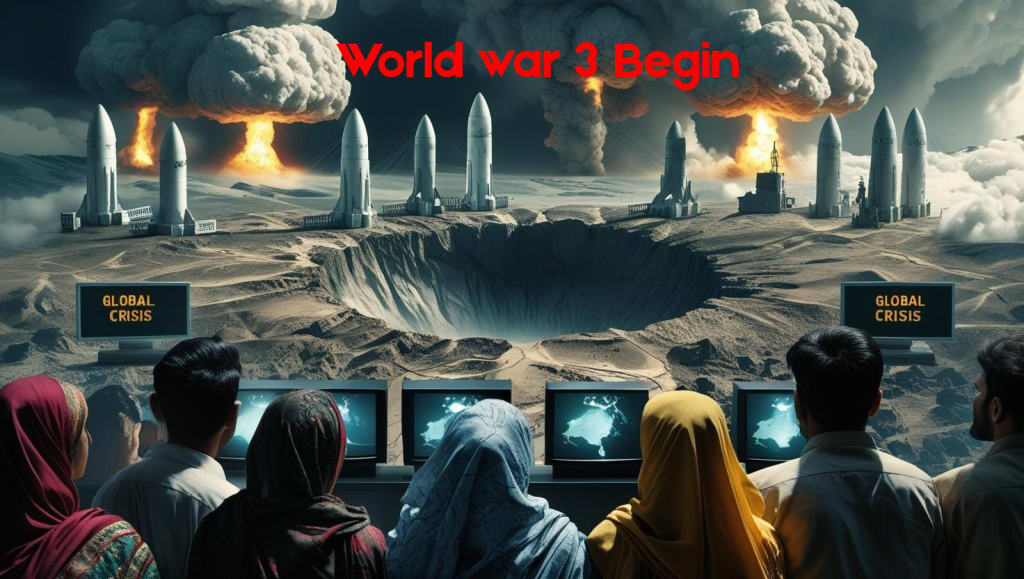
It begins with a spark. A cross-border skirmish between India and Pakistan in Kashmir spirals out of control. Nationalist leaders on both sides refuse to back down. Words become threats. Threats become missile tests. And within weeks, the world stands on the edge of a nuclear apocalypse.
While the world holds its breath, another scenario brews in the background: rising tensions between Pakistan and the United States over regional influence, drone strikes, or accusations of harboring terrorists. In a world already stressed by economic collapses and political divisions, any spark could ignite a global inferno.
🧨 The Indo-Pak Flashpoint
India and Pakistan have fought several wars since 1947, but the stakes have never been higher than now. Both nations are nuclear-armed. Both have large populations and volatile internal politics. A war in 2025 or beyond wouldn't be like past battles—it would be digital, aerial, nuclear, and terrifyingly fast.
If war begins:
Millions could die within days, especially in urban centers like Delhi, Lahore, Mumbai, and Islamabad.
The Indus Water Treaty might collapse, leading to water wars that would devastate agriculture in both nations.
Cyber attacks would paralyze infrastructure, banks, and hospitals.
Refugees would flood neighboring countries, overwhelming borders.
And the worst-case scenario? Nuclear escalation.
According to estimates by Princeton University, even a limited nuclear war between India and Pakistan could kill up to 125 million people within the first week. The smoke from such blasts could trigger a “nuclear winter,” blocking sunlight and causing crop failures around the globe.
🇺🇸 What If the U.S. Gets Involved?
If the U.S. were to go to war with Pakistan—whether through miscalculation, proxy battles in Afghanistan, or over China's growing influence—it could ignite an even larger conflict. The U.S. military is powerful, but Pakistan has nuclear weapons and close ties with China, Russia, and Iran.
If this triangle gets involved:
China could back Pakistan, fearing the expansion of U.S. influence in Asia.
Russia might support Pakistan covertly, just to weaken American global dominance.
NATO may fracture, as European nations are unlikely to back a war that could reach their shores via global alliances.
This wouldn't just be a South Asian war—it would become World War III.
🌀 The Global Fallout
Oil prices would skyrocket, collapsing already fragile economies.
The U.N. would be paralyzed, as Security Council members (China, U.S., Russia) would be on opposing sides.
Global shipping routes in the Arabian Sea and Indian Ocean could be blocked, causing massive trade disruptions.
Stock markets would crash, triggering a second Great Depression.
Even countries not directly involved—like Brazil, Nigeria, France, or Australia—would suffer from food shortages, economic shocks, and millions of climate refugees.
☠️ A War With No Winner
No side would truly win. Cities would be uninhabitable. Economies would be in ruins. The global climate could be permanently altered. This is not just political fiction—it’s a future we must avoid at all costs.
War in the 21st century isn’t about borders. It’s about survival. In a nuclear age, even one bomb can end the future.
✌️ What Must Be Done?
We need diplomacy, not ego. Communication channels between India and Pakistan, and even between the U.S. and South Asian nations, must remain open. The world needs peace architects, not warlords. This article isn’t a prediction—it’s a warning.
🔥 The Aftermath: A World Reshaped by War
Imagine waking up in a world where major cities like Islamabad, Delhi, Karachi, and Mumbai are reduced to ash. Where global news flashes show food riots in Europe, radiation clouds over Central Asia, and an eerie silence in once-busy airports. This isn’t science fiction—it’s the realistic aftermath of a full-scale nuclear war between South Asian powers or a superpower confrontation with Pakistan.
Post-war, billions of dollars in infrastructure would be wiped out. Healthcare systems would crumble under radioactive injuries and disease. Children born years later might suffer genetic damage. Economists predict that such a war could set global development back by 50 years or more.
More dangerously, trust in global institutions like the United Nations, NATO, and even the Geneva Convention would evaporate. Countries would shift toward isolationism, fearing further escalation. Travel would become restricted, borders militarized, and cyberspace a new battlefield for surveillance and sabotage.
In this broken world, AI and autonomous weapons could become dominant as humans fear putting soldiers on the ground again. Civil liberties would vanish in the name of national security. Governments would become more authoritarian, using fear to control populations shattered by trauma and grief.
And amid this chaos, the greatest casualty wouldn’t be the cities or the soldiers—it would be hope. A generation would grow up with only memories of war, not peace. Rebuilding would take centuries, and the scars—emotional, physical, and environmental—might never fully heal.
This is not just about war—it’s about the death of civilization as we know it. And the most terrifying part? It’s only one decision away.
And if we ignore it, history won’t forgive us.
About the Creator
Keep reading
More stories from Abid Ali Khan and writers in The Swamp and other communities.
When Iran Stared Down the USA: The War the World Can’t Afford to Ignore
🇮🇷 Iran vs USA – A War Not Just of Bullets, But of Minds and Maps The world watches with bated breath as tensions between Iran and the United States escalate—again. But this time, it's different. This isn't just a regional scuffle—it’s a collision of ideologies, military power, and energy interests that could ripple across the globe.
By Abid Ali Khan8 months ago in The Swamp
The Forsyth House Fire
Since 1851, Forsyth House has stood on the corner of Union Street and Gordon Street in the heart of Glasgow. Its iconic, or was... because on Sunday 8th of March, 2026, a fire broke out in a small, seemingly un-named shop in the building and tore all that history down. As I write, the rubble is still unsettled and the street is still blocked off. Central Station is quiet on the upper level, and around 30 small businesses have quite literally gone up in smoke.
By S. A. Crawford3 days ago in The Swamp
Iran War Update
The ongoing conflict involving Iran has rapidly become one of the most significant geopolitical crises in recent years. As the war escalates, attention has increasingly focused on the Strait of Hormuz, a narrow waterway that plays a crucial role in global energy trade. Developments around this strategic route have intensified concerns across the Middle East and beyond.
By Saboor Brohi 2 days ago in The Swamp


Comments
There are no comments for this story
Be the first to respond and start the conversation.