
We Should Be Concerned About New Anti-protest Legislation
How do we protest about our right to protest being taken away?


Amid the nauseating guff that was spouted all weekend on the news channels vis-a-vis the recent coronation of Charlie Three, there was a side issue that was too big for the news media to ignore. I refer to the police clampdown against those who desired to make it known via placards that the head of state is Not My King, an act of suppression more suited to the regime of North Korea than the free-speech-loving inhabitants of John Bull’s Island.
The police, no doubt, feared the motley mob might set off smoke bombs, roll marbles under the hooves of guardsmens’ horses, and run alongside the gold state coach with hands firmly superglued to the rumps of the beasts pulling that ostentatious monstrosity. Such disruption would never do, so taking the view that prevention is better than cure, the police swooped on prospective protestors, clapping them in handcuffs and seizing their placards.
Disruptive action
Only days before the coronation, the Home Office introduced a new anti-protest law that allows police officers to arrest protesters in advance of any disruptive action. The timing of the introduction of the new law was, according to the Home Office, coincidental. Security minister, Tom Tugendhat, said that anti-monarchists would still “have the liberty to protest, but they would not have the liberty to disrupt others. That’s where we’re drawing a difference.”
A total of 64 people were arrested on Saturday on a range of charges that included being in possession of a megaphone. Many have viewed this approach as heavy-handed and at odds with our cherished right to protest. The chair of the London Assembly’s Police and Crime Committee, Caroline Russell, called the actions of the police “a chilling suppression.”
Graham Smith, leader of the anti-monarchy campaign group Republic, said he was arrested and held in a police cell for 16 hours. His arrest came despite the group having been in discussions with the Met for four months. He told the BBC; “The whole thing was a deliberate attempt to disrupt and diminish our protest in order to protect the coronation,”
Mr Smith added that the Met had "repeatedly said right up until Friday that they had no concerns about our protest plans, they were well aware of what we were going to do, and they would engage with us and not disrupt us. So they have repeatedly lied about their intentions, and I believe that they had every intention of arresting us prior to doing so.”
Civil disobedience
By its very nature, protest is disruptive, and here in Britain, we have a rich tapestry of examples of that. From the destruction of a threshing machine by labourers in 1830 that triggered a revolt across southern England, during which many more machines were destroyed, to the suffragette movement and their policy of civil disobedience, right up to recent times, and the Just Stop Oil protester who attached himself via a cable-tie around the neck to a goalpost at half time during a football match.
Protest and civil disobedience are ineffective if those protesting are made to follow rules and guidelines. In many cases, the element of surprise is a key part of attracting publicity and getting a message across. Had the Russian punk band Pussy Riot asked permission to perform their protest piece A Punk Prayer at Moscow’s Cathedral of Christ the Savior, they would have been refused, so they did it without clearance and were later jailed. Protest with restrictions attached is sterile, and that's just how the authorities like it.
Probably lefties
Meanwhile, back at the coronation, a bunch of protesters, who are probably lefties anyway, being arrested wouldn’t attract a great deal of sympathy from the majority, who hoped for the event to go off without hindrance. And, for those who have been recently inconvenienced by the actions of such organisations as Just Stop Oil and Extinction Rebellion, the clampdown may have been viewed as a welcome form of retribution. But the bigger picture shows that this affects us all, and we should be concerned.
For, what if something were to happen in a locality that citizens would be likely to protest against? Let us say for example, a proposed bypass that would destroy an area of much-loved woodland. The usual plan is to hold placards and invite passing motorists to honk their support. It would be difficult to achieve such an audible show of solidarity if the placard inviting participation was in the back of a police van — along with its owner.
In this country, it's as though we tamely accept the erosion of our rights with the traditional stiff upper lip and cup of sweet tea. For some reason, we live in an atmosphere of apathy, and my countrymen seem less inclined to kick against the pricks in large numbers than those of other nations, and a recent illustration of this contrast could be seen across the channel in France. When President Macron’s government set about raising the pension age for French citizens from 62 to 64, vast swathes of the populace took their anger onto the streets. Here in Blighty, the retirement age is 66, and this is expected to rise to 68 by 2044. On the whole, the people are cool with that.
About the Creator
Joe Young
Blogger and freelance writer from the north-east coast of England
A Gathering of Evil Bosses
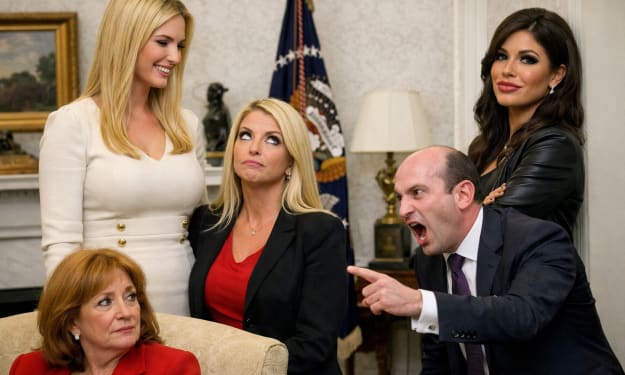
“I’m the queen of chin jutting while I smooth my hair, attacking, insulting, and deflecting to protect my appointer.” “Oh, please, Blondi, my hair is curled, highlighted, and longer than yours. I feature television commercials telling immigrants that we will give them a free plane ride home, and if they voluntarily turn themselves in, they will be allowed to legally apply for re-entry. It runs everywhere, and I look good in it! You can’t compete because of your blond hair. Mine is nicer, and my lips are prettier than yours.”
By Andrea Corwin 10 days ago in The Swamp
US and Israel Launch ‘Massive’ Strikes on Iran as Trump Calls for Regime Change
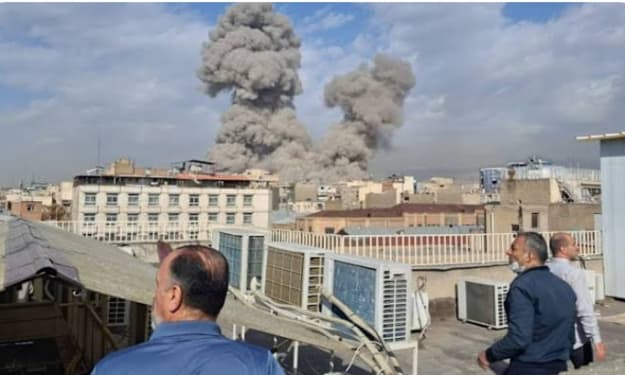
In one of the most significant geopolitical escalations of recent years, the United States and Israel launched large-scale military strikes on Iran, marking the start of what officials described as a “massive and ongoing” campaign against the Iranian government. The operation has rapidly transformed regional tensions into a direct military confrontation that could reshape the balance of power across the Middle East. U.S. President Donald Trump confirmed the attacks in a public address, stating that the operation aims to neutralize what he called “imminent threats” posed by Iran’s missile and nuclear capabilities. The strikes targeted multiple sites across Iran, including military facilities, missile infrastructure, and locations believed to be connected to the country’s nuclear program. � Jerusalem Post +1 Trump went further than previous U.S. leaders by openly suggesting that the campaign could lead to regime change in Iran, urging the Iranian people to take control of their government once the operation concludes. The Military Operation Begins The joint offensive, reportedly coordinated between American and Israeli forces, began in the early hours of February 28, 2026. Explosions were reported in several Iranian cities, including the capital Tehran, as missiles and airstrikes struck strategic military locations. The Israeli government referred to the campaign as Operation Lion’s Roar, describing it as a pre-emptive strike designed to eliminate threats from Iran’s missile systems and nuclear ambitions. � Wikipedia According to early reports: Multiple missile and air-defense installations were targeted. Sites linked to ballistic missile development were struck. Key military infrastructure across several provinces was damaged. Initial casualty estimates from Iranian emergency organizations suggested that more than 200 people were killed and hundreds injured, although these figures remain difficult to independently verify. � Gulf News The scope of the operation suggests careful planning and coordination between the two allies. U.S. and Israeli officials have argued that the strikes were necessary to prevent Iran from expanding its military capabilities and threatening regional stability. Trump’s Call for Regime Change Perhaps the most controversial aspect of the operation was President Trump’s rhetoric surrounding the attacks. In a video statement posted online, Trump called on Iranian citizens and military personnel to abandon the current leadership and take control of their country. He stated that the objective of the campaign is to eliminate threats from the Iranian regime and ensure that Iran cannot develop nuclear weapons in the future. � Jerusalem Post Trump also issued a warning to Iranian military forces, particularly the powerful Islamic Revolutionary Guard Corps, telling them to disarm and cooperate or face severe consequences. His message included two key themes: Protection of U.S. national security Support for the Iranian people against their government By framing the operation as an opportunity for the Iranian population to overthrow its leadership, Trump’s remarks signaled a clear shift from purely military objectives to political transformation. Israel’s Strategic Perspective For Israel, the strikes represent the culmination of years of tension with Iran. Israeli leaders have long argued that Iran’s missile program and nuclear ambitions pose an existential threat to their country. Israeli Prime Minister Benjamin Netanyahu said the operation was launched to remove that threat and create conditions for a safer Middle East. Netanyahu emphasized that Iran’s leadership has consistently called for the destruction of Israel and supported militant groups throughout the region. From Israel’s perspective, allowing Iran to expand its military capabilities would increase the risk of future conflict and destabilize neighboring countries. The decision to act militarily, therefore, reflects a strategic calculation that diplomacy alone has failed to contain Iran’s ambitions. Iran’s Reaction and Threats of Retaliation Iranian officials quickly condemned the attacks, calling them illegal and unjustified acts of aggression. Iran’s foreign ministry accused the United States of abandoning diplomacy and warned that Tehran would respond decisively. Military officials vowed retaliation against both American and Israeli targets. Within hours of the strikes, reports emerged of missile launches toward Israel and U.S. military facilities in the region. Iran’s leadership framed the operation as proof that Western powers are attempting to destabilize the country and impose political change by force. The possibility of further retaliation raises fears of a broader regional conflict that could involve multiple countries. A Region on Edge The Middle East has experienced numerous conflicts over the past decades, but direct military confrontation between the United States and Iran represents a particularly dangerous escalation. Several factors increase the risk of a wider war: U.S. military bases across the Middle East Iranian-backed armed groups operating in several countries Strategic waterways such as the Strait of Hormuz The involvement of other regional powers Any prolonged conflict could disrupt global energy markets, threaten shipping routes, and destabilize neighboring nations. Many governments around the world have urged restraint and called for an immediate return to diplomacy. Global Reactions The strikes have triggered strong reactions from governments and international organizations. Some U.S. allies have expressed support for the operation, arguing that Iran’s missile and nuclear programs present a genuine security threat. Others have urged caution, warning that military action could escalate into a prolonged war with devastating consequences. The United Nations Security Council convened an emergency meeting to discuss the situation, with diplomats calling for de-escalation and dialogue. European leaders in particular have emphasized the importance of diplomatic solutions and warned that regime change efforts could create further instability. The Human Cost of Conflict While geopolitical strategies dominate headlines, the immediate consequences of the strikes are felt by civilians living in affected areas. Explosions in densely populated regions have raised concerns about casualties and infrastructure damage. Hospitals and emergency services across Iran were reportedly placed on high alert following the attacks. Humanitarian organizations have warned that prolonged conflict could lead to displacement, shortages of medical supplies, and severe economic hardship for ordinary people. The humanitarian dimension of the crisis remains one of the most pressing concerns for international observers. Political Debate Inside the United States Within the United States, the strikes have sparked intense political debate. Supporters of the operation argue that confronting Iran militarily was necessary to prevent the country from developing nuclear weapons and threatening American allies. Critics, however, warn that military intervention could lead to another prolonged Middle Eastern conflict similar to previous wars in Iraq and Afghanistan. Lawmakers from both parties have called for congressional oversight and clearer explanations of the administration’s long-term strategy. The question now facing policymakers is whether the operation will remain limited or evolve into a larger conflict. The Uncertain Path Ahead The situation remains highly volatile. Military analysts suggest several possible scenarios for the coming weeks: Limited conflict — short-term strikes followed by negotiations Escalation — continued retaliation between Iran, Israel, and U.S. forces Regional war — involvement of additional countries or armed groups Much will depend on Iran’s response and whether diplomatic channels can reopen. For now, the world is watching closely as the crisis unfolds. A Turning Point in Middle Eastern Politics The joint U.S.–Israel strikes on Iran represent a defining moment in modern geopolitics. By openly linking military action with the possibility of regime change, the United States has taken a bold and controversial step that could reshape the future of the region. Supporters argue the operation could weaken an adversarial government and strengthen regional security. Critics warn it may ignite a conflict with unpredictable consequences. Either way, the events unfolding today will likely influence international relations, energy markets, and global security for years to come.
By Zahid Hussainabout 2 hours ago in The Swamp


Comments
There are no comments for this story
Be the first to respond and start the conversation.