
US vs Iran’: Can Yemen Houthis Hijack USS Abraham Lincoln if It Strikes Iran?
Analysis of Houthi capabilities and limits as Yemen rebels threaten U.S. naval forces if Washington joins strikes on Iran.

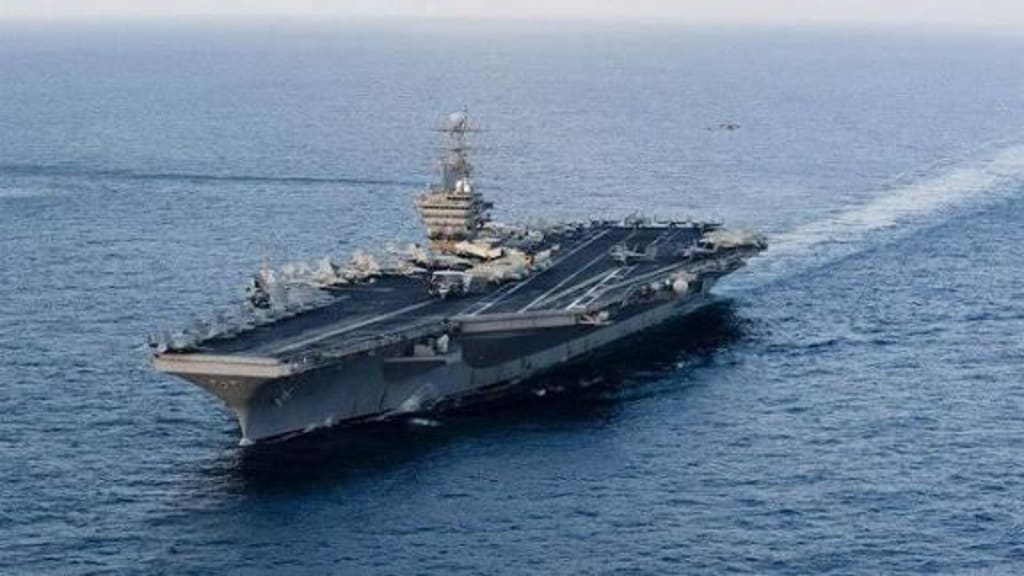
As the United States weighs potential military action against Iran amid heightened tensions over nuclear negotiations and regional hostilities, defence analysts are closely watching not just Tehran’s response but that of Yemen’s Houthi movement — the Iran-aligned armed group that has been targeting international shipping and signalling it may strike U.S. naval assets if Washington enters a conflict.
While the idea of a direct “hijacking” of an aircraft carrier such as the USS Abraham Lincoln is highly implausible given modern naval defenses and U.S. military superiority, the Houthi threat underscores how a broader regional conflagration could pull in additional actors and complicate any American operations.
Houthis: From Shipping Attacks to Threats on U.S. Ships
Over the past several years, the Iran-backed Houthis — formally known as Ansar Allah — have launched repeated missile and drone strikes on commercial vessels and naval targets in the Red Sea, the Bab al-Mandeb strait, and the Gulf of Aden. The group claims these actions are in solidarity with Palestinians and in protest of Western and Israeli military policies. Since late 2023, the Houthis say they have attacked more than 100 ships, firing missiles and drones across one of the world’s most important shipping lanes.
U.S. Central Command has responded by intercepting and destroying Houthi drones and missiles, including in self-defence operations, and has struck Houthi weapon storage and command facilities in Yemen to degrade those capabilities.
Importantly, in June 2025, Reuters reported that the Houthis openly threatened to target U.S. ships — including warships — “if Washington joins strikes on Iran.” That declaration suggests that the group sees American involvement in a wider regional conflict as an impetus to escalate its own actions
Geography and Capabilities: What the Houthis Can and Cannot Do
The Houthis control significant territory in northern Yemen, including large coastal stretches on the Red Sea. They have used this geography to fire missiles, drones and even unmanned surface vessels at international shipping and naval assets. Analysts say their arsenal is a mix of short-range ballistic missiles, anti-ship cruise missiles, and armed drones — many believed to be of Iranian origin or design.
However, these systems have limitations. While they can threaten unarmoured merchant vessels and pose risks to smaller craft, they lack the precision, range, and frequency needed to overwhelm a carrier strike group’s layered defenses. U.S. Navy carriers like the Abraham Lincoln are protected by:
Aegis-equipped escort destroyers, capable of tracking and intercepting missiles and drones
Carrier air wings, including fighters and early-warning aircraft
Electronic warfare systems and point-defence weapons designed to defeat approaching threats
These assets make a direct “hijack” or capture scenario nearly impossible; carriers are some of the most heavily defended platforms in the world.
Threat vs. Capability
Despite the group’s rhetoric, there is no verified event in which Houthis have successfully damaged or captured a U.S. aircraft carrier. When claims have been made — including assertions of targeting U.S. carriers with a combination of missiles and drones — U.S. military officials have either denied hits or confirmed only interception of various Houthi UAVs and missiles with no damage to warships.
That said, the group’s pattern of attacks has forced Western navies to expend time, ammunition and strategic focus on patrols in the Red Sea rather than elsewhere. In 2024 and 2025, U.S. and allied forces conducted hundreds of air and cruise missile strikes against Houthi sites in response to repeated attacks.
If the U.S. Strikes Iran
A U.S. strike on Iran could significantly change the calculus. The Houthis would likely ramp up operations in the Red Sea and Gulf of Aden, viewing the conflict as part of a broader struggle involving Iran and its network of allied militias. Statements published by Yemen-based outlets and observers indicate that the group has linked its actions to wider geopolitical dynamics and said it will resume targeting Western shipping if cease-fires or restraint collapse.
However, even in a worst-case scenario of heightened operations, analysts believe the Houthis would focus on swarming attacks using drones and missiles against commercial and lightly defended naval units — not the complex and extremely costly attempt to board or hijack an American carrier, which would be militarily unrealistic.
Regional Strategic Fallout
Even without realistic capability to strike a carrier directly, Houthi threats add a complicating factor. A broader Middle Eastern conflict could force the U.S. Navy to divide attention between protecting high-value national assets and countering opportunistic proxy attacks. It would also draw other Iran-aligned groups in Iraq, Lebanon and Syria into a wider vector of conflict, risking a multi-front crisis unlike any the region has seen since 2003.
About the Creator
Fiaz Ahmed
I am Fiaz Ahmed. I am a passionate writer. I love covering trending topics and breaking news. With a sharp eye for what’s happening around the world, and crafts timely and engaging stories that keep readers informed and updated.
Keep reading
More stories from Fiaz Ahmed and writers in The Swamp and other communities.
What Happens to All These Trade Deals Now?
Global trade agreements negotiated over the past few years face a period of intense uncertainty as political, legal, and economic conditions shift rapidly — especially after a major U.S. Supreme Court ruling and evolving tariff strategies from Washington. Governments and businesses around the world are asking the same question: what comes next for trade deals that have been painstakingly negotiated? Legal Uncertainty in the United States The immediate trigger for trade deal confusion was a recent Supreme Court decision that struck down key U.S. tariffs previously imposed under emergency powers. The court ruled that the government lacked unilateral authority to set sweeping tariffs without explicit Congressional approval, undermining the legal foundation for many trade arrangements tied to those levies. In response, the White House has moved to impose new global tariffs under alternative authorities — including Section 122 of the Trade Act — raising levies to 15 percent on many imports for a limited 150-day period. That move has compounded uncertainty: while some deals were negotiated under the assumption of earlier tariff caps, the new rates could render those frameworks obsolete or financially unattractive. Treasury officials have publicly urged foreign governments to honor existing trade deals, saying many negotiated commitments remain intact despite the ruling, especially pacts with countries like India. However, legal experts warn that the viability of certain provisions could hinge on how tariffs are implemented moving forward. Interim Agreements and Modified Deals Not all trade arrangements are in jeopardy. In early 2026, the United States and India announced a framework for a bilateral interim trade agreement, including significant tariff reductions — from 25 percent to around 18 percent on many goods — in exchange for broader market access commitments. That deal was intended to set the stage for a full-scale Trade Agreement. Even after the tariff ruling, both Washington and New Delhi have signalled their intention to keep negotiating the interim pact, adapting to the changed legal context. New Delhi’s commerce officials suggested the reciprocal tariff figure may adjust, but that the broader deal remains a priority. The Daily Star Other deals — such as reciprocal trade frameworks with Indonesia and Bangladesh — have also been part of U.S. efforts to diversify trade ties. These agreements aim to lower tariff baselines and address non-tariff barriers, offering market access to U.S. agricultural and industrial goods while gaining concessions abroad. EU and Other Major Trade Pacts Across the Atlantic, the European Union and India are finalizing one of the world’s biggest free-trade agreements, which promises to cut tariffs on most goods and boost services access once legal reviews are complete. That pact — projected to cover roughly 25 percent of global GDP — may still proceed independently of U.S. policy shifts. However, the U.S.–EU trade framework agreed in 2025 has already been complicated by tariff unpredictability and political tensions. Several European lawmakers have paused approval of trade arrangements in reaction to ongoing U.S. tariff threats, including levies between 10 percent and 25 percent that run counter to prior commitments. Market and Strategic Shifts The knock-on effects extend far beyond legal questions. Asian and European economies are increasingly recalibrating trade routes and agreements outside U.S. direction, seeking stability amid tariff turbulence. Some analysts argue that the United States could risk being sidelined as Europe and Asia push forward with deeper integration and lowered barriers between major economic blocs. Reddit Yet others point out that structured deals — once signed — carry inertia. Even if tariffs change or legal bases shift, countries often maintain existing market access terms to preserve supply chains, stability for exporters and importers, and mutual economic interdependence. This is especially true for longstanding partners such as Canada, Mexico, and strategic markets in East Asia. Foreign Policy Looking Ahead The coming months could determine the future of many trade deals. Lawmakers in the United States might consider new legislation to clarify tariff authority, while international partners watch closely to see if interim agreements are formalised or if renegotiations become necessary. For businesses, the lesson is clear: flexibility and diversification may be more important than ever. Trade deals that once seemed settled now face legal and political stress tests, and the global trading system may evolve into a more fragmented set of regional arrangements rather than a single cohesive framework. Amid these shifts, governments and corporations alike will be watching how legal decisions, geopolitical priorities, and economic pressures intersect — and what that means for the future of global trade.
By Fiaz Ahmed about 14 hours ago in The Swamp
A Gathering of Evil Bosses
“I’m the queen of chin jutting while I smooth my hair, attacking, insulting, and deflecting to protect my appointer.” “Oh, please, Blondi, my hair is curled, highlighted, and longer than yours. I feature television commercials telling immigrants that we will give them a free plane ride home, and if they voluntarily turn themselves in, they will be allowed to legally apply for re-entry. It runs everywhere, and I look good in it! You can’t compete because of your blond hair. Mine is nicer, and my lips are prettier than yours.”
By Andrea Corwin 4 days ago in The Swamp


Comments
There are no comments for this story
Be the first to respond and start the conversation.