
US Senate to Vote on Bid to Stop Trump from Taking Further Military Action in Venezuela
A Constitutional Showdown Over War Powers and America’s Role Abroad


The United States is at a political and constitutional crossroads. In early January 2026, the U.S. Senate prepared to vote on a resolution aimed at limiting President Donald Trump’s ability to order further military action in Venezuela without Congress’ approval.
The move has sparked a dramatic debate about the balance of power between the president and Congress — and what it means for America’s role on the global stage.
Why the Senate Is Acting Now
The immediate spark was a controversial U.S. military raid in Venezuela. Special forces captured Venezuelan President Nicolás Maduro and brought him to New York on charges related to alleged narco-terrorism.
While some lawmakers praised the objective — removing a leader accused of serious crimes — many others were alarmed. Democrats and even some Republicans argued the Trump administration failed to consult Congress before launching a major military incursion.
The question on everyone’s mind: Can a president unilaterally launch major military operations, or does Congress have a say?
War Powers Under the Constitution
The U.S. Constitution gives Congress the power to declare war, while the president serves as commander in chief. Historically, presidents have interpreted their powers broadly, often acting without formal declarations of war.
To address this, Congress passed the War Powers Resolution of 1973, requiring the president to consult lawmakers when introducing U.S. forces into hostilities. Now, legislators are invoking that law to prevent further military action in Venezuela without their approval.
Senators Tim Kaine (D‑VA) and Rand Paul (R‑KY) are leading a bipartisan push, joined by Senate leaders like Charles Schumer and Adam Schiff. Their argument: unchecked military action erodes constitutional balance and puts U.S. troops at risk.
What the Resolution Would Do
If passed, the resolution would require Trump to obtain Congressional approval for any additional military operations in Venezuela — including strikes, troop deployments, or other offensive actions.
Lawmakers insist this is not just procedural. They view it as a crucial step to reassert Congressional authority and prevent unilateral military adventures abroad.
Divisions in the Senate
The vote is far from guaranteed. Many Republicans support Trump, arguing that the president acted lawfully and that restricting his military flexibility could weaken America’s global position.
Even within the Republican Party, there is frustration over being kept in the dark about the Maduro raid. Bipartisan concerns about transparency and oversight are fueling debate.
Even if the Senate passes the resolution, it faces hurdles: it must pass the House and survive a presidential veto — requiring a two-thirds majority to override.
Why It Matters Beyond Venezuela
This vote isn’t just about one country. Lawmakers warn that similar measures could be needed if the president seeks military action elsewhere — including Cuba, Mexico, or even Greenland.
The central issue: Who decides when America goes to war — Congress or the president? The outcome could redefine U.S. foreign policy and influence how allies and adversaries view American intentions.
Public Opinion and the Future
Many Americans oppose giving the president unchecked authority to engage in military conflicts abroad. Polls suggest bipartisan support for requiring Congressional approval for major operations.
The Senate vote will signal whether lawmakers align with public opinion or defer to presidential discretion.
The Bigger Picture
At stake is more than Venezuela. This is a test of constitutional balance, separation of powers, and America’s role in the world.
As global tensions rise and questions of intervention intensify, the Senate’s decision could echo far beyond Washington. It is a moment that could shape how the U.S. engages internationally for years to come.
Key Takeaways:
The Senate vote seeks to limit Trump’s unilateral military action in Venezuela.
The resolution invokes the 1973 War Powers Act to reassert Congressional authority.
Bipartisan divisions make the outcome uncertain.
The decision has implications for U.S. foreign policy, constitutional power, and global perceptions.
About the Creator
Muhammad Hassan
Muhammad Hassan | Content writer with 2 years of experience crafting engaging articles on world news, current affairs, and trending topics. I simplify complex stories to keep readers informed and connected.
Keep reading
More stories from Muhammad Hassan and writers in The Swamp and other communities.
Russian War Deaths Are Rising to Unsustainable Levels, Says Ukraine
The war in Ukraine, now stretching into its fourth year, has become one of the deadliest conflicts in recent European history. Recently, Ukrainian officials issued a stark warning: Russian military deaths are climbing to levels they call “unsustainable.” But what does that really mean? And how could this affect the future of the war—and the world beyond Ukraine? Kyiv Sounds the Alarm Ukrainian military sources have been blunt. Russia’s losses on the battlefield, they say, are mounting at a pace Moscow can’t sustain indefinitely. Exact numbers are difficult to verify. The Russian government has not released comprehensive casualty data, and the fog of war makes independent reporting challenging. Yet estimates suggest staggering figures: over 1.1 million Russian casualties—including killed, wounded, and missing—since the invasion began in February 2022. Ukraine’s officials point out that these losses aren’t just numbers on a page. They weaken military capacity, strain morale, and could affect Russia’s ability to maintain a prolonged campaign. Why “Unsustainable” Isn’t Just a Word When Ukrainian officials call Russian losses unsustainable, they’re talking about more than just battlefield deaths. Several factors contribute: 1. Military Capacity Erosion High casualties make it harder for Russia to field trained soldiers. Recruitment struggles, combined with heavy losses, reduce the effectiveness of frontline units. 2. Domestic Pressure Rising deaths may fuel public dissatisfaction in Russia. Casualty fatigue can weaken support for the war and put pressure on political leaders. 3. Economic Burden The human cost translates into an economic one. Wounded soldiers require care, families are affected, and resources are diverted from other priorities—adding financial strain on top of sanctions. 4. Strategic Limitations Despite heavy losses, territorial gains have often been limited. This mismatch underscores Kyiv’s argument: Russia is paying a steep price for little progress. Numbers and Estimates Different organizations provide varying casualty figures: UK Defence Intelligence estimates over 1.1 million Russian casualties, with hundreds of thousands killed or missing. Independent tallies suggest at least 150,000 Russian deaths, excluding irregular forces. Analysts at CSIS estimate around 250,000 fatalities and nearly one million total casualties by 2025. While exact numbers vary, the pattern is clear: Russian losses are extremely high and continue to rise, which is why Kyiv warns they could become unsustainable. The Global Impact Russia’s rising casualties have implications far beyond Ukraine: International Diplomacy Western allies monitor casualty trends closely. Rising losses could justify continued military aid to Ukraine, ensuring Kyiv can hold its ground and push Russia toward negotiation. Negotiation Leverage Weakened Russian forces may give Ukraine more leverage in future ceasefire talks or peace negotiations. Domestic Response in Russia A population confronted with mounting fatalities may pressure the Kremlin to reconsider its strategy, potentially impacting political stability. The Challenge of Verification It’s worth noting that casualty figures in wartime are notoriously hard to verify. Russia has historically underreported losses, while Ukraine may emphasize them to maintain international support. Despite this, multiple intelligence assessments and open-source investigations converge on one point: the human toll of the war is staggering, and losses are rising faster than Russia can comfortably manage. A War Without Easy Answers Even if Russian losses aren’t literally “unsustainable,” the human and political toll is undeniable. The war has already reshaped geopolitics in Eastern Europe, influenced NATO strategy, and forced global powers to rethink security and diplomacy in the region. For now, the conflict drags on. Each casualty has consequences, not just on the battlefield but across societies, governments, and international relations. Key Takeaways: Russia’s casualties are extremely high, with estimates ranging from 150,000 deaths to over 1 million total casualties. Ukraine calls these losses “unsustainable” due to military, social, and economic strain. Rising deaths could influence NATO, global diplomacy, and negotiations. Verification is difficult, but the human toll remains undeniable.
By Muhammad Hassan4 days ago in The Swamp
Switzerland Used Car Market Size & Forecast 2025–2033
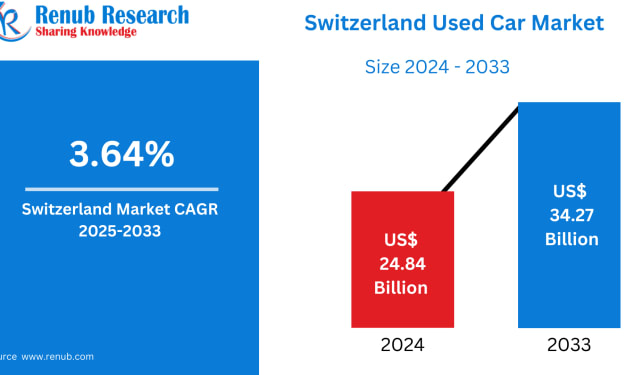
Switzerland Used Car Market Overview The Switzerland Used Car Market is undergoing steady and resilient expansion, reflecting changing consumer priorities, economic pragmatism, and evolving mobility trends. According to Renub Research, the market is expected to grow from US$ 24.84 billion in 2024 to US$ 34.27 billion by 2033, registering a Compound Annual Growth Rate (CAGR) of 3.64% between 2025 and 2033.
By Marthan Sir5 days ago in The Swamp
Fair Exchange, No Robberies
Dark Memoirs - Index There are at least two kinds of people in the world: those who write this half-arsed kind of intro to a story that looks to separate the rare and the norm, and those who realise it's an overused framing device and don't.
By Paul Stewart6 days ago in Chapters



Comments
There are no comments for this story
Be the first to respond and start the conversation.