
Unnecessary C-Sections Surge in Pakistan as Hospitals Prioritize Profit: A Growing Health Crisis
Rising number of C-sections signals a shift in the priorities of hospitals, with consequences for maternal health.

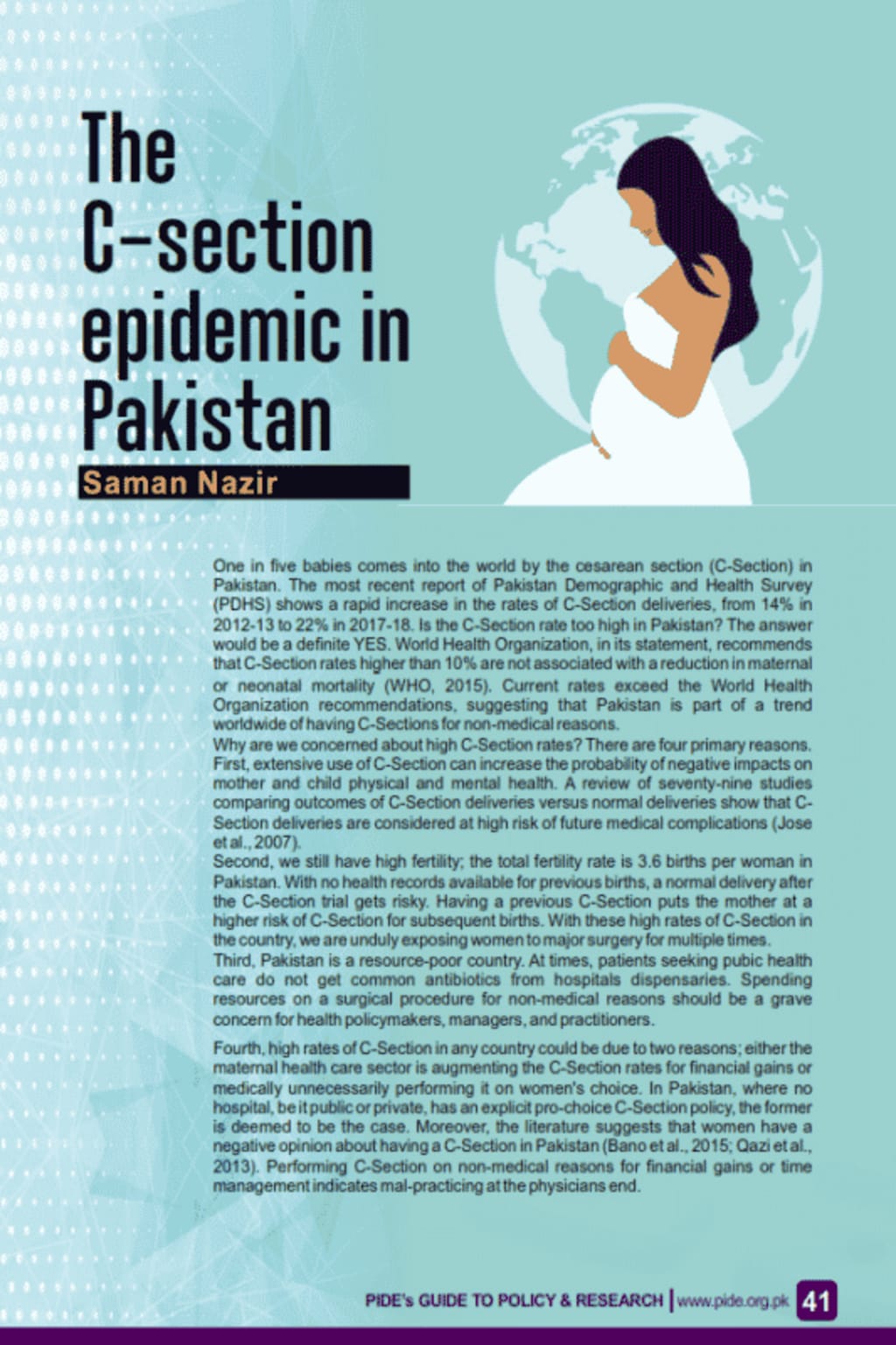
In Pakistan, the surge in unnecessary cesarean sections (C-sections) has become a disturbing trend, raising concerns over maternal health and hospital ethics. While C-sections are crucial for saving lives in certain medical situations, an increasing number of them are being performed for non-medical reasons, leading to complications and long-term health issues for mothers. This surge is largely attributed to hospitals prioritizing profit over patient care, with some institutions encouraged to push C-sections as a more profitable option for delivery.
According to recent studies, the C-section rate in Pakistan has seen a significant increase over the past few years, with some reports indicating that nearly 40% of all births in private hospitals are by C-section. This is an alarming statistic when compared to the World Health Organization's recommendation that C-sections should only account for 10-15% of births, indicating that the practice in Pakistan is not only widespread but often unnecessary.
The Profit Motive in the Medical Industry
One of the primary reasons behind the rising number of C-sections is the increasing commercialisation of the healthcare sector in Pakistan, particularly in private hospitals. C-sections, though more expensive than vaginal deliveries, are viewed as more profitable for hospitals. This is due to the higher medical fees associated with the procedure, including the surgical costs, the length of hospital stays, and follow-up care. As a result, some private hospitals are incentivized to encourage expectant mothers to opt for a C-section, even when a natural birth would suffice.
Hospitals and healthcare providers often use persuasive tactics to convince women to undergo C-sections, claiming that the procedure is safer or more convenient, particularly for women who have busy schedules or prefer the predictability of scheduled surgeries. However, these claims are not always grounded in medical necessity. The over-reliance on C-sections is undermining maternal health and causing unnecessary medical risks for both mothers and their babies.
Health Risks and Consequences
While C-sections can save lives in certain high-risk situations, they also carry significant health risks. These include infections, blood loss, longer recovery times, and increased risks for future pregnancies. Women who undergo multiple C-sections are at greater risk for complications in subsequent pregnancies, such as placenta previa, uterine rupture, and placenta accreta, which can be life-threatening. Additionally, C-sections also contribute to a higher rate of premature births and respiratory problems for babies.
The impact of unnecessary C-sections on maternal health cannot be understated. Women who have C-sections may experience more intense pain during recovery, longer hospital stays, and a higher risk of post-surgical complications, such as infections or blood clots. These risks are compounded by the fact that many women in Pakistan do not receive proper post-operative care or adequate information about the potential risks associated with C-sections.
The Role of Education and Awareness
One of the most significant factors contributing to the rise in unnecessary C-sections is the lack of education and awareness among pregnant women. Many women in Pakistan are unaware of the risks associated with C-sections and are often swayed by the advice of healthcare providers. The lack of proper information leaves women vulnerable to making decisions based on convenience rather than informed consent.
Educational campaigns about the benefits of natural childbirth, the risks of C-sections, and the importance of seeking second opinions could help empower women to make better choices for their health and the health of their babies. There is also a need for better training for healthcare providers, emphasizing patient-centered care and the importance of using C-sections only when medically necessary.
The Need for Regulatory Measures
The rise in unnecessary C-sections in Pakistan points to a larger problem of inadequate regulation and oversight in the healthcare industry. While private hospitals continue to prioritize profits, the government and relevant medical authorities must step in to enforce stricter guidelines for C-sections. This could include stricter monitoring of medical practices, better reporting of C-section rates, and more stringent requirements for informed consent before performing elective C-sections.
Furthermore, health insurance companies must also play a role in reducing unnecessary procedures by incentivizing hospitals to follow evidence-based practices and discouraging over-medicalization of childbirth.
Conclusion
The surge in unnecessary C-sections in Pakistan is a troubling trend that raises serious questions about the priorities of the healthcare system. While private hospitals may benefit financially from increased C-section rates, the consequences for maternal and child health are dire. It is essential that Pakistan’s healthcare system shifts its focus from profit to patient-centered care, prioritizing the health and well-being of mothers and babies. Public awareness, regulatory oversight, and proper education for both healthcare providers and patients are crucial to reversing this trend and ensuring a safer, healthier future for all expectant mothers in Pakistan.
About the Creator
Fiaz Ahmed Brohi
I am a passionate writer with a love for exploring and creating content on trending topics. Always curious, always sharing stories that engage and inspire.
Keep reading
More stories from Fiaz Ahmed Brohi and writers in The Swamp and other communities.
China Threatened to Cancel Key Trade Talks After UK Minister’s Taiwan Visit in June
China reportedly threatened to cancel important trade negotiations with the United Kingdom following the visit of a British minister to Taiwan in June, according to multiple diplomatic sources. The revelation underscores the delicate balance between economic engagement and geopolitical sensitivities in the Indo-Pacific region. The UK minister’s visit to Taiwan, aimed at strengthening diplomatic and economic ties, prompted a sharp reaction from Beijing. Chinese officials viewed the visit as a violation of the “One China” policy, which considers Taiwan part of China, and warned London that it could jeopardize ongoing trade discussions. While the UK insists its visit was in line with international norms and focused on trade and cultural exchange, China perceived it as a political provocation. Trade relations between China and the UK have been significant, with billions of pounds of goods exchanged annually. Sectors such as finance, technology, and advanced manufacturing have benefited from bilateral cooperation. However, Beijing’s threat to cancel talks reflects growing caution in its approach to countries that engage with Taiwan in a formal capacity. Diplomatic sources indicate that Chinese officials issued the warning shortly after the minister’s visit, signaling that they could reconsider future trade agreements if the UK continued actions perceived as undermining Chinese sovereignty. A senior UK official described the threat as “blunt but expected,” emphasizing that such responses are part of China’s broader strategy to maintain influence over Taiwan-related matters. The incident also highlights the increasingly complex environment for global trade negotiations. Governments are now required to navigate not only economic objectives but also geopolitical considerations. Analysts suggest that countries like the UK, which seek to expand trade with Asian markets, must weigh the benefits of economic engagement against the potential diplomatic repercussions of high-profile visits to Taiwan. Beijing’s approach follows a pattern observed with other Western nations that have pursued closer ties with Taiwan. In recent years, countries that have sent officials to Taiwan or strengthened defense and economic cooperation have faced warnings, sanctions, or diplomatic pushback from China. The UK’s situation is a clear example of how even routine trade discussions can be influenced by broader geopolitical dynamics. The timing of the threat was particularly sensitive, as both the UK and China were preparing for high-level trade negotiations intended to secure agreements in areas such as technology transfer, green energy, and financial services. Analysts suggest that Beijing’s warning created pressure for London to balance its diplomatic principles with the economic imperative of securing trade deals with one of its largest trading partners. Despite the tension, both countries have signaled a desire to continue engagement. British officials have emphasized that trade talks will proceed, albeit with the awareness that political developments, such as ministerial visits to Taiwan, can influence negotiations. China, meanwhile, is reportedly monitoring the UK’s actions closely, sending signals that further engagement may be contingent on diplomatic restraint regarding Taiwan. Experts note that this incident is part of a broader challenge facing international relations in 2026 and beyond. Trade, technology, and geopolitical influence are increasingly interconnected, meaning that countries cannot treat economic discussions as separate from political actions. The UK’s experience highlights the complexities facing smaller powers attempting to maintain sovereignty over their foreign policy while engaging economically with major global powers. For the business community, the threat of canceled talks serves as a reminder of the unpredictability inherent in international trade. Companies operating in both the UK and China may face delays or uncertainty in contracts and agreements if political tensions escalate. Industries reliant on Chinese imports or investment must now factor in potential diplomatic disputes that could affect supply chains and market access. In the broader context, the episode underscores the continuing tension over Taiwan, a flashpoint in global geopolitics. While countries like the UK engage with Taiwan on trade, culture, and technology, China remains highly sensitive to any form of international recognition or engagement that could suggest support for Taiwanese independence. This dynamic ensures that trade relations are often intertwined with political signaling, requiring careful diplomatic navigation. As the UK and China move forward, observers are closely watching how both nations manage their economic and political priorities. The challenge lies in maintaining robust trade relations while avoiding actions that could provoke diplomatic backlash. The June incident serves as a reminder of the fine line countries walk in balancing global trade ambitions with geopolitical realities. Ultimately, the warning issued by China in response to the UK minister’s Taiwan visit highlights the complex interplay of diplomacy and commerce in today’s world. While trade talks are vital for economic growth, they cannot be separated from the broader strategic environment in which they occur, particularly when sensitive issues like Taiwan are involved. For the UK, navigating this delicate balance will remain a priority in ensuring both economic opportunities and stable international relations.
By Fiaz Ahmed Brohi18 days ago in The Swamp



Comments
There are no comments for this story
Be the first to respond and start the conversation.