
United States Tire Market Size and Forecast 2025–2033
How Innovation, EV Adoption, and a Massive Replacement Market Are Reshaping America’s Tire Industry

United States Tire Market Overview
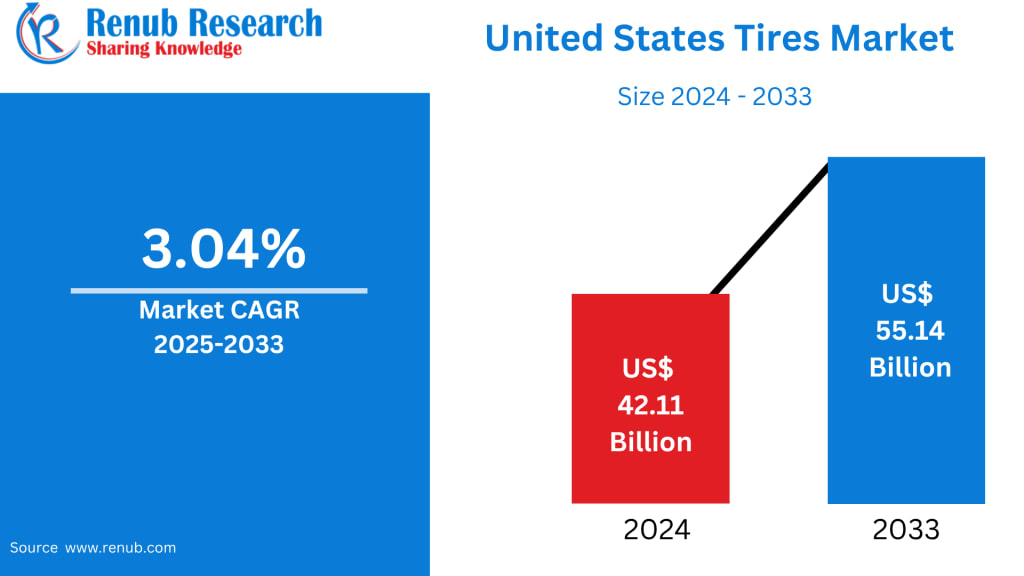
The United States Tires Market is expected to grow extensively, from US$ 42.11 billion in 2024 to US$ 55.14 billion by 2033, expanding at a Compound Annual Growth Rate (CAGR) of 3.04% between 2025 and 2033, according to Renub Research. This steady expansion reflects the central role tires play in the nation’s vast transportation ecosystem—supporting personal mobility, logistics, public transit, and emerging electric vehicle (EV) infrastructure.
Tires are vital vehicle components designed to deliver traction, stability, and control under diverse road and weather conditions. Manufactured from advanced rubber compounds, steel belts, and engineered polymers, modern tires enhance fuel efficiency, safety, comfort, and durability. From all-season and winter tires to high-performance and eco-friendly variants, today’s tire portfolio is highly specialized to meet evolving consumer preferences and regulatory standards.
In the United States, the tire industry remains a cornerstone of the automotive value chain. With nearly 300 million vehicles on the road, demand for quality tires is constant, driven not only by new vehicle sales but also by a massive replacement market. Increasing environmental awareness, advances in materials science, and digital retail platforms are further redefining how tires are designed, sold, and serviced across the country.
United States Tire Market Outlook
The U.S. tire market is transitioning from a mature replacement-driven industry to a technology-oriented ecosystem focused on sustainability, performance optimization, and vehicle electrification. Consumer expectations now extend beyond durability and affordability to include noise reduction, low rolling resistance, smart monitoring features, and reduced environmental impact.
The rapid growth of electric and hybrid vehicles, combined with increasing urbanization and e-commerce logistics, is reshaping demand patterns. At the same time, tire manufacturers are navigating volatile raw material prices, tightening environmental regulations, and supply chain disruptions—requiring innovation in sourcing, production, and recycling.
With strong aftermarket channels, established brand loyalty, and continuous R&D investment, the U.S. tire market is well-positioned for sustained growth throughout the forecast period.
Growth Drivers in the United States Tire Market
Expansion of the Automotive Sector and Rising Vehicle Ownership
One of the most influential drivers of tire demand is the steady expansion of the U.S. automotive sector. Growth in passenger cars, light commercial vehicles, trucks, and electric vehicles directly increases both OEM and replacement tire consumption.
Vehicle ownership continues to rise across urban and suburban regions, supported by stable consumer confidence and improving disposable incomes. E-commerce and logistics growth have further boosted the demand for fleet vehicles, increasing wear cycles and accelerating replacement frequency.
The aging of the U.S. vehicle fleet also plays a crucial role. According to industry data, the average vehicle age in the United States has climbed to nearly 12.8 years, while the total number of registered vehicles has surpassed 289 million. With lower scrappage rates, older vehicles remain in service longer—driving continuous demand for replacement tires.
Rising Adoption of Electric and Hybrid Vehicles
The rapid shift toward electric and hybrid mobility is transforming the U.S. tire industry. EVs place unique demands on tires due to higher vehicle weight from battery packs, instant torque, and the need for quieter operation. As a result, tire manufacturers are engineering products with reinforced structures, advanced tread compounds, and low rolling resistance to enhance efficiency and driving range.
Government incentives, charging infrastructure investments, and stricter emission regulations are accelerating EV adoption nationwide. In 2024 alone, electric vehicle sales crossed 1.6 million units, accounting for more than 10% of new vehicle purchases. Although growth rates have moderated compared to previous years, the long-term shift toward electrification continues to create new opportunities in premium and specialty tire segments.
Tires optimized for EV performance—featuring longer lifespan, enhanced grip, and reduced road noise—are emerging as a high-value category within the U.S. market.
Replacement Tire Market Expansion and Aftermarket Growth
The replacement segment remains the backbone of the U.S. tire industry, accounting for a significantly larger share of sales than OEM channels. With an aging vehicle fleet and extensive road usage, replacement demand is both recurring and resilient.
Consumers are increasingly proactive about tire maintenance, safety, and fuel efficiency, leading to more frequent upgrades. The rise of online platforms, independent retailers, and national service chains has made tire purchasing more convenient and competitive. Seasonal demand—particularly for winter, all-terrain, and off-road tires—further supports recurring sales cycles.
Additionally, the growth of used vehicle ownership and extended vehicle lifespans continues to reinforce long-term demand for replacement tires, making this segment a stable revenue engine for manufacturers and distributors alike.
Challenges Facing the United States Tire Market
Raw Material Price Volatility and Supply Chain Constraints
Fluctuating prices of natural rubber, synthetic rubber, and petroleum-based inputs pose ongoing challenges to tire manufacturers. Since raw materials represent a significant portion of production costs, even minor price swings can impact margins and pricing strategies.
Geopolitical uncertainties, shipping disruptions, and global supply chain constraints have also created bottlenecks in sourcing and logistics. Although domestic production capacity has improved, dependence on imported raw materials remains high. To mitigate risks, manufacturers are investing in recycled materials, alternative compounds, and sustainable sourcing practices.
Environmental Regulations and Waste Management Issues
Environmental compliance is another major challenge. The U.S. Environmental Protection Agency (EPA) enforces strict standards on emissions, chemical usage, and waste disposal in tire manufacturing. Non-compliance can result in financial penalties and operational disruptions.
End-of-life tire (ELT) management remains a critical issue, with millions of discarded tires generated annually. While recycling and energy recovery programs have expanded, illegal dumping and landfill capacity constraints persist in some states. As a result, manufacturers are increasingly adopting circular economy models—focusing on retreading, material recovery, and eco-friendly production processes.
Balancing environmental responsibility with cost efficiency and product performance will remain a defining challenge for the industry.
Segment Analysis
United States Radial Tires Market
Radial tires dominate the U.S. market due to their superior durability, fuel efficiency, and ride comfort compared to bias tires. Their steel-belted construction enhances traction, heat dissipation, and overall performance—making them the standard choice for passenger cars, SUVs, light trucks, and electric vehicles.
Continuous innovations in tread design, silica-based compounds, and pressure monitoring systems are further strengthening radial tire demand. As consumers prioritize safety, comfort, and sustainability, premium radial tires—especially low-rolling-resistance and eco-friendly variants—are becoming a central pillar of market growth.
United States OEM Tires Market
The OEM tire segment closely tracks domestic vehicle production trends. Automakers increasingly collaborate with tire manufacturers to develop customized solutions that improve fuel efficiency, handling, and safety.
With the rise of electric vehicles and advanced mobility technologies, OEM demand is shifting toward specialized, high-performance tire designs. Although fluctuations in vehicle manufacturing volumes can affect this segment, strategic partnerships and diversified product portfolios are helping tire companies maintain stability and innovation.
United States Passenger Car Tires Market
Passenger cars account for the largest share of tire demand in the United States, driven by widespread vehicle ownership and daily commuting patterns. The growing popularity of SUVs, sedans, and electric cars has diversified demand across performance, touring, and all-season categories.
Consumers increasingly value low noise, fuel economy, and advanced safety features. Manufacturers are responding with smart tread designs, noise-reduction technologies, and connected tire systems that provide real-time performance monitoring.
Seasonal weather variations also support demand for winter, all-weather, and all-terrain tires, ensuring steady replacement cycles across regions.
United States Three-Wheelers Tires Market
Although niche in size, the three-wheeler tire segment is gradually expanding due to applications in urban mobility, delivery services, and recreational vehicles. The rise of electric trikes and micro-mobility platforms is opening new avenues for lightweight, durable, and energy-efficient tire designs.
Last-mile logistics and urban transport solutions are key growth areas, with manufacturers focusing on puncture resistance, longevity, and adaptability across mixed road conditions. While this segment remains smaller than two- and four-wheeler categories, technological innovation could accelerate its future adoption.
United States Offline Tires Market
Offline retail remains the dominant distribution channel in the U.S. tire market, supported by established service networks and customer trust. Many consumers prefer in-store purchases for professional fitting, alignment, and maintenance services.
Large retail chains and franchise outlets offer broad product selections, financing options, and loyalty programs. Commercial fleets also rely heavily on offline channels for bulk purchases and service contracts.
Although online platforms are gaining traction, the offline segment continues to thrive by integrating digital tools such as inventory tracking, appointment scheduling, and omnichannel customer experiences.
Regional Market Highlights
California Tires Market
California represents one of the most dynamic tire markets in the United States, driven by high vehicle density, diverse terrain, and strong environmental policies. The state’s leadership in electric vehicle adoption is boosting demand for low-emission, energy-efficient tires.
Urban centers such as Los Angeles and San Francisco prioritize sustainable transportation, prompting manufacturers to introduce eco-friendly compounds and smart tire technologies. A strong aftermarket ecosystem further reinforces California’s role as a key innovation hub in the U.S. tire industry.
New York Tires Market
New York’s tire demand is shaped by dense urban traffic, extensive commercial transportation, and pronounced seasonal weather patterns. Snow and all-weather tires experience heightened demand during winter months, while delivery fleets ensure steady replacement cycles year-round.
Robust retail networks and recycling initiatives support market accessibility and sustainability. Tire manufacturers continue to focus on durability and traction solutions tailored to New York’s diverse driving conditions.
Washington Tires Market
Washington’s growing population, expanding EV adoption, and mix of urban and rural transport needs make it a balanced and evolving tire market. Frequent rainfall and hilly terrain increase demand for all-season and high-performance tires.
State sustainability initiatives are encouraging environmentally responsible manufacturing and recycling practices. Industrial growth along major transport corridors further supports demand for heavy-duty commercial tires.
Market Segmentation
By Design
Radial
Bias
By End-Use
OEM
Replacement
By Vehicle Type
Passenger Cars
Light Commercial Vehicles
Medium & Heavy Commercial Vehicles
Two Wheelers
Three Wheelers
Off-the-Road (OTR)
By Distribution Channel
Offline
Online
By Top States
California, Texas, New York, Florida, Illinois, Pennsylvania, Ohio, Georgia, New Jersey, Washington, North Carolina, Massachusetts, Virginia, Michigan, Maryland, Colorado, Tennessee, Indiana, Arizona, Minnesota, Wisconsin, Missouri, Connecticut, South Carolina, Oregon, Louisiana, Alabama, Kentucky, and Rest of the United States.
Competitive Landscape
Leading companies operating in the U.S. tire market include:
Apollo Tyres Ltd.
Bridgestone Corporation
Continental AG
Hankook Tire & Technology Co., Ltd.
MRF Tyres
Sumitomo Rubber Industries, Ltd.
The Goodyear Tire & Rubber Company
The Michelin Group
Toyo Tire Corporation
Yokohama Tire Corporation
Each company is analyzed across five viewpoints: Overview, Key Personnel, Recent Developments, SWOT Analysis, and Revenue Performance, highlighting the industry’s emphasis on innovation, strategic partnerships, and geographic expansion.
Final Thoughts
The United States Tire Market is entering a transformative era defined by electrification, sustainability, and digital integration. With revenues projected to rise from US$ 42.11 billion in 2024 to US$ 55.14 billion by 2033, the industry demonstrates resilience rooted in a vast replacement market, technological innovation, and evolving consumer expectations.
While challenges such as raw material volatility and environmental compliance persist, they are also accelerating innovation in recycling, alternative materials, and smart manufacturing. As electric vehicles, connected mobility, and sustainability become central to transportation policy, tire manufacturers that invest in performance optimization, eco-friendly solutions, and omnichannel retail will be best positioned to capture long-term growth.
For businesses, investors, and policymakers alike, the U.S. tire industry offers a compelling example of how a mature market can reinvent itself—driving forward on the wheels of innovation, efficiency, and responsible mobility.
About the Creator
Renub Research
Renub Research is a Market Research and Consulting Company. We have more than 15 years of experience especially in international Business-to-Business Researches, Surveys and Consulting. Call Us : +1-478-202-3244
Keep reading
More stories from Renub Research and writers in The Swamp and other communities.
Germany Transportation Battery Market Size and Forecast 2025–2033
Germany Transportation Battery Market Overview The Germany Transportation Battery Market is entering a decisive growth phase as the country accelerates its transition toward climate-neutral mobility. According to Renub Research, the market is expected to expand from US$ 4.77 billion in 2024 to US$ 13.84 billion by 2033, registering a strong compound annual growth rate (CAGR) of 12.56% from 2025 to 2033. This rapid expansion reflects Germany’s deep commitment to electric mobility, renewable energy integration, and long-term energy independence.
By Renub Research4 days ago in The Swamp
European Leaders Rally Behind Greenland as Miller Ramps Up Trump Threats
A Renewed Focus on Greenland’s Strategic Importance European leaders have publicly rallied behind Greenland after comments from U.S. political figure Stephen Miller, a close ally of former President Donald Trump, reignited controversy over Washington’s intentions toward the Arctic territory. Miller’s remarks, widely interpreted as reinforcing earlier Trump-era threats to exert control or influence over Greenland, have triggered swift diplomatic responses across Europe.
By Aarif Lashari4 days ago in The Swamp
Bruce Lee and The God of War: Kuan Ti
It starts with love.. The Power to the God Of War and Wealth Walk into a Chinese restaurant (even in Oklahoma, USA), a Chinese police station, a kung fu martial arts studio or even a Chinese temple and you often see a red faced warrior holding a heavy quan-do (spear like weapon).
By WILD WAYNE : The Dragon King3 days ago in Chapters


Comments
There are no comments for this story
Be the first to respond and start the conversation.