
United States Robotic Vacuum Cleaner Market Size and Forecast 2025–2033
How Smart Homes, AI Integration, and Lifestyle Changes Are Shaping America’s Robotic Cleaning Revolution

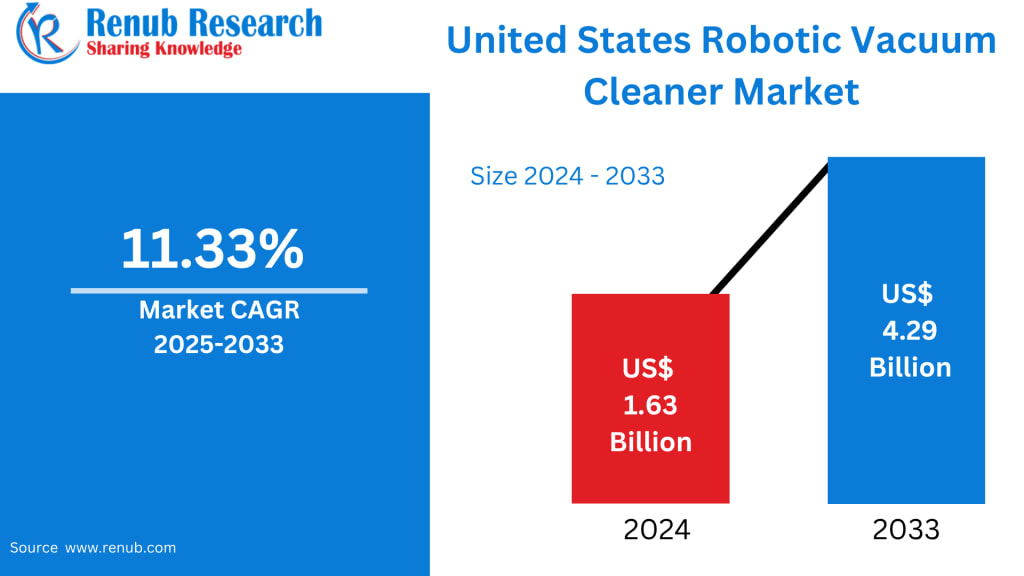
The United States Robotic Vacuum Cleaner Market is undergoing remarkable growth as smart home adoption accelerates and consumers increasingly embrace tech-driven convenience. According to Renub Research, the market is projected to reach US$ 4.29 billion by 2033, up from US$ 1.63 billion in 2024, expanding at a CAGR of 11.33% from 2025 to 2033. This rapid rise reflects an evolving consumer mindset, a surge in home automation preferences, and continuous advancements in AI-enabled cleaning technologies.
Robotic vacuum cleaners—once considered luxury gadgets—have transformed into essential home appliances for millions of Americans. The proliferation of smart devices, busy urban lifestyles, and heightened awareness of hygiene post-pandemic have all accelerated demand. Whether in a compact Manhattan apartment, a suburban Texas household, or a tech-forward California residence, robotic vacuums are redefining how Americans approach cleanliness.
United States Robotic Vacuum Cleaner Industry Overview
The U.S. market for robotic vacuum cleaners is maturing quickly due to rising interest in home automation, adherence to hygiene standards, and growing consumer preference for devices that save time and effort. Modern households—especially in urban and suburban regions—seek efficient, automated cleaning solutions that blend seamlessly into their smart living environments.
Robotic vacuum cleaners today are equipped with advanced navigation sensors, AI-based room mapping, self-charging docks, and app-controlled scheduling. These features provide unmatched convenience, reduced human intervention, and consistent cleaning performance. The combination of AI-driven intelligence, energy-efficient operation, and smartphone connectivity is setting a new benchmark in home maintenance.
Furthermore, the expansion of smart home ecosystems—dominated by platforms like Amazon Alexa, Google Assistant, and Apple HomeKit—is making robotic vacuum cleaners more intuitive and responsive. The integration of voice commands, real-time monitoring, and personalized cleaning schedules is transforming user expectations while fostering widespread adoption.
Commercial facilities—particularly hotels, offices, and retail spaces—are also deploying robotic vacuum cleaners to streamline operations and maintain cleanliness standards, thereby contributing to broader market growth.
Despite high demand, challenges such as premium pricing, maintenance requirements, and occasional performance inconsistencies continue to pose hurdles. However, ongoing technological improvements and the introduction of cost-effective models are steadily addressing these concerns.
Key Factors Driving Market Growth in the United States
1. Rising Adoption of Smart Home Technology
The smart home revolution is at the heart of the U.S. robotic vacuum cleaner boom. Millions of American households are integrating smart devices to enhance daily life, improve convenience, and increase energy efficiency. Robotic vacuum cleaners fit perfectly into this ecosystem.
Consumers appreciate features such as:
Wi-Fi connectivity
Scheduled cleaning
Voice command compatibility
Real-time mapping
Remote control via mobile apps
These capabilities allow users to automate routine cleaning tasks entirely, making robotic vacuums indispensable in busy households.
The growing market for IoT devices continues to propel adoption, especially as robotic vacuums become more compatible with mainstream smart home platforms.
2. Technological Advancements in AI, Navigation, and Cleaning Power
Technology remains the most influential growth driver. Today’s robotic vacuum cleaners are far more advanced than earlier models.
Key advancements include:
AI-powered navigation systems capable of identifying obstacles, generating room maps, and avoiding hazards
Advanced sensors for detecting drop-offs, furniture, and debris levels
Improved suction power for cleaning carpets and hard floors
Self-emptying dustbins that drastically reduce manual maintenance
Extended battery life, allowing efficient cleaning of larger homes
Advanced HEPA filtration for improved indoor air quality
These upgrades are attracting tech-savvy users and simplifying household maintenance for families, seniors, and working professionals.
As manufacturers continue investing in AI-driven improvements and user-focused designs, the U.S. market is expected to witness steady technological evolution.
3. Growing Urbanization and Time-Conscious Lifestyles
Urban America is increasingly characterized by long work hours, dual-income households, and compact living spaces. These lifestyle factors strongly favor the adoption of robotic cleaning devices.
The conveniences offered by robotic vacuum cleaners—such as scheduled cleanings, quiet operation, and autonomous functionality—align perfectly with:
Working professionals
Families with children
Pet owners
Elderly individuals seeking minimal-effort solutions
Additionally, growing awareness of indoor air quality and hygiene has boosted the appeal of devices that can maintain a clean environment with minimal human involvement.
As urban density increases and consumers continue seeking time-saving solutions, robotic vacuum cleaners will remain an essential part of modern living.
Challenges in the U.S. Robotic Vacuum Cleaner Market
1. High Cost and Affordability Issues
Premium robotic vacuum cleaners equipped with advanced features often come with high price tags. Price-sensitive households may hesitate to purchase leading brands due to:
High upfront costs
Cost of replacement parts
Maintenance expenses
Additional investment for accessories
While entry-level models exist, they may lack essential features like mapping, strong suction, and advanced navigation—resulting in reduced value perception.
To overcome this, brands must focus on offering mid-range products with premium features at competitive price points.
2. Technical Limitations and Maintenance Requirements
Despite technological maturity, robotic vacuum cleaners still face functional constraints:
Struggles with thick carpets
Difficulty reaching corners and edges
Challenges in cluttered environments
Occasional navigation errors
Software connectivity issues
Need for regular cleaning of filters, brushes, and sensors
These aspects can diminish user satisfaction, especially for first-time buyers.
Manufacturers are working to improve durability, multi-surface compatibility, and user-friendly maintenance systems to deliver a more frictionless cleaning experience.
United States Robotic Vacuum Cleaner Market Overview by Key States
California
California leads the U.S. in robotic vacuum cleaner adoption thanks to:
High smart home adoption rates
Strong tech culture
Busy urban lifestyles
High disposable incomes
Cities like San Francisco, Los Angeles, and San Diego show strong uptake, driven by consumer preference for automated, eco-efficient home appliances. The state’s eco-conscious mindset has also encouraged adoption of energy-efficient robotic vacuums.
Texas
Texas is emerging as a major hub for smart home technology and robotic vacuum adoption. Factors contributing to strong demand include:
Rapid urban expansion
Growing disposable incomes
Increased adoption of home automation
A large population of working professionals
Cities such as Austin, Houston, and Dallas are major contributors, driven by both residential and commercial usage.
New York
New York’s dense population, fast-paced urban lifestyle, and prevalence of compact living spaces make robotic vacuum cleaners ideal for its residents.
Key drivers include:
Strong preference for time-saving technologies
High smart home penetration
E-commerce convenience
High disposable incomes in metro areas
Although space constraints and affordability may hinder adoption for some households, the market continues to expand steadily.
Florida
Florida’s adoption has been driven by:
Rapid residential modernization
Dust-prone and coastal environments
High smart home adoption in cities like Miami and Tampa
Growing retirement communities that prefer convenience-based appliances
Tourism-driven hospitality businesses are also adopting robotic vacuums to streamline cleaning operations.
Recent Developments in the U.S. Market
A notable development in 2024 was the U.S. debut of Dyson’s 360 Vis Nav robotic vacuum cleaner, featuring:
A 360-degree navigation camera
65 air watts of suction
HEPA filtration
Enhanced mobility and smart navigation
The launch reflects the broader industry shift toward:
Voice-enabled controls
AI-enhanced mapping
Sustainable and energy-efficient designs
Stronger suction and deep-cleaning capabilities
This innovation is reshaping competitive dynamics and pushing brands to enhance product sophistication.
Market Segmentations
By Type
Robotic Floor Vacuum Cleaner
Robotic Pool Vacuum Cleaner
By Type of Charging
Manual Charging
Automatic Charging
By Distribution Channel
Institutional / Direct Sales
Retail Sales
By Application
Vacuum Cleaning Only
Vacuum Cleaning and Mopping
By End User
Residential
Commercial
By States
California, Texas, New York, Florida, Illinois, Pennsylvania, Ohio, Georgia, New Jersey, Washington, North Carolina, Massachusetts, Virginia, Michigan, Maryland, Colorado, Tennessee, Indiana, Arizona, Minnesota, Wisconsin, Missouri, Connecticut, South Carolina, Oregon, Louisiana, Alabama, Kentucky, and Rest of the United States
Key Players Covered
Metapo, Inc.
iRobot Corporation
Haier Electronics Group Co. Ltd.
Neato Robotics
Hayward Industries, Inc.
Dyson Ltd.
Koninklijke Philips N.V.
Samsung Electronics Co. Ltd.
Maytronics Ltd.
LG Electronics Inc.
Includes:
✔ Company Overviews
✔ Key Executives
✔ Recent Developments
✔ SWOT Analysis
✔ Revenue Analysis
Final Thoughts
The United States Robotic Vacuum Cleaner Market is on an impressive trajectory, powered by technological innovation, rising smart home adoption, and evolving lifestyle trends. As AI-driven automation becomes a staple of American households, robotic vacuum cleaners are set to play an even more central role in home maintenance.
With the market expected to hit US$ 4.29 billion by 2033, growth opportunities abound for manufacturers who prioritize user-friendly designs, affordability, and advanced automation features. The future of cleaning is undeniably intelligent, connected, and fully automated — and robotic vacuum cleaners are leading this transformation across America.
About the Creator
Sushant. Renub Research
I’m Sushanta Halder, Digital Marketing Manager at Renub Research with 15+ years in SEO, content, PPC & lead generation. Passionate about data-driven growth strategies.
Keep reading
More stories from Sushant. Renub Research and writers in The Swamp and other communities.
North America RFID Market Size and Forecast 2025–2033
The North America RFID market is entering one of the most transformative phases in its history. According to Renub Research, the market is projected to surge from US$ 14.18 billion in 2024 to a robust US$ 36.56 billion by 2033, growing at an impressive CAGR of 11.1% during 2025–2033. This accelerated expansion reflects the technology’s crucial role across major industries—from retail and logistics to healthcare, financial services, and government operations.
By Sushant. Renub Research2 months ago in The Swamp


Comments
There are no comments for this story
Be the first to respond and start the conversation.