
United States Hardware Stores Market Size and Forecast 2025–2033
Market Poised for Steady Growth as DIY Culture and Home Renovation Trends Accelerate

United States Hardware Stores Market Overview
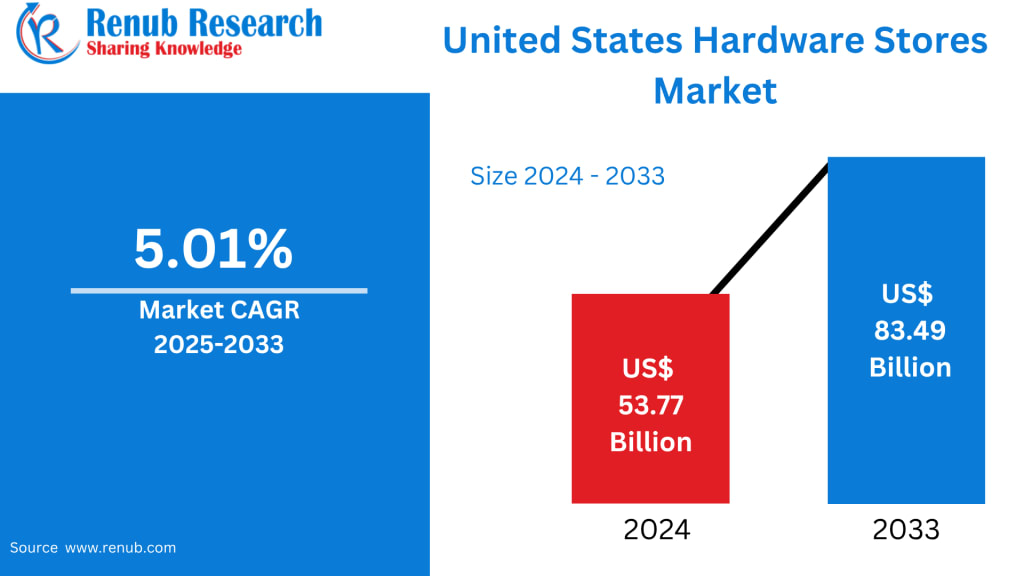
The United States Hardware Stores Market continues to be a cornerstone of the country’s construction, renovation, and home improvement ecosystem. According to Renub Research, the market is expected to reach US$ 83.49 billion by 2033, growing from US$ 53.77 billion in 2024, at a CAGR of 5.01% from 2025 to 2033.
This consistent expansion reflects changing consumer behavior, rising investments in home remodeling, and increasing demand for functional and aesthetic upgrades in residential and commercial properties. Hardware stores remain critical distribution hubs for tools, building materials, plumbing and electrical supplies, paint products, and outdoor and garden solutions.
The market includes a broad mix of independent neighborhood hardware stores, regional chains, and large national retailers such as The Home Depot, Lowe’s Companies Inc., and Ace Hardware. While digital commerce has reshaped purchasing habits, brick-and-mortar hardware stores continue to thrive by offering expert advice, immediate product availability, and strong community engagement.
Industry Evolution and Current Landscape
Over the past decade, the U.S. hardware store industry has undergone significant transformation. Rising homeownership, aging housing stock, and lifestyle changes have fueled demand for maintenance, repair, and improvement products. Consumers are no longer purchasing hardware only for necessity-driven repairs; instead, many are investing in upgrades that enhance comfort, energy efficiency, and visual appeal.
At the same time, omnichannel retail strategies have become essential. Leading hardware retailers now combine physical store experiences with online ordering, curbside pickup, mobile apps, and fast delivery services. This hybrid approach allows them to compete more effectively with pure-play e-commerce platforms while maintaining the advantage of in-person expertise.
However, the industry is not without challenges. Supply chain volatility, labor shortages, and fluctuating raw material prices have increased operational complexity. Despite these pressures, hardware stores have demonstrated resilience by optimizing inventory management, strengthening supplier partnerships, and diversifying product offerings.
Recent Industry Developments
In September 2023, Lowe’s announced the extension of its multi-year partnership with the NFL. The initiative included a national advertising campaign, the introduction of a new roster of “Lowe’s Home Team” players, and the launch of a limited-edition DIY Wrist Coach accessory. This move highlights how major hardware retailers are increasingly leveraging sports marketing and lifestyle branding to connect with younger, DIY-focused audiences.
Key Factors Driving the United States Hardware Stores Market Growth
1. Expanding Do-It-Yourself (DIY) Culture
One of the strongest growth drivers for the U.S. hardware stores market is the rapid expansion of the DIY culture. Consumers are increasingly opting to complete home repairs, décor upgrades, and small renovations on their own. Easy access to online tutorials, cost-saving motivations, and the satisfaction of hands-on work have all contributed to this trend.
Social media platforms such as YouTube, Instagram, and TikTok have become influential learning tools, offering step-by-step guidance for projects ranging from furniture assembly to bathroom remodeling. Younger homeowners and renters, in particular, are embracing DIY as a way to personalize living spaces.
In response, hardware retailers are:
Offering beginner-friendly tool kits
Providing in-store workshops and demonstrations
Curating project-based product bundles
These initiatives not only increase sales but also strengthen customer loyalty and repeat visits.
2. Strong Home Renovation and Remodeling Trends
Home renovation remains a major pillar of demand for hardware stores across the United States. Homeowners are investing heavily in projects that improve functionality, energy efficiency, and property value. Kitchens, bathrooms, flooring, lighting, and outdoor living areas are among the most popular renovation categories.
The COVID-19 pandemic accelerated this trend, as remote work and extended time at home prompted consumers to rethink their living environments. Even post-pandemic, renovation spending remains elevated due to rising housing prices and limited availability of new homes.
Hardware stores benefit directly from this trend through increased sales of:
Paints and coatings
Power tools and hand tools
Fixtures and fittings
Lumber and building materials
Retailers that offer project planning assistance, financing options, and installation referrals are particularly well-positioned to capture higher-value purchases.
3. Integration of Smart Home Technologies
The growing adoption of smart home solutions is reshaping product demand within hardware stores. Consumers are increasingly seeking smart thermostats, lighting systems, security cameras, doorbells, and energy management devices that enhance convenience and safety.
As smart devices become more affordable and user-friendly, both new construction and retrofit projects are incorporating connected technologies. Hardware stores are expanding their assortments to include smart home ecosystems and related accessories, often supported by in-store displays and trained staff.
By offering guidance and installation support, hardware retailers play a crucial role in bridging the knowledge gap for less tech-savvy customers, positioning themselves as trusted advisors in the smart home journey.
Challenges in the United States Hardware Stores Market
High Competition from E-Commerce Platforms
E-commerce continues to pose a significant challenge to traditional hardware stores. Online giants such as Amazon and Walmart attract customers with competitive pricing, extensive product ranges, and rapid delivery options.
Smaller and independent hardware stores often struggle to match these capabilities due to limited digital infrastructure and logistics resources. As consumer preferences increasingly shift toward online and mobile shopping, hardware retailers must invest in:
Robust e-commerce platforms
Efficient fulfillment and delivery systems
Seamless online-to-offline experiences
Failure to adapt could result in declining market share, particularly among younger, digitally native consumers.
Dependence on Housing Market Cycles
The performance of hardware stores is closely tied to the health of the housing market. Slowdowns in home sales, new construction, or renovation activity can directly impact demand for hardware products.
Macroeconomic factors such as rising interest rates, inflation, and tighter lending conditions may cause homeowners to postpone large renovation projects. Seasonal fluctuations and regional housing trends further add to market volatility.
To mitigate these risks, hardware retailers are diversifying their offerings, focusing on maintenance and repair products, and targeting both professional contractors and DIY consumers across different economic cycles.
United States Hardware Stores Market Overview by States
California Hardware Stores Market
California represents one of the most dynamic hardware store markets in the country. Driven by a large population, active construction sector, and strong DIY culture, demand spans residential, commercial, and outdoor applications.
Environmental regulations and green building standards boost sales of energy-efficient and sustainable products. Retailers must adapt to regional climate differences, earthquake-resistant construction needs, and seasonal demand patterns while competing with big-box and online retailers.
Texas Hardware Stores Market
Texas boasts a robust hardware store market supported by rapid urbanization, population growth, and a thriving construction industry. Major cities such as Houston, Dallas, and Austin serve as key retail hubs.
The state’s agricultural and ranching sectors also generate demand for specialized tools and equipment. Hardware retailers in Texas are increasingly adopting digital platforms and omnichannel strategies to enhance customer engagement and operational efficiency.
New York Hardware Stores Market
New York’s hardware store landscape reflects its diverse urban and rural environments. In metropolitan areas like New York City, stores cater to compact living spaces and older infrastructure with specialized products and services.
Community engagement, workshops, and personalized service help independent stores build strong customer relationships, while suburban and rural areas see greater presence of large-format retailers. The integration of e-commerce and in-store pickup continues to gain traction across the state.
Market Segmentation Overview
By Product Type
Tools and Hardware
Building Materials
Plumbing and Electrical Supplies
Paint and Home Improvement
Outdoor and Garden Supplies
By Application
Professional Contractors
DIY Consumers
Institutional Buyers
Industrial Customers
By States
California, Texas, New York, Florida, Illinois, Pennsylvania, Ohio, Georgia, Washington, New Jersey, and Rest of United States
Competitive Landscape and Company Analysis
The U.S. hardware stores market is moderately consolidated, with major national players coexisting alongside regional and independent retailers. Key companies include:
The Home Depot
Lowe’s Companies Inc.
Menard Inc.
Ace Hardware
True Value Hardware
84 Lumber
Handy Andy Home Improvement Centers Inc.
Hippo Hardware and Trading Company
Orchard Supply Hardware
Harbor Freight Tools
Company analysis typically covers overviews, key personnel, recent developments, SWOT analysis, and revenue performance, highlighting how each player competes through pricing, product breadth, customer service, and digital innovation.
Final Thoughts
The United States Hardware Stores Market is set for steady and sustainable growth through 2033, underpinned by strong DIY enthusiasm, ongoing home renovation activity, and increasing adoption of smart home technologies. While competition from e-commerce and housing market volatility pose challenges, hardware retailers that embrace omnichannel strategies, personalized service, and product innovation are well-positioned to succeed.
As communities continue to invest in homes, infrastructure, and outdoor living spaces, hardware stores will remain indispensable partners in shaping functional, efficient, and comfortable environments across the United States.
About the Creator
Renub Research
Renub Research is a Market Research and Consulting Company. We have more than 15 years of experience especially in international Business-to-Business Researches, Surveys and Consulting. Call Us : +1-478-202-3244
Keep reading
More stories from Renub Research and writers in The Swamp and other communities.
Latin America Non-Lethal Weapons Market Trends & Summary (2025–2033)
Introduction The Latin America Non-Lethal Weapons Market is undergoing a significant transformation as governments and security agencies increasingly seek solutions that ensure public order while minimizing fatalities and long-term injuries. According to Renub Research, the market is projected to grow from US$ 407.51 million in 2024 to US$ 652.65 million by 2033, expanding at a compound annual growth rate (CAGR) of 5.37% between 2025 and 2033.
By Renub Research24 days ago in The Swamp
In Pictures: Protests Held in US Cities After Woman Shot Dead by Immigration Agent
Across the United States, protests have erupted in multiple cities following the fatal shooting of a woman by a US immigration enforcement agent. From Minneapolis to Los Angeles, demonstrators have gathered in streets, parks, and public squares, holding candles, placards, and photographs as they demand justice, transparency, and accountability.
By Aarif Lashari3 days ago in The Swamp
Day 4 of Quitting
If this is how sobriety feels, maybe it’s better to go through life a little buzzed… this, along with other hits like, I want to kill myself, I wish I was dead, and I’m going to throw myself off a bridge have been the only thoughts on rotation these past few days. I promise myself that if, in a month, I still feel like this (‘this’ meaning despondent, full of rage, and simultaneously numb) I can go back to smoking. Until mid-February though? Nicotine is off the table.
By sleepy drafts4 days ago in Longevity


Comments
There are no comments for this story
Be the first to respond and start the conversation.