
"U.S. Faces Economic and Educational Upheaval Amid Trade Wars and Political Shifts in 2025"
U.S. Economy Struggles Under Pressure From Aggressive Tariff Policies

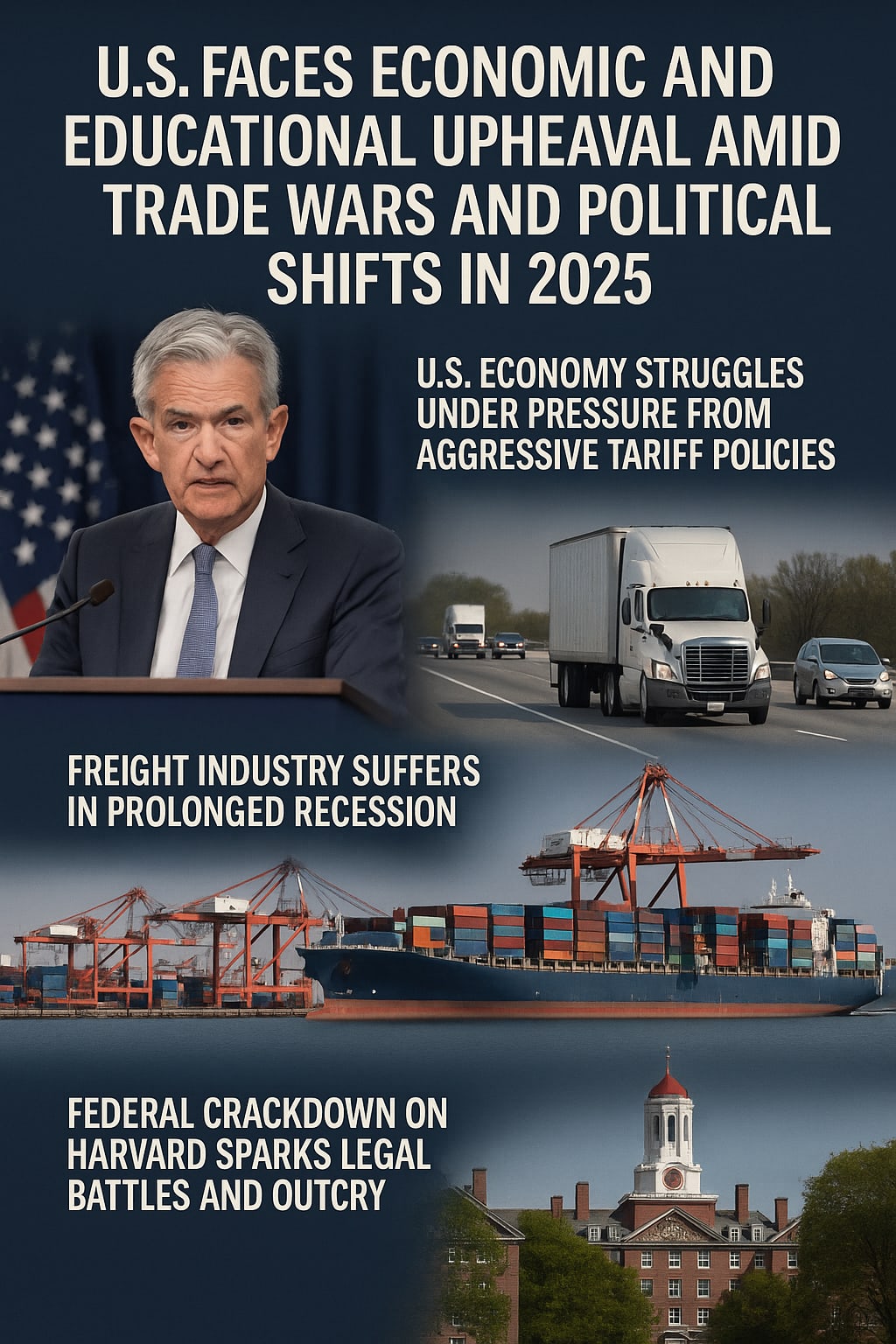
The United States finds itself at a pivotal crossroads in April 2025, grappling with major shifts across its economic, political, and educational landscapes. A combination of protectionist trade policies, mounting pressure on elite academic institutions, and a rapidly transforming energy grid is shaping a new and uncertain era for the nation.
U.S. Economy Struggles Under Pressure From Aggressive Tariff Policies
The American economy is exhibiting signs of distress as a result of intensified tariff measures under the Trump administration’s trade policy. Designed to reduce reliance on foreign imports and strengthen domestic manufacturing, these tariffs have instead led to a cascade of challenges across multiple sectors.
According to a new Reuters poll, economists have raised the probability of a recession in the next 12 months to 45%, the highest level since the end of 2023. GDP growth projections for 2025 have also been revised downward—from an anticipated 2.2% to a modest 1.4%. Inflation continues to hover above the Federal Reserve’s 2% target, with few signs of abatement in the near future.
Federal Reserve Chair Jerome Powell voiced concern in a recent briefing, warning that continued trade restrictions could further derail the Fed’s policy goals and deepen uncertainty in both consumer and investor markets. He emphasized that while short-term job growth in manufacturing may look promising on the surface, the long-term cost to American businesses and consumers could be steep.
Freight Industry Suffers in Prolonged Recession
Nowhere is the impact of economic strain more evident than in the freight and logistics industry. Trucking giant J.B. Hunt reported an 8% year-over-year drop in operating income, reflecting sluggish demand, overcapacity, and rising fuel costs.
Analysts describe the current state of the trucking industry as a full-blown freight recession. Excess capacity created during the pandemic, combined with weak consumer spending and global trade fragmentation, has created a storm from which recovery could take more than a decade.
Freight companies are cutting jobs, reducing fleet sizes, and pausing major investments. Supply chain disruptions caused by international tensions have further complicated logistics operations, especially as companies scramble to reorient their sourcing strategies away from China.
U.S.-China Trade Decoupling Signals Global Shift
The World Trade Organization has confirmed a significant reduction in trade between the U.S. and China—projecting an 80% drop in merchandise trade volume this year alone. This decoupling represents a broader ideological and economic rift between two of the world’s largest economies, pushing the global system toward a “bifurcated” trade landscape.
In response to national security concerns, the U.S. government is also assessing the feasibility of further limiting imports of rare earth minerals and semiconductors from China. These materials are critical to a wide range of industries, from defense to clean energy.
The long-term consequences of this decoupling are still unfolding. While some American companies have moved production to nations like India, Vietnam, and Mexico, the overall cost of this strategic realignment remains high. Consumers may continue to feel the effects through elevated prices on goods, while global supply chains are forced to adapt to new trade corridors and political alliances.
Federal Crackdown on Harvard Sparks Legal Battles and Outcry
The Trump administration’s escalating battle with Harvard University has reached new heights. Citing what it calls a “pattern of institutional noncompliance,” the federal government has moved to revoke Harvard’s tax-exempt status and has issued a ban on admitting new international students.
At the heart of the conflict are disagreements over admissions policies, hiring practices, and curriculum content. The administration argues that elite institutions like Harvard are operating as ideological echo chambers and must be held accountable to federal oversight.
Harvard officials have pushed back, calling the moves “unprecedented overreach” that threaten academic freedom and global collaboration. International students currently enrolled at Harvard have filed lawsuits against the Department of Homeland Security, claiming violations of due process and abrupt visa cancellations.
Legal experts suggest this may set a precedent for federal involvement in higher education not seen since the civil rights era. The case is expected to reach the Supreme Court by the end of the year.
Clean Energy Surges Forward Despite Turbulent Times
Amid the political and economic turbulence, there is a bright spot: renewable energy. For the first time in history, the U.S. is expected to generate over 51% of its electricity from clean energy sources in April 2025, according to data from the U.S. Energy Information Administration.
The increase is driven largely by solar and wind production, which have benefited from improved battery storage, lower production costs, and aggressive state-level policy support. The drop in overall electricity demand during the spring season has also contributed to the clean energy milestone.
Environmental groups are celebrating the achievement as proof that the energy transition is not only possible but inevitable. However, energy experts caution that long-term investment is still needed in transmission infrastructure, grid modernization, and workforce development to sustain this momentum.
Looking Ahead
The United States stands on shifting ground, where economic forces, policy decisions, and global dynamics are colliding to reshape the national landscape. From Wall Street to Main Street, and from the halls of academia to the deserts dotted with solar farms, Americans are confronting a new reality.
While the immediate future may seem uncertain, these converging stories reveal a country in transition—facing both peril and possibility. How policymakers, institutions, and citizens respond in the coming months will determine whether these crises become catalysts for renewal or deeper division.
About the Creator
Saqib Ullah
Saqib Ullah is a content creator and writer on Vocal.media, sharing SEO-friendly articles on trending news, lifestyle, current affairs, and creative storytelling. Follow for fresh, engaging, and informative reads.
Keep reading
More stories from Saqib Ullah and writers in The Swamp and other communities.
Putin’s “Doomsday Aircraft”: A Plane Even a Nuclear Bomb Can’t Destroy
Russian President Vladimir Putin is not just one of the most powerful leaders in the world—he also flies in one of the most secure and advanced aircraft ever built. This aircraft, often referred to as the "Doomsday Plane", is designed to withstand nuclear attacks and keep the Russian leadership in full control during any global catastrophe. Built for survival in extreme warfare, this plane is more than just a flying office—it's an airborne fortress.
By Saqib Ullah9 months ago in The Swamp



Comments
There are no comments for this story
Be the first to respond and start the conversation.