
U.S. and Venezuela Tensions Rise Amid Global Nuclear Concerns
Diplomatic relations deteriorate as major powers issue warnings on nuclear testing

Diplomatic Relations Reach a New Low
The United States has reinstated broad economic sanctions on Venezuela's oil and gas sector.This move reverses a temporary relaxation of sanctions from late 2023. The U.S. State Department stated the decision followed a failure by the government of President Nicolás Maduro to uphold its electoral commitments. The reinstated sanctions are expected to significantly impact Venezuela's primary source of foreign revenue. This action marks a serious downturn in bilateral relations.
Venezuela's Response and Regional Alliances
The Venezuelan government condemned the U.S.decision as "coercive and illegal." Officials in Caracas have framed the sanctions as an attack on the Venezuelan people. In response, Maduro's administration has sought to strengthen ties with strategic allies, including Iran, Russia, and China. These nations have historically provided Venezuela with economic and diplomatic support. The renewed sanctions are likely to push Venezuela into a deeper economic reliance on these partnerships.
The Territorial Dispute with Guyana
A separate regional issue is adding to international tensions.Venezuela has renewed its historical claim over the oil-rich Essequibo region, which constitutes about two-thirds of neighboring Guyana. An international court is currently hearing the case, but Venezuela has rejected its jurisdiction. The United States has conducted joint military exercises with Guyana and reaffirmed its support for Guyana's sovereignty. This stance is viewed by Caracas as direct U.S. involvement in the territorial dispute.
Global Warnings on Nuclear Testing
Parallel to these tensions,a separate geopolitical development is unfolding. Major nuclear powers, including the United States, Russia, and China, have issued statements expressing concern over reports of potential nuclear test preparations. These warnings appear directed at a specific nation, though official statements often avoid direct naming. The context suggests increased activity at known test sites, raising global non-proliferation alarms.
Connecting Regional Tensions to Global Stability
Analysts observe that regional conflicts and global nuclear posturing can create a linked chain of instability.A nation like Venezuela, facing increased isolation, may seek more concrete security guarantees from its powerful allies. These allies, in turn, may use moments of global distraction or regional crisis to advance their own strategic positions. The deterioration of U.S.-Venezuela relations occurs within this broader landscape of major power competition.
Economic Impact on Venezuela
The practical effect of the reinstated U.S.sanctions will be economic. Prior to the six-month relief period, U.S. sanctions had contributed to a deep economic crisis in Venezuela. The temporary license had allowed a modest increase in oil production and exports. Its revocation creates immediate uncertainty for foreign oil companies operating in Venezuela. The Venezuelan state oil company PDVSA must now seek alternative, and often less profitable, markets for its crude.
Humanitarian Consequences
International aid organizations have expressed concern about the humanitarian impact.While U.S. sanctions explicitly exempt humanitarian transactions, the broader economic consequences can worsen living conditions. A shrinking economy affects the availability of food, medicine, and basic services for the Venezuelan population. The situation creates a complex debate on the efficacy of sanctions as a policy tool versus their human cost.
The Role of International Mediation
Some European and Latin American nations have called for continued dialogue.They advocate for a negotiated path that encourages democratic processes in Venezuela without triggering a full economic collapse. However, the space for neutral mediation appears to be narrowing. The reinstatement of sanctions is seen as a shift from a diplomatic to a pressure-centric approach by the U.S. administration.
Military Posturing in the Caribbean
The territorial claim over Essequibo has led to increased military movement.Venezuela has conducted military exercises near its border with Guyana. The United States has responded with aerial exercises alongside Guyanese forces. While both sides state they seek a peaceful resolution, the buildup of military assets increases the risk of a miscalculation or accidental clash. This regional standoff adds another layer of volatility.
Nuclear Non-Proliferation Framework Under Stress
The warnings on nuclear testing highlight the fragile state of global arms control agreements.Key treaties have eroded or been abandoned in recent years. The public warnings from major powers indicate intelligence assessments point to a potential breach of international norms. Such a test would represent a significant escalation and likely trigger severe international responses, further dividing the global security landscape.
Energy Markets and Global Implications
Venezuela possesses the world's largest proven oil reserves.The fluctuation of its production and export capacity due to sanctions affects global energy markets. In a period of existing volatility, the removal of Venezuelan oil from certain markets can influence global prices. This gives the situation in Venezuela an economic dimension that extends far beyond the Western Hemisphere.
Pathways for De-escalation
De-escalation currently seems difficult.For the U.S., easing sanctions would require concrete, irreversible steps by Maduro toward allowing free and fair elections. For Venezuela, it would require a political shift it has so far been unwilling to make. On the nuclear front, de-escalation requires a return to transparent dialogue within a non-proliferation framework that is currently weakened.
A Multifaceted Security Challenge
The strain in U.S.-Venezuela relations and the global nuclear warnings represent two distinct but concurrent crises.They both stress international diplomatic systems and conflict-resolution mechanisms. The intersection lies in how regional disputes can become proxy points for larger strategic competitions, and how global tensions can empower hardline positions in regional conflicts. The international community faces the dual task of managing an immediate bilateral breakdown while upholding a decades-old nuclear taboo. The stability of both regional and global order is being
About the Creator
Saad
I’m Saad. I’m a passionate writer who loves exploring trending news topics, sharing insights, and keeping readers updated on what’s happening around the world.
A Gathering of Evil Bosses
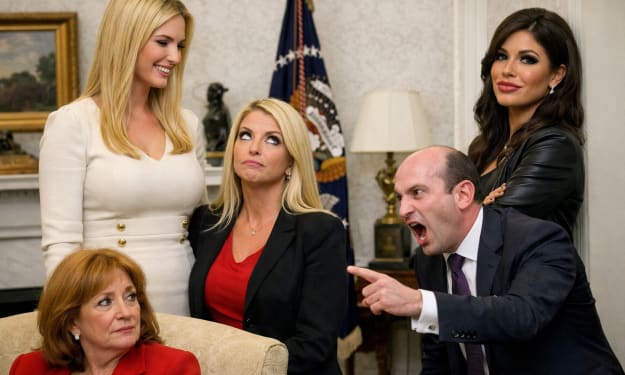
“I’m the queen of chin jutting while I smooth my hair, attacking, insulting, and deflecting to protect my appointer.” “Oh, please, Blondi, my hair is curled, highlighted, and longer than yours. I feature television commercials telling immigrants that we will give them a free plane ride home, and if they voluntarily turn themselves in, they will be allowed to legally apply for re-entry. It runs everywhere, and I look good in it! You can’t compete because of your blond hair. Mine is nicer, and my lips are prettier than yours.”
By Andrea Corwin 24 days ago in The Swamp



Comments
There are no comments for this story
Be the first to respond and start the conversation.