
Typhoon Spotted Loaded With Rocket Pods for the First Time
New configuration of the Eurofighter jet signals expanded close-air support capabilities and a shift in modern aerial combat tactics.

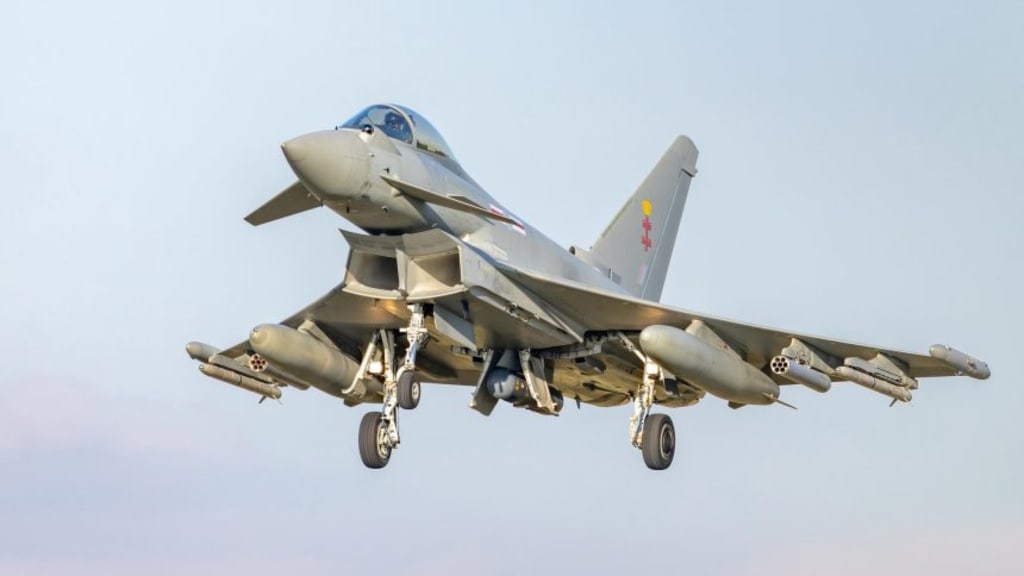
A rare and notable sighting of a combat aircraft has drawn attention from defense analysts around the world after a Eurofighter Typhoon was photographed carrying rocket pods for the first time. The unusual weapons configuration suggests that the advanced fighter jet may be expanding its operational role beyond traditional air-to-air combat and precision strike missions.
Images of the aircraft, released during a recent training exercise, show the Typhoon equipped with unguided rocket pods mounted beneath its wings. The development has sparked discussion among military experts about how modern air forces are adapting their fleets to respond to evolving battlefield demands.
The Eurofighter Typhoon is widely regarded as one of the most capable fourth-generation fighter aircraft in service today. Designed primarily as an air-superiority fighter, the jet has gradually been adapted over the years to perform a broader set of roles, including ground attack, reconnaissance, and electronic warfare.
Traditionally, the Typhoon has been armed with precision-guided bombs, air-to-air missiles, and sophisticated targeting systems. The addition of rocket pods, however, indicates that military planners may be exploring new ways to use the aircraft in close air support (CAS) missions, where pilots provide direct assistance to ground troops during combat operations.
Rocket pods typically carry multiple unguided rockets, which can be fired rapidly in succession to suppress enemy positions or provide firepower against lightly armored vehicles and defensive positions. These weapons have long been used by attack aircraft and helicopters, but they are less commonly seen on high-performance fighter jets like the Typhoon.
Defense analysts say that adding rocket pods could give Typhoon pilots greater flexibility in certain operational scenarios. While precision-guided munitions remain highly effective against strategic targets, unguided rockets can be useful in situations where rapid firepower is required against dispersed enemy forces.
The new configuration also highlights the adaptability of the Typhoon platform. The aircraft was originally developed through a multinational partnership involving several European countries, including United Kingdom, Germany, Italy, and Spain. These nations continue to upgrade the jet’s capabilities to ensure it remains competitive in a rapidly evolving security environment.
Some analysts believe the rocket pod configuration could be linked to recent conflicts where air forces have needed to engage a wide variety of targets, ranging from armored vehicles to irregular militia forces. In such conflicts, having multiple weapon options available on a single aircraft can significantly enhance operational flexibility.
Another factor behind the development may be the increasing emphasis on multi-role capability in modern air forces. As defense budgets come under pressure and security challenges multiply, militaries are seeking aircraft that can perform several missions without requiring specialized platforms for each task.
The Typhoon has already proven its versatility in several international operations. The aircraft has been deployed in air-policing missions across Europe, participated in NATO exercises, and carried out combat operations in regions such as the Middle East. Each deployment has led to further upgrades in the aircraft’s weapons systems, sensors, and mission software.
Despite the excitement generated by the recent sighting, defense officials have not yet confirmed whether the rocket pod configuration will become a standard option for Typhoon squadrons. It is possible that the setup is being tested as part of an experimental evaluation or training program.
If the configuration does enter regular service, it could represent a subtle but important shift in how modern fighter aircraft are used in complex conflicts. By combining high-speed performance, advanced sensors, and diverse weapon systems, the Typhoon would be able to operate effectively in both high-intensity warfare and lower-intensity battlefield support roles.
For now, the images of the rocket-armed Typhoon serve as a reminder that even well-established military platforms continue to evolve. As technological innovation and changing battlefield requirements shape the future of warfare, aircraft like the Typhoon are likely to undergo further modifications to meet the challenges of modern combat.
About the Creator
Fiaz Ahmed
I am Fiaz Ahmed. I am a passionate writer. I love covering trending topics and breaking news. With a sharp eye for what’s happening around the world, and crafts timely and engaging stories that keep readers informed and updated.
Keep reading
More stories from Fiaz Ahmed and writers in The Swamp and other communities.
Trump Tightens Pressure on Cuba as U.S. Pushes for Charges Against Leaders
The administration of Donald Trump has intensified its pressure campaign against the Cuban government, signaling a new phase in Washington’s long-running confrontation with Havana. U.S. officials are now exploring legal avenues to pursue charges against senior Cuban leaders, accusing them of human rights abuses, political repression, and alleged support for anti-American activities abroad. The move reflects a broader strategy by Washington to isolate the Cuban leadership and increase international scrutiny of its political system. Officials say the effort could involve cooperation with international partners, legal experts, and human rights organizations to examine whether Cuban officials could face legal consequences under U.S. law or international legal frameworks. Senior administration officials argue that the policy shift is necessary to hold the Cuban government accountable for its actions against dissidents and activists. According to the U.S. State Department, Cuba continues to detain critics of the government, restrict freedom of speech, and maintain tight control over political life on the island. “The Cuban people deserve freedom, democratic institutions, and respect for human rights,” a senior U.S. official said during a briefing. “We are reviewing all available options to ensure those responsible for abuses are held accountable.” Relations between the United States and Cuba have fluctuated dramatically over the decades. Diplomatic ties were severed after the Cuban Revolution and remained largely frozen for more than half a century. Although a brief thaw occurred during the administration of Barack Obama, which restored diplomatic relations in 2015, the Trump administration later reversed many of those policies. Under Trump’s leadership, the United States tightened sanctions on Havana, restricted travel to the island, and limited financial transactions involving Cuban state entities. The latest push to consider criminal charges against Cuban leaders represents one of the most aggressive steps taken by Washington in years. The Cuban government has strongly rejected the allegations, accusing the United States of attempting to undermine its sovereignty. Officials in Havana argue that Washington’s sanctions and diplomatic pressure are part of a long-standing effort to destabilize the country’s political system. Cuba’s foreign ministry released a statement condemning what it described as “hostile and interventionist actions” by the United States. “Our nation will not bow to threats or intimidation,” the statement said, emphasizing that the Cuban government considers the accusations politically motivated. Analysts say the new U.S. initiative could further strain already tense relations between the two countries. Some experts believe the effort to pursue charges may face legal and diplomatic obstacles, particularly if it involves international courts or cooperation with other governments. “Bringing charges against foreign leaders is a complicated process,” said one international law specialist. “It requires clear evidence, jurisdictional authority, and often the support of other nations.” At the same time, human rights organizations have long documented allegations of political repression in Cuba. Groups such as Amnesty International and Human Rights Watch have criticized the Cuban government for detaining activists and restricting civil liberties. Supporters of the administration’s policy argue that stronger action is needed to pressure Havana into political reforms. Critics, however, warn that increased confrontation could worsen economic hardships for ordinary Cubans while doing little to change the government’s behavior. The island nation has already been facing severe economic challenges, including inflation, shortages of basic goods, and declining tourism revenues. Additional diplomatic tensions with the United States could deepen those problems, economists say. For now, the Trump administration appears determined to maintain its hard-line approach toward Cuba. Whether the effort to pursue charges against Cuban leaders will succeed remains uncertain, but the move signals that Washington’s confrontation with Havana is entering a more confrontational phase. As both governments exchange accusations, the future of U.S.–Cuba relations once again looks uncertain. What began decades ago as a Cold War rivalry continues to shape policy and politics today, suggesting that the dispute between Washington and Havana is far from over.
By Fiaz Ahmed a day ago in The Swamp
A Gathering of Evil Bosses
“I’m the queen of chin jutting while I smooth my hair, attacking, insulting, and deflecting to protect my appointer.” “Oh, please, Blondi, my hair is curled, highlighted, and longer than yours. I feature television commercials telling immigrants that we will give them a free plane ride home, and if they voluntarily turn themselves in, they will be allowed to legally apply for re-entry. It runs everywhere, and I look good in it! You can’t compete because of your blond hair. Mine is nicer, and my lips are prettier than yours.”
By Andrea Corwin 18 days ago in The Swamp
The Iran War Makes It Official – America Is Breaking With Europe
The latest war with Iran may come to define more than Middle Eastern geopolitics. It may mark the moment when the transatlantic alliance—one of the central pillars of global order since 1945—began to fracture openly and irreversibly. While Washington launched military strikes alongside Israel, European leaders responded with caution, calls for restraint, and diplomatic language. The divergence was stark, visible, and symbolic.
By Jameel Jamali6 days ago in The Swamp


Comments
There are no comments for this story
Be the first to respond and start the conversation.