
Trump Warns: U.S. Will “No Longer Help Iraq” If Maliki Returns as Prime Minister
How political leadership, foreign intervention, and hardline rhetoric reshape America’s role in Iraq
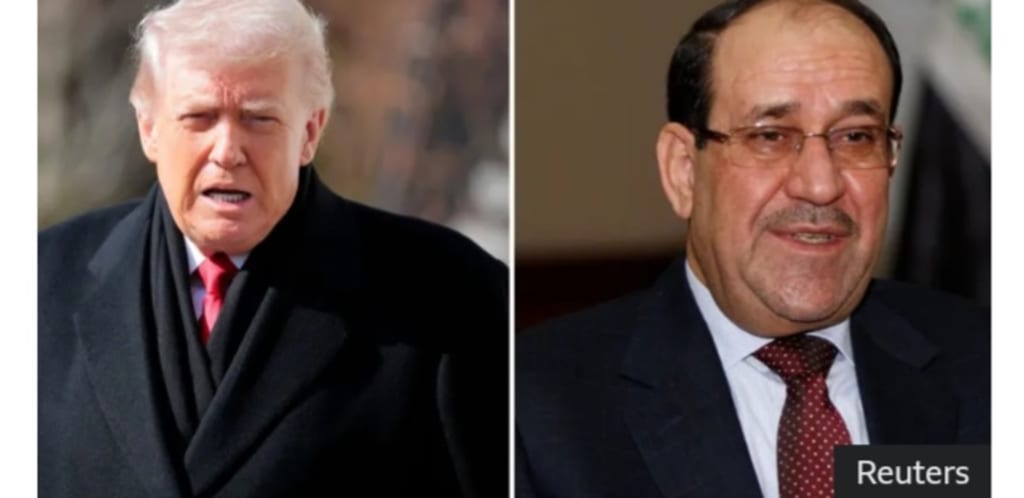
Former U.S. President Donald Trump has never been known for subtle diplomacy, and his statement that the United States would “no longer help Iraq” if Nouri al-Maliki were chosen again as prime minister reflects that blunt approach. The remark, controversial and politically charged, reopened long-standing debates about U.S. intervention in Iraq, the legacy of Maliki’s leadership, and Washington’s willingness to condition support on political outcomes in sovereign nations.
Trump’s warning was rooted in a broader narrative he consistently promoted: that American involvement in Iraq had been costly, poorly managed, and ultimately unrewarding. By singling out Maliki, Trump was not merely criticizing an individual politician; he was symbolizing what many in Washington viewed as a failed chapter of post-invasion Iraqi governance.
Nouri al-Maliki served as Iraq’s prime minister from 2006 to 2014, a period marked by sectarian tensions, weakening institutions, and the eventual rise of ISIS. Critics argue that Maliki’s leadership alienated Sunni communities, centralized power, and undermined national unity—conditions that created fertile ground for extremist groups. Supporters, however, contend that he faced extraordinary pressure in a country struggling to recover from war, occupation, and internal division.
Trump’s statement highlighted a core question in U.S. foreign policy: should American assistance be unconditional, or should it depend on the political choices of allied governments? By threatening to withdraw support, Trump signaled a transactional view of international relations—one where aid is leverage, not obligation.
This approach resonated with Trump’s “America First” doctrine. Throughout his presidency, he repeatedly argued that the United States had spent trillions of dollars overseas while neglecting domestic priorities. Iraq, in his view, symbolized a strategic failure where American sacrifice yielded little stability or gratitude. His warning suggested that Washington should no longer bear the burden of decisions made by Iraqi political elites.
However, critics warned that such rhetoric could have dangerous consequences. Iraq remains strategically important in the Middle East, both for regional stability and for counterterrorism efforts. A sudden withdrawal of U.S. support, particularly during periods of political uncertainty, could weaken Iraqi security forces and create power vacuums—conditions extremist groups have historically exploited.
Moreover, Trump’s statement raised concerns about sovereignty and diplomatic norms. While the United States has significant influence in Iraq, openly threatening to cut assistance based on leadership choices can be perceived as coercive. For many Iraqis, such remarks reinforce the perception that their country remains subject to external pressure rather than fully autonomous decision-making.
The issue also exposed divisions within U.S. political circles. Some policymakers agreed with Trump’s hard stance, arguing that continued support for governments associated with corruption or sectarianism only prolongs instability. Others countered that disengagement would not punish political elites but ordinary Iraqis, who depend on international assistance for security, reconstruction, and economic recovery.
From Iraq’s perspective, the debate over Maliki’s potential return was already deeply polarizing. His name evokes strong reactions across ethnic and sectarian lines. Trump’s intervention, therefore, risked intensifying internal divisions by tying domestic politics to external approval. Instead of fostering reform, it could encourage defiance or nationalist backlash against perceived American interference.
The broader implication of Trump’s warning lies in how global actors interpret U.S. reliability. Allies and adversaries alike closely watch how Washington responds to political developments abroad. Conditional support may signal toughness, but it can also create uncertainty about long-term commitments. In regions already marked by volatility, unpredictability can be destabilizing.
Yet Trump’s message also reflected a growing sentiment among American voters. After years of war, many question why the United States continues to invest heavily in countries where outcomes remain uncertain. From this viewpoint, demanding accountability from foreign partners is not abandonment but realism.
Ultimately, the controversy surrounding Trump’s statement underscores a deeper dilemma: how should powerful nations balance strategic interests, moral responsibility, and respect for sovereignty? Iraq’s future depends primarily on its own political decisions, but those decisions do not occur in isolation. External actors, especially the United States, remain influential whether they choose engagement or withdrawal.
Trump’s warning that the U.S. would “no longer help Iraq” if Maliki returned to power was more than a passing remark. It was a reflection of shifting attitudes toward intervention, a critique of past alliances, and a signal of how foreign policy can be reshaped by populist rhetoric. Whether such an approach promotes accountability or fuels instability remains one of the many unanswered questions shaping the future of U.S.–Iraq relations.
About the Creator
Keep reading
More stories from Ayesha Lashari and writers in The Swamp and other communities.
Facing “Serious, Unanswered Questions” in an Age of Uncertainty
We are living in an age where information is everywhere, yet clarity feels increasingly rare. Headlines arrive by the minute, social media amplifies every opinion, and leaders speak constantly—yet many of the most important questions remain unanswered. Across politics, economics, climate policy, technology, and social justice, societies are facing what can only be described as serious, unanswered questions. These are not small gaps in knowledge; they are fundamental uncertainties shaping our collective future.
By Ayesha Lasharia day ago in The Swamp
Melania Documentary Struggles in UK Cinemas as Vue Admits Sales Are ‘Soft’
Low Turnout for a Highly Anticipated Documentary The new documentary chronicling the life of Melania Trump has faced unexpectedly soft ticket sales in the UK, according to cinema chain Vue. Despite a high-profile marketing campaign and media attention, the film has struggled to attract audiences, raising questions about the current appetite for celebrity documentaries.
By Aarif Lashari2 days ago in The Swamp



Comments
There are no comments for this story
Be the first to respond and start the conversation.