
Trump Says He Is Considering F-35 Fighter Jet Deal With Saudis
A high-stakes defense conversation that could reshape U.S.–Middle East relations

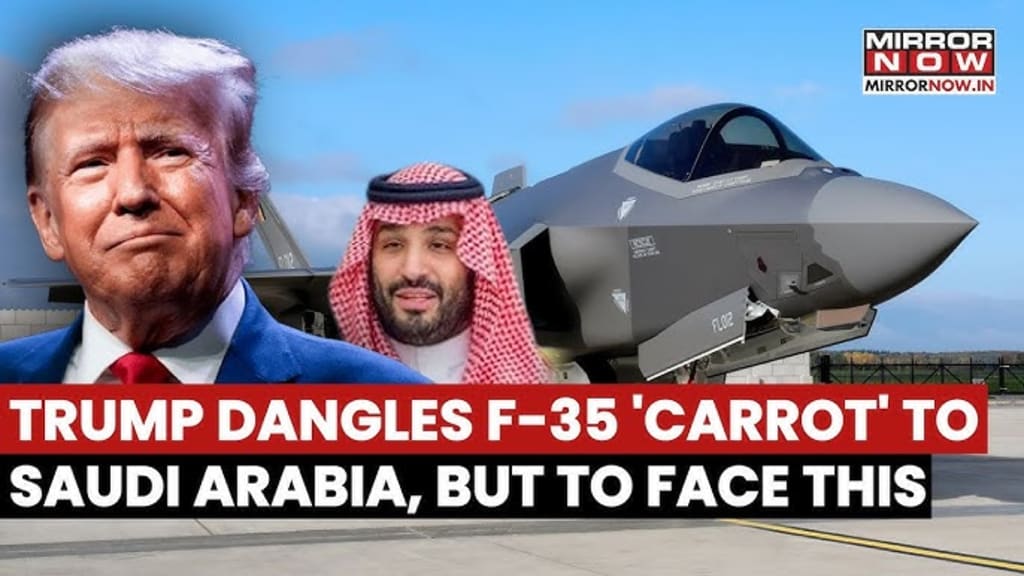
When former U.S. President Donald Trump stated that he was “considering” a potential F-35 fighter jet sale to Saudi Arabia, political observers instantly took notice. The remark, though brief, carries enormous weight: it touches on diplomacy, defense strategy, regional power balancing, and America’s long-standing role in Middle Eastern security.
The F-35 is not just another fighter jet. It is one of the most advanced military aircraft ever built, capable of stealth, precision strikes, real-time data sharing, and unmatched airborne intelligence. Any country granted access to such a weapon automatically gains more influence in geopolitical and regional conflicts. For Trump to publicly speak about this possibility signals a renewed willingness to strengthen U.S.–Saudi ties at a crucial moment.
For years, Saudi Arabia has sought access to the F-35 program, a privilege historically offered only to America’s closest allies. The kingdom already invests billions in U.S. defense systems, from air defense missiles to drones to tactical equipment. But the F-35 has remained off-limits, largely due to regional sensitivities, particularly Israel’s “qualitative military edge”—a policy ensuring Israel always maintains superior defense capability over its neighbors.
Trump’s latest remarks reopen a debate that has shaped Middle East policy for decades: Should the U.S. enhance Saudi military power, or should it proceed with caution given the kingdom’s complex regional role?
Supporters of a potential deal argue that Saudi Arabia is a crucial American partner in a region shaped by volatility. The kingdom faces threats from Iran-backed groups, cross-border missile and drone strikes, and growing cyber warfare challenges. From this perspective, giving Saudi Arabia the ability to defend itself with high-end technology would stabilize the region, deter adversaries, and strengthen Washington’s influence.
Moreover, a massive defense deal would carry economic incentives. The F-35 program supports hundreds of thousands of jobs across the U.S. defense industry. A contract with Saudi Arabia would bring billions of dollars in revenue, appealing both to policymakers and to Trump’s business-minded political base. Trump has long emphasized the economic benefits of arms sales, often framing them as job-creating opportunities for American workers.
However, critics note that an F-35 agreement could deepen tensions rather than ease them. The Middle East remains a battlefield of competing alliances, and advanced weapons can easily alter strategic balances. Iran, America’s long-standing adversary, would view Saudi possession of F-35 jets as a direct threat, potentially sparking an arms race or harsher retaliation.
There are also human rights concerns. Saudi Arabia’s role in conflicts like Yemen has drawn widespread criticism; lawmakers and humanitarian groups worry that enhancing the kingdom’s military capabilities might unintentionally fuel more civilian casualties. The U.S. Congress has previously blocked or paused weapon sales due to such concerns, and analysts expect renewed debate should an F-35 deal come close to formal consideration.
Trump’s statement must also be understood in the context of his political ambitions. With the U.S. elections approaching, every foreign policy remark carries strategic intent. Positioning himself as a leader willing to reinforce American power abroad—and strengthen alliances with wealthy partners—appeals to his base. It also contrasts him with critics who argue for scaling back U.S. involvement in Middle Eastern conflicts.
What makes this moment particularly interesting is the shifting regional dynamic. Saudi Arabia has recently pursued diplomatic normalization with multiple countries, invested heavily in soft-power projects, and attempted to position itself as a global economic hub. An F-35 deal would amplify these ambitions. It would mark the kingdom’s transformation into one of the world’s most technologically advanced military powers.
On the American side, such a deal would represent a major foreign policy decision—one that could redefine U.S. priorities for the decade ahead. Would the U.S. commit to long-term defense cooperation with Saudi Arabia, even amid political disagreements? Or would it use this opportunity to negotiate conditions aimed at reducing regional conflicts and improving human rights policies?
As of now, Trump’s comment is only a signal, not a confirmation. But in geopolitics, signals matter. They shape expectations, influence markets, and spark diplomatic conversations behind closed doors.
If the U.S. moves forward with the F-35 sale, the effects will be far-reaching—from Washington to Riyadh to Tehran. If it does not, the mere discussion will still leave an imprint on global military and political strategy.
One thing is clear: when it comes to the F-35, no decision is simple, and no statement is insignificant.
About the Creator
Fiaz Ahmed
I am Fiaz Ahmed. I am a passionate writer. I love covering trending topics and breaking news. With a sharp eye for what’s happening around the world, and crafts timely and engaging stories that keep readers informed and updated.
Keep reading
More stories from Fiaz Ahmed and writers in The Swamp and other communities.
US Justice Department Investigates Epstein’s Alleged Ties to Clinton and Banks After Trump Request
The name Jeffrey Epstein continues to cast a long, dark shadow over American politics, financial institutions, and public trust. Years after his death, the network of relationships he built — stretching from Wall Street to Washington — still fuels controversy, speculation, and demands for accountability. Now, the story has taken another unexpected turn.
By Fiaz Ahmed 2 months ago in The Swamp


Comments
There are no comments for this story
Be the first to respond and start the conversation.