
Trump’s Strategic Demands from Saudi Arabia and Global Allies
Linking Foreign Visits to Economic Revival Through Arms Deals and Global Partnerships
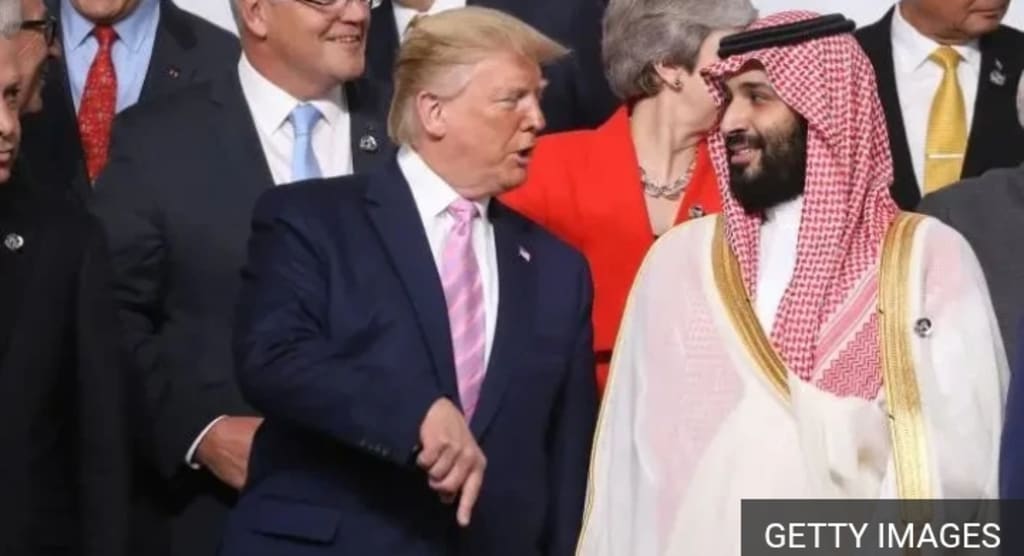
Iran's Threat, the Cost of Protection, and the 'Promise of a Gift': What Does Trump Want from Saudi Arabia?
During his first term in 2018, U.S. President Donald Trump made a historic statement:
"There are countries that wouldn’t last even a week without our protection—and they’ll have to pay for it."
Following this, Trump adopted a “pay-to-stay” policy, demanding that countries in Europe, the Middle East, Japan, and South Korea ensure payments to the United States for its protection.
Now, with Trump returning to the White House in 2025, it appears that this policy remains unchanged.
Ahead of his upcoming visits to Gulf countries—including Saudi Arabia, the UAE, and Qatar—Trump has once again publicly and clearly demanded payment from Saudi Arabia.
This raises several questions: Will Saudi Arabia pay? What might compel it to do so? And what will it receive in return?
During the January 2025 Davos Economic Forum, President Trump demanded a $1 trillion investment from Saudi Arabia. This came after Saudi Crown Prince Mohammed bin Salman announced plans to invest $600 billion in the U.S. over the next four years.
Notably, according to international relations expert Dr. Ghada Jaber, "Saudi Arabia has not yet officially commented on Trump’s demand for a trillion-dollar investment." However, she added, "Trump might get what he wants, especially given his recent role in the region and his perceived successes concerning Iran."
In 2017, during his visit to Saudi Arabia, Trump secured $350 billion in investments, including a $110 billion arms deal.
He also managed to extract billions from Qatar, including $8 billion for renovations to the U.S. military base at Al-Udeid in 2019, alongside other defense agreements.
In September 2020, Qatar’s foreign minister stated that his country had invested over $200 billion in the U.S. economy.
Analysts say such Saudi funds underline the significance of shared interests between the two nations.
Mohammed Al-Zayyat, Regional Director of the Al Yamamah Foundation and head of the Riyadh Center for Political and Strategic Studies, said: "This is the secret of U.S.-Saudi relations—it must be protected to prevent the decline of mutual interests."
Potential for Increased Investment
Recently, Saudi Minister of Economy Faisal Al-Ibrahim stated that additional investment opportunities could further increase the $600 billion Saudi investment commitment.
Does this mean there’s no cap on Saudi investments in the U.S.? Especially as Saudi Arabia attempts to establish itself as a regional hub for industry and technology.
These efforts are aligned with Saudi Vision 2030 and recent legal reforms aimed at encouraging industrial and technological growth within the kingdom.
In an interview with the BBC, Mohammed Al-Zayyat said, "Saudi Arabia sees the U.S. as the world’s greatest power, while Washington views Saudi Arabia as the gateway to the Middle East and a shield for stabilizing oil markets and global energy security."
Dr. Ghada Jaber told the BBC that Trump believes he has "secured many benefits" for Gulf nations, especially Saudi Arabia.
She mentioned Trump's “successes” in the region include the weakening of the Assad regime in Syria, support for Israeli strikes on Hezbollah in Lebanon, recent strikes on Houthis in Yemen under his command, threats of military action against Iran, and limiting Iran’s regional influence.
Recently, Trump announced the end of military operations in Yemen, claiming the Houthis have surrendered and will no longer attack U.S. ships in the Red Sea.
Gulf Funds as a Major Source
Trump's visit comes amid shifting regional dynamics, including negotiations over Iran’s nuclear program and its changing strategic position.
Dr. Ghada Jaber said the U.S. has used the threat of Iran to pressure regional countries. Iranian presence in Syria, Iraq, Lebanon, and Yemen has been a longstanding concern for Saudi Arabia and others.
Iran's nuclear program adds another layer, particularly alarming for Israel. Trump recently expressed a desire to completely dismantle Iran’s nuclear program.
Sharif Abdul Hamid, director of Iranian Studies at the Gulf Center, stated that U.S. policy toward Iran is the biggest driver of Gulf funds. He said Trump aims to convince Saudi and Gulf leaders that their protection from Iranian threats depends on cooperating with the U.S.
Tensions between Saudi Arabia and Iran date back to the 1979 Iranian Revolution. Saudi Arabia supported Iraq against Iran in the 1980s, and in 1987, the Saudi embassy in Iran was attacked and set on fire.
Iran has supported the Houthis in Yemen, who have launched missile strikes on Saudi oil infrastructure—deepening the crisis between the two nations.
In March 2023, with Chinese mediation, Saudi-Iran relations began to thaw—potentially paving the way for regional stability and cooperation.
According to Zayyat, this Saudi-Iran agreement must be understood within the context of both countries’ domestic and foreign policies. Saudi Arabia wants to balance relations between East and West to promote economic growth. Iran, on the other hand, is facing internal unrest and economic struggles due to U.S. sanctions, and thus seeks to ease external tensions.
Abdul Hamid argues that resolving issues with Iran may reduce conflict, but the U.S. and Israel might oppose this, since regional tension serves their political and economic interests.
Investments from UAE and Qatar
Even before Trump’s visit, the UAE and Qatar announced major investments. In Dubai, Trump Organization revealed plans to build a $1 billion Trump International Hotel and Tower. In Qatar, a $2 billion Trump International Golf Club project was unveiled.
Trump’s “Gifts”
Trump has made it clear: regional countries must bear the financial burden of American wars. The U.S. even asked Egypt to allow free passage through the Suez Canal for military and commercial ships targeting the Houthis.
Egypt has not officially responded, but reports suggest that President El-Sisi rejected the request during a phone call with Trump.
During his Gulf visit, Trump is also expected to offer a “political gift” to the region, possibly including renaming the Persian Gulf to the “Arabian Gulf” on official maps—something that could be seen as a symbolic win for Gulf states.
According to analysts, Trump has linked his visit to Saudi Arabia with the fulfillment of his demands.
His primary objective is to establish agreements under which the wealth of Saudi Arabia and other Gulf countries would be used to revive the American economy by purchasing American weapons and equipment.
Ziyad states that Saudi Arabia has been clear in its dealings with the U.S. and is also part of an economic partnership. “Certainly, Saudi Arabia will not reject Trump’s gift.”
According to him, Trump does not need the money of the Gulf countries; rather, he wants to bring financial benefit to the U.S. with the help of its global allies.
Trump has also demanded that Europe and Japan pay for the cost of the alliance. He also seeks to benefit from China, for which he has imposed heavy tariffs and is now encouraging American companies to relocate from China back to the U.S.
About the Creator
Keep reading
More stories from Ikram Ullah and writers in The Swamp and other communities.
Flying Palace or Political Turbulence?
Air Force One's Alternative ‘Flying Palace’: The Qatari ‘Gift’ That Could Land Trump in Trouble The recent discussions between the White House and Qatar’s royal family have focused on a luxury jumbo jet. This lavish aircraft might be handed over for use as Air Force One by the President of the United States.
By Ikram Ullah10 months ago in The Swamp
The Forsyth House Fire
Since 1851, Forsyth House has stood on the corner of Union Street and Gordon Street in the heart of Glasgow. Its iconic, or was... because on Sunday 8th of March, 2026, a fire broke out in a small, seemingly un-named shop in the building and tore all that history down. As I write, the rubble is still unsettled and the street is still blocked off. Central Station is quiet on the upper level, and around 30 small businesses have quite literally gone up in smoke.
By S. A. Crawford3 days ago in The Swamp
Hottest in the Office
Dear Rafi, You’re very distracting to work around. For the first second I saw you the other day, I thought you were some type of executive. It took a moment to realize no, you were just the new guy, dressed up for the job he wants. Be still, my heart.
By Gabriel Shames6 days ago in Pride



Comments
There are no comments for this story
Be the first to respond and start the conversation.