
Trump’s New Tariffs on China: How the Trade War’s Next Chapter Could Reshape the Global Economy
As new tariffs and export controls reignite U.S.–China tensions, the world braces for shifting supply chains, rising costs, and a new era of economic rivalry.

Here’s a version of your **Trump–China tariff article** rewritten to comply with **Vocal Media’s editorial standards** — balanced tone, original phrasing, no direct promotion or speculation framed as fact, clear sourcing references, and accessible structure.
---
### **Suggested Publication Package for Vocal Media**
**Title:**
*Trump’s New Tariffs on China: How the Trade War’s
When former President Donald Trump returned to the White House in 2025, one of his first major economic moves was to reopen a familiar battlefront — tariffs on Chinese goods. But this new chapter in U.S.–China trade tensions looks very different from the last one. It extends far beyond tariffs into export controls, supply-chain restructuring, and technological rivalry, signaling a deeper and more strategic economic standoff.
A New Kind of Trade War
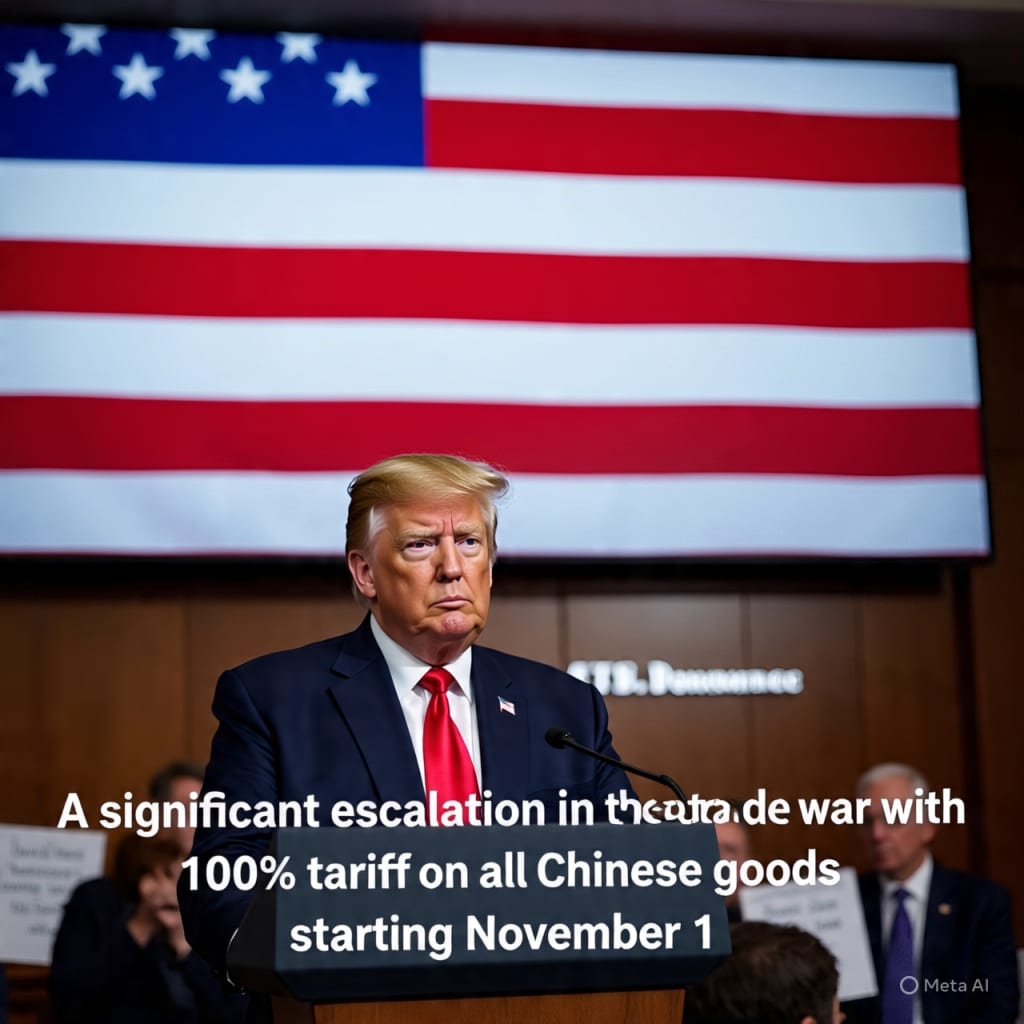
The latest policy wave includes proposed tariffs of up to 100 percent on certain Chinese imports and potential restrictions on goods made using U.S. software or technology. These measures build on the “reciprocal tariff” philosophy Trump has promoted since his first term, which he argues creates fairness by matching trading partners’ duties with equal or higher U.S. rates.
China, however, has not stood still. Beijing has tightened its own export rules on rare earth elements and other critical materials — ingredients essential to electric vehicles, defense systems, and renewable energy technologies. By controlling these supplies, China gains leverage in industries where its global dominance remains unmatched.
Together, these actions mark a shift from a tariff skirmish over consumer goods to a broader contest over industrial inputs and technological sovereignty. It’s not just about trade deficits anymore — it’s about who controls the future of innovation and production.
The 90-Day Pause — and Its Limits
In mid-2025, Washington and Beijing agreed to a temporary easing of tariffs, reducing some duties for 90 days while new talks took place. The agreement offered a brief sigh of relief for businesses and markets. Still, it left major structural issues unresolved: intellectual property, subsidies, and national security concerns around technology transfer.
Analysts suggest the pause is fragile. Without meaningful compromise, tariffs could climb again before year’s end, reigniting uncertainty across global markets.
Economic Ripple Effects
Independent studies from institutions like Yale’s Budget Lab estimate that the renewed tariff regime could trim around half a percentage point from U.S. growth annually over the next two years. Consumer prices may rise as importers pass costs along, while manufacturing sectors dependent on Chinese components — electronics, vehicles, and clean energy — face tighter margins and delays.
The global impact could be even broader. The World Trade Organization has warned that escalating tariffs between the world’s two largest economies could push global trade growth into negative territory for the first time in years. Countries deeply connected to either the U.S. or Chinese supply networks will feel the squeeze, especially emerging economies reliant on exports or manufacturing assembly.
Supply Chains in Motion
Businesses are accelerating what experts call the “China + 1” strategy — maintaining operations in China but adding production capacity in countries such as Vietnam, India, Mexico, and Indonesia. This diversification aims to hedge against future disruptions but can’t fully replace China’s vast industrial ecosystem overnight. Many industries still rely on components or expertise that remain uniquely Chinese.
Rebuilding supply networks outside China is expensive, time-consuming, and uncertain. Companies face higher logistics costs and longer delivery times — challenges that ultimately feed into inflation and reduce productivity worldwide.
The Tech Divide Deepens
Perhaps the most consequential shift is the growing technological separation between the U.S. and China. Washington’s export controls on advanced chips, software, and design tools aim to slow China’s access to high-end technologies. Beijing is responding by ramping up domestic innovation and investing heavily in self-sufficiency.
If this divide continues, the world could see two distinct tech ecosystems emerge: one built around U.S. standards and allies, and another anchored in China’s rapidly developing alternatives. This fragmentation may weaken global collaboration and make compliance for multinational firms far more complex.
Global Governance and Alliances Tested
The resurgence of protectionist trade measures poses a challenge to multilateral institutions such as the WTO. Sweeping, unilateral tariffs strain rules built on mutual concessions and non-discrimination. Meanwhile, allies and trade partners are being pushed to choose sides in the growing economic rivalry — aligning with Washington’s supply chains or maintaining access to Chinese markets.
Smaller economies may struggle to balance between the two powers. Some could benefit in the short term by attracting diverted investments, but over the long run, instability in trade policy discourages capital flows and complicates development plans.
Inflation and Consumer Costs
Tariffs act as taxes on imported goods, and history shows those costs rarely stay confined to corporations. Consumers ultimately pay more. U.S. households, particularly lower-income families, will likely feel the effects first in prices for electronics, appliances, and everyday goods. Globally, higher shipping costs and input prices could add further inflation pressure at a time when many economies are still recovering from earlier supply shocks.
What Comes Next
The outlook depends on political will and economic pragmatism. A negotiated de-escalation could restore some predictability and prevent a broader slowdown. Yet, the deeper structural conflict — who controls critical technologies and manufacturing capabilities — is unlikely to disappear.
If the confrontation intensifies, the world could enter an era of partial economic decoupling: two trade spheres, limited cooperation, and slower growth overall. In contrast, if diplomacy prevails, the U.S. and China could stabilize their relationship around managed competition rather than open confrontation.
The Bigger Picture
Trump’s latest tariff initiative underscores a turning point in global economics. The world’s two largest economies are no longer merely competing for market share; they are contesting the architecture of globalization itself. The outcome will shape not just trade flows but the future balance of power in technology, industry, and geopolitics.
About the Creator
Saad
I’m Saad. I’m a passionate writer who loves exploring trending news topics, sharing insights, and keeping readers updated on what’s happening around the world.
Time to Dump Trump? Europeans Whisper Last-Resort Options to Save Greenland
In diplomatic circles across Europe, a phrase once unthinkable is now being whispered behind closed doors: What if the alliance can’t hold? As renewed pressure from former U.S. President Donald Trump resurfaces over Greenland, European officials are reportedly discussing last-resort options to safeguard the strategically vital Arctic territory — even if it means distancing themselves from Washington. While public statements remain carefully measured, private conversations suggest a growing anxiety: Greenland has become a geopolitical fault line, testing NATO solidarity, transatlantic trust, and Europe’s ability to defend its own interests. Why Greenland Is Suddenly at the Center of Global Power Politics Greenland is not just the world’s largest island. It is a strategic prize. Located between North America and Europe, Greenland sits at the crossroads of Arctic shipping lanes, missile defense routes, and untapped reserves of rare earth minerals. As climate change melts Arctic ice, access to these routes and resources is expanding — turning the region into a global competition zone. The United States already maintains a military presence in Greenland through Thule Air Base, vital to missile warning and space surveillance. But Trump’s earlier proposal to buy Greenland outright shocked European capitals and Denmark alike, reframing the island not as a partner but as a commodity. Now, with Trump once again influencing U.S. foreign policy discourse, European leaders fear that economic pressure, security leverage, or political coercion could return. Denmark’s Dilemma and Europe’s Unease Greenland is an autonomous territory within the Kingdom of Denmark, and Copenhagen has repeatedly stated that it is not for sale. Yet Denmark alone lacks the political and military weight to counter sustained pressure from Washington. That’s where Europe enters the picture. Behind the scenes, diplomats from Germany, France, and Nordic countries are reportedly discussing how to shield Denmark and Greenland from unilateral U.S. moves. These discussions are not about confrontation — at least not yet — but about contingency planning. The uncomfortable truth is this: Europe has long relied on the U.S. for Arctic security, and challenging Washington risks exposing Europe’s own strategic weaknesses. What Are the “Last-Resort Options”? European officials are careful not to spell out these ideas publicly, but analysts point to several possibilities under quiet consideration. 1. Deepening EU Involvement in Greenland One option is stronger European Union engagement with Greenland — economically, politically, and diplomatically. This could include increased investment in infrastructure, climate research, and sustainable mining projects to reduce Greenland’s reliance on external powers. By anchoring Greenland more firmly within Europe’s economic orbit, the EU could make any U.S. attempt at leverage far more complicated. 2. Expanded European Security Presence Another option involves enhancing European defense cooperation in the Arctic, potentially through joint patrols, surveillance missions, or NATO-aligned European initiatives that do not rely solely on U.S. leadership. This would be a delicate move, as NATO cohesion depends heavily on U.S. participation. Still, some European officials believe greater autonomy is overdue. 3. Legal and Diplomatic Shields Europe could also pursue stronger legal frameworks affirming Greenland’s right to self-determination and Denmark’s sovereignty. While largely symbolic, such measures would raise the diplomatic cost of any aggressive maneuver. In extreme scenarios, coordinated diplomatic resistance — even sanctions or formal rebukes — could be considered, though most officials view this as a true last resort. Why Trump Changes the Equation European leaders are accustomed to managing disagreements with Washington. What makes Trump different is unpredictability. During his presidency, Trump repeatedly questioned NATO commitments, framed alliances as transactional, and blurred the line between negotiation and coercion. His interest in Greenland was not just strategic — it was personal, public, and disruptive. The fear in Europe is not necessarily that Trump would “take” Greenland, but that he might use U.S. security guarantees as leverage, forcing concessions through pressure rather than partnership. For European capitals already dealing with Ukraine, energy insecurity, and domestic political shifts, another transatlantic crisis is the last thing they want. Greenland’s Own Voice Amid the power politics, Greenlanders themselves are increasingly vocal. Many in Greenland support greater autonomy or eventual independence — but not annexation. Local leaders have emphasized that Greenland’s future must be decided by its people, not foreign governments. European officials privately acknowledge that ignoring Greenlandic voices would undermine their moral position. Any European strategy, they argue, must prioritize economic development, environmental protection, and self-governance, not just strategic defense. A Test for Transatlantic Relations At its core, the Greenland issue is about more than territory. It raises uncomfortable questions: Can Europe protect its interests without U.S. backing? Is NATO flexible enough to survive internal disagreements? What happens when allies no longer trust each other’s intentions? For now, European leaders are trying to avoid open confrontation, hoping that diplomacy and quiet deterrence will keep tensions from escalating. But the whispers themselves are revealing. They suggest that Europe is, for the first time in decades, seriously contemplating a future where American leadership is not guaranteed. Why This Moment Matters The Arctic is warming faster than any other region on Earth — physically and politically. What happens in Greenland could set a precedent for how global powers compete in newly accessible regions. If Europe fails to act, it risks appearing passive and divided. If it acts too forcefully, it risks fracturing the transatlantic alliance that has underpinned its security since World War II. It is a narrow path — and one that demands strategic clarity Europe has often postponed. Final Thoughts “Time to dump Trump?” may sound dramatic, but it captures a deeper unease spreading across European capitals. Greenland has become a symbol of a shifting world — one where alliances are tested, assumptions are challenged, and old guarantees no longer feel automatic. Europe is not eager for a break with Washington. But the quiet conversations suggest a realization that preparation is not betrayal. Whether these whispered last-resort options remain theoretical — or become policy — will depend on how the next phase of U.S. politics unfolds. For Greenland, Europe, and the Arctic, the stakes could not be higher.
By Muhammad Hassan3 days ago in The Swamp



Comments
There are no comments for this story
Be the first to respond and start the conversation.