
Trump's 2025 Executive Orders: Key Actions on Day 1
Discover the key executive orders signed by Trump in 2025, covering immigration, climate, healthcare, and more on his first day in office.

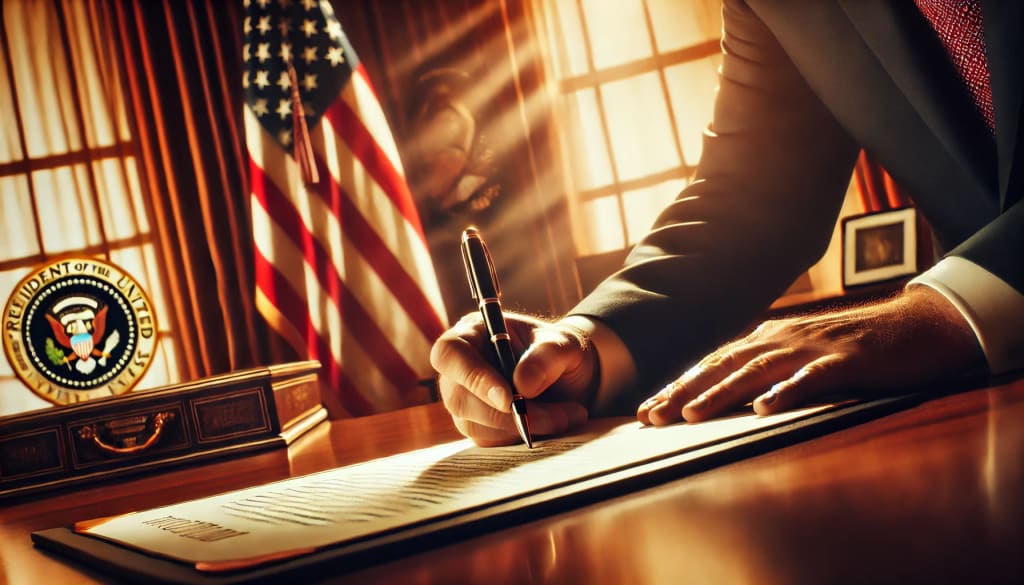
On January 20, 2025, Donald Trump was sworn in as the President of the United States. He immediately took significant steps to implement his agenda through a series of executive orders. These orders addressed crucial areas like immigration, healthcare, energy, and defense, reflecting his commitment to his campaign promises. Below is an in-depth look at these actions and their implications.
What Are Executive Orders?
Executive orders are directives issued by the President to manage operations of the federal government. Unlike legislation, they do not require Congressional approval but must align with existing laws and the Constitution. Presidents often use executive orders to enact policy changes swiftly, especially when facing legislative gridlock.
Key Executive Orders Signed by Trump on Day 1
1. Immigration and Border Security
Immigration was a central focus of Trump’s campaign, and his first-day actions reflected his priorities:
- Border Wall Construction: Trump reinstated the national emergency at the southern border, paving the way for expedited wall construction.
- "Remain in Mexico" Policy: He brought back the policy requiring asylum seekers to stay in Mexico while their claims are processed.
- Enhanced Border Patrol: Additional resources were allocated to the Border Patrol to strengthen enforcement and expedite deportations.
2. Energy and Climate Policies
Reversing many of his predecessor’s climate policies, Trump signed orders prioritizing fossil fuels and energy independence:
- Withdrawal from the Paris Agreement: Trump officially ended U.S. participation in the international climate accord, citing economic concerns.
- Fast-Tracking Fossil Fuel Projects: Permits for oil and gas projects were expedited, while renewable energy projects, like offshore wind farms, faced new restrictions.
3. Healthcare Reforms
Healthcare reforms were another priority, with Trump aiming to increase affordability and accessibility:
- Short-Term Health Plans: Trump expanded access to affordable, short-term health insurance plans that bypass certain federal regulations.
- Health Savings Accounts (HSAs): He increased the contribution limits for HSAs, allowing individuals to save more for medical expenses.
4. Child Support Reform
Trump introduced a groundbreaking executive order on child support laws:
- The reform ensures fair calculations of child support payments, emphasizing income equity and family stability.
- This move has been widely discussed under the term "Trump child support law".
5. Military and Defense
In a nod to his "America First" agenda, Trump made bold moves to support the military:
- Reinstatement of Troops: Military personnel discharged for refusing COVID-19 vaccinations were reinstated with back pay.
- Border Assistance: Additional troops were deployed to the southern border to assist with enforcement efforts.
6. Economic and Trade Policies
Trump's first-day executive orders also included measures to boost the economy and protect American industries:
- Trade Tariffs: New tariffs were announced on imports to protect domestic manufacturing.
- TikTok Restrictions: Trump gave TikTok 75 days to address data security concerns or face a ban.
How Do Executive Orders Work?
Executive orders allow the president to bypass Congress for swift action, but they can face legal challenges. Critics argue they grant the executive branch too much power, while supporters see them as tools for decisive leadership.
Public Reaction
The response to Trump’s executive orders has been polarized:
- Supporters praise his immediate action on immigration, economic protection, and military readiness.
- Critics warn of potential setbacks in climate policy, international relations, and social equity.
Frequently Asked Questions
What executive orders did Trump sign today?
On his first day in office, Trump signed over 100 executive orders covering immigration, healthcare, child support reforms, and trade policies.
Do executive orders require Congressional approval?
No, executive orders do not require Congressional approval but must comply with existing laws and the Constitution.
What is the purpose of Trump’s child support reform?
Trump’s child support reform aims to ensure equitable calculations, considering income and family stability.
How many executive orders did Trump sign on Day 1?
Trump signed more than 100 executive orders on his first day back in office, making it one of the most active first days in U.S. presidential history.
Conclusion
Donald Trump’s executive orders on January 20, 2025, signal a significant shift in U.S. policy. From immigration to healthcare and energy to defense, these actions reflect his commitment to reshaping the country’s future. While supporters celebrate his decisive leadership, critics raise concerns about the long-term implications. As his presidency progresses, these executive orders will play a crucial role in defining his administration and its legacy.
About the Creator
Matt Guides
I'm Just A Random Guy That Creates Content!
Keep reading
More stories from Matt Guides and writers in The Swamp and other communities.
How AI is Transforming Healthcare: The Future in 2025
Artificial Intelligence (AI) is no longer just a futuristic concept; it’s a transformative force reshaping industries worldwide, and healthcare is no exception. As technology continues to evolve, AI is making strides in improving medical diagnoses, personalizing patient care, and even assisting in drug discovery.
By Matt Guidesabout a year ago in The Swamp
Parallel Protests
I haven't written for quite some time, but I have A LOT of thoughts about yesterday's protest rally against our government's involvement and complicity in America's war on Iran, on the harbourside of my home city Bristol, and I need to put them somewhere. My gorgeous girlfriend is always a loving and listening ear and sharing it all with her will always be a healthy and happy way of processing the mental and emotional weight, but getting it straight in my brain to share means writing it all down in straight lines, so, here we are and thanks for being here.
By Steph Cole10 days ago in The Swamp
Reports suggest discussions inside Washington about limited troop deployment as tensions with Tehran escalate.
As tensions between the United States and Iran intensify, reports from officials familiar with internal discussions suggest that Donald Trump has privately shown serious interest in deploying U.S. ground troops inside Iran. While no final decision has been made, the conversations highlight a potentially significant escalation in a conflict that has so far been dominated by air strikes and naval operations. According to multiple sources cited in recent reports, Trump has discussed the possibility of sending a limited contingent of American troops into Iran for specific strategic missions rather than launching a full-scale ground invasion. The discussions reportedly took place in conversations with advisers, Republican allies, and military officials. Those familiar with the talks emphasized that the concept centers on deploying a relatively small force designed to achieve targeted objectives such as securing sensitive nuclear facilities, protecting strategic sites, or assisting allied operations. The potential move comes amid a rapidly evolving military confrontation in the region. U.S. forces have conducted extensive air operations aimed at Iranian military infrastructure, while Iran has responded with missile and drone strikes targeting American and allied assets in the Middle East. The growing cycle of attack and retaliation has raised fears of a broader regional war. Despite the private discussions, the White House has pushed back against reports suggesting that a ground deployment is imminent. Officials insist that the president has not issued any orders and that all military options remain under review. A spokesperson emphasized that any speculation about specific plans should be treated cautiously, noting that the administration often evaluates multiple scenarios during a crisis. Military analysts say even a small ground presence inside Iran would mark a dramatic escalation in the conflict. Iran is a large country with significant military capabilities, and any deployment of foreign troops could provoke a strong response from Iranian forces and allied militias across the region. The United States has previously avoided placing “boots on the ground” in Iran, relying instead on air power, naval deployments, and regional partnerships to contain tensions. However, some policymakers argue that certain strategic goals—such as securing nuclear materials or stabilizing key locations—could be difficult to achieve without limited ground operations. Trump himself has publicly suggested that he is not ruling out any options. In recent remarks, he stated that while ground troops may not be necessary, they could become a possibility if circumstances require stronger action. Supporters of a tougher approach toward Iran argue that decisive military pressure could weaken Tehran’s leadership and force negotiations over nuclear development and regional influence. They also believe that demonstrating U.S. willingness to escalate may deter further Iranian attacks. Critics, however, warn that even a limited deployment could quickly spiral into a larger war. Memories of prolonged conflicts in Iraq and Afghanistan remain fresh in the minds of many policymakers and voters, raising concerns about the risks of becoming entangled in another long and costly military engagement in the Middle East. Another factor influencing the debate is the potential geopolitical impact. Any U.S. ground operation inside Iran would likely draw reactions from major global powers and could disrupt energy markets, particularly given Iran’s position near key oil shipping routes in the Persian Gulf. Within Washington, lawmakers from both parties have called for greater transparency regarding military planning. Some members of Congress argue that any decision to deploy troops should involve legislative approval, while others insist the president must retain flexibility to respond quickly to emerging threats. Meanwhile, international leaders are urging restraint and diplomatic engagement to prevent further escalation. Several governments have called for renewed negotiations aimed at reducing tensions and avoiding a broader regional conflict that could destabilize global security. For now, the idea of U.S. ground troops in Iran remains a possibility under discussion rather than an approved policy. But the mere consideration of such a move underscores the seriousness of the current crisis and the complex choices facing American leaders. As the conflict continues to evolve, the decisions made in Washington could shape the future of Middle Eastern geopolitics—and determine whether the confrontation remains limited or expands into a much larger war.
By Fiaz Ahmed 6 days ago in The Swamp
Worth the Wait: Puerto Viejo, Costa Rica
Beach bumming in a small Caribbean beach town sounded like a perfect way to end our 6-month trip through Mexico and Central America. Or so we thought. The foul, fishy stench of rotten seaweed hit our nostrils as we stepped from the cramped bus and looked out at a rather depressing, empty, and underwhelming black sand beach. It was pouring with rain, and we had to quickly fish out our ponchos. We thought, this couldn’t be it, could it?
By Sh*t Happens - Lost Girl Travel7 days ago in Wander




Comments
There are no comments for this story
Be the first to respond and start the conversation.