
Trump Endorses Candidate with Open Anti-Muslim Views
Trump Endorses Candidate with Open Anti-Muslim Views


Trump Endorses Candidate with Open Anti-Muslim Views
America has long been described as a melting pot — a place where people from diverse backgrounds, faiths, and beliefs come together to build a shared future. It is expected that those elected to serve in public office represent all citizens fairly and without prejudice. Unfortunately, recent political trends have moved in the opposite direction, with certain figures pushing divisive rhetoric into the mainstream.
One such case is that of far-right activist Laura Loomer, a controversial figure who recently won the GOP primary in Florida’s 21st district. Loomer, who proudly identifies as an “Islamophobe,” has openly called Islam a “cancer” — a statement that has drawn sharp criticism from across the country. Despite this, former President Donald Trump has publicly endorsed her candidacy, a move that has left many Americans, especially Muslim communities, shocked and concerned.
This endorsement is not an isolated case but part of a troubling pattern. Since Trump’s initial campaign in 2016, his inflammatory remarks about various minority groups have emboldened others within the Republican party to express openly racist and bigoted views. While not all conservatives share these beliefs, the normalization of such statements from candidates and elected officials is growing increasingly common.
Muslim Americans, along with other minority communities, have begun speaking out more strongly. Many feel that what was once hidden behind coded language — the “dog whistles” — is now being shouted without shame. Robert McCaw, director of government affairs at the Council on American-Islamic Relations (CAIR), recently commented that anti-Muslim sentiments have become embedded not only in the White House but in legislative offices as well.
McCaw noted in a public statement that we have “moved past subtlety,” and bigotry is becoming part of mainstream conservative messaging. He warned that such actions could backfire politically, especially in communities where Muslim Americans are active, engaged, and growing in number.
Wajahat Ali, a well-known writer and legal analyst, added his voice to the criticism. He emphasized that Loomer’s extremist views have resulted in her being banned from multiple online platforms, including Twitter, yet she still gained political traction — and worse, the president of the United States is backing her. According to Ali, the Republican Party is increasingly being taken over by extremist elements that were once considered fringe.
Trump’s strategy appears rooted in appealing to a specific voter base — one that is drawn to nationalist and exclusionary ideas. Critics argue that by aligning himself with figures like Loomer, Trump is betting that there are more voters who support racial and religious intolerance than those who value inclusion and diversity.
This trajectory has alarmed many Americans, who now see the upcoming election as more than just a political contest — it's a defining moment about the kind of country the U.S. wants to be. Will it remain a place that welcomes people of all backgrounds, or will it allow voices of hate to shape its future?
It’s time for the American public to make a clear and united stand. Candidates who promote hatred should be rejected at the ballot box. The only way to push back against this growing wave of bigotry is to vote — not just for candidates, but for the values that define a truly inclusive society.
Silence, in moments like this, is not neutrality. It’s consent. And the stakes are too high to sit on the sidelines.
About the Creator
Keep reading
More stories from waseem khan and writers in The Swamp and other communities.
A Gathering of Evil Bosses
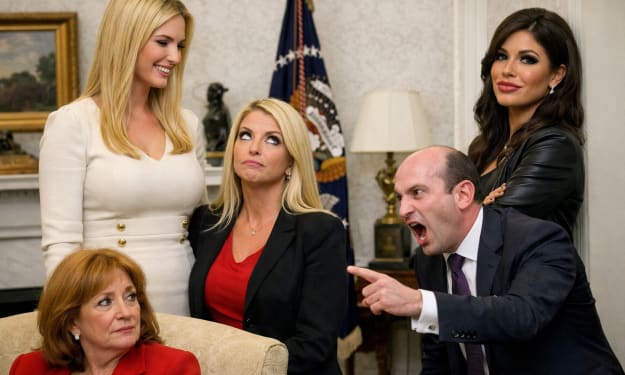
“I’m the queen of chin jutting while I smooth my hair, attacking, insulting, and deflecting to protect my appointer.” “Oh, please, Blondi, my hair is curled, highlighted, and longer than yours. I feature television commercials telling immigrants that we will give them a free plane ride home, and if they voluntarily turn themselves in, they will be allowed to legally apply for re-entry. It runs everywhere, and I look good in it! You can’t compete because of your blond hair. Mine is nicer, and my lips are prettier than yours.”
By Andrea Corwin 23 days ago in The Swamp
Trump names new head for VOA parent after court rebukes Kari Lake
A major leadership shift has taken place at the U.S. government agency that oversees international broadcasting after a federal court ruling invalidated the authority of a previous appointee. Donald Trump has nominated a new head to lead the organization that supervises Voice of America and several other global media outlets, marking a new chapter for American public diplomacy and international broadcasting. The new nominee, Sarah B. Rogers, currently serves as the U.S. undersecretary of state for public diplomacy and public affairs. She has been selected to lead the United States Agency for Global Media (USAGM), the independent federal agency responsible for overseeing international broadcasters funded by the U.S. government. Her nomination comes shortly after a federal judge ruled that the previous acting head, Kari Lake, had exercised authority without proper legal appointment. The decision follows weeks of controversy surrounding Lake’s tenure at the agency. A federal court concluded that she had not been legally authorized to serve as chief executive because she had not been formally nominated and confirmed for the role as required by federal law. As a result, actions taken during her time in charge—including sweeping layoffs and operational changes—were declared invalid by the court. The ruling was delivered by U.S. District Judge Royce Lamberth, who found that Lake’s leadership violated the Federal Vacancies Reform Act and constitutional rules governing senior federal appointments. The judge’s decision effectively nullified major policy changes made under her direction, including staff reductions at several media outlets operated by USAGM. The court case was brought by a group of journalists and employees connected to Voice of America who challenged Lake’s authority to restructure the agency. Many of the plaintiffs argued that the changes threatened the editorial independence and operational stability of U.S.-funded international broadcasters. Following the ruling, several journalists described the decision as a victory for press freedom and institutional integrity. The United States Agency for Global Media plays a significant role in American foreign policy communication. Created in 1999, the agency supervises multiple broadcasters that deliver news and information to audiences worldwide, especially in countries where independent journalism is restricted. These outlets include Radio Free Europe/Radio Liberty, Radio Free Asia, and the Middle East Broadcasting Networks. Among them, Voice of America is the most widely recognized. Founded during World War II, the broadcaster delivers news programming in multiple languages to global audiences and has long been considered a key tool of U.S. “soft power.” Its mission is to provide accurate, balanced journalism while promoting democratic values and open information. Rogers’ nomination is expected to bring a period of stabilization after months of uncertainty inside the agency. However, her appointment must still be confirmed by the U.S. Senate before she can formally assume the position. Until then, another Trump administration official, Michael Rigas, is expected to serve as acting chief executive. Supporters of Rogers describe her as a strong advocate of free speech and international communication, with experience in public diplomacy and government media strategy. Critics, however, have raised concerns about some of her past political positions and associations, suggesting that her leadership could shape the future direction of the agency’s editorial mission. Meanwhile, Lake has strongly criticized the court ruling and signaled her intention to challenge the decision. She has argued that the reforms introduced during her tenure were necessary to restructure the agency and reduce bureaucracy. Her supporters also claim that the changes were aimed at improving efficiency and strengthening U.S. messaging abroad. The controversy surrounding the leadership of USAGM reflects a broader debate over the role of government-funded international media in the modern geopolitical environment. As global information battles intensify and authoritarian governments expand their propaganda efforts, institutions like Voice of America remain central to the United States’ strategy for promoting independent journalism and democratic values worldwide. With Rogers’ nomination now before the Senate, the future direction of America’s global broadcasting system may soon become clearer. For now, the agency faces the challenge of restoring stability, rebuilding trust within its newsroom operations, and continuing its mission to deliver credible news to audiences around the world.
By Fiaz Ahmed about 22 hours ago in The Swamp



Comments
There are no comments for this story
Be the first to respond and start the conversation.