
Trump Doubles Down on Greenland: ‘No Going Back’ Amid Leaked Texts and AI Mock-Ups
From digital mock-ups to leaked diplomatic messages, Trump signals a bold, controversial Arctic strategy that has Europe on alert.

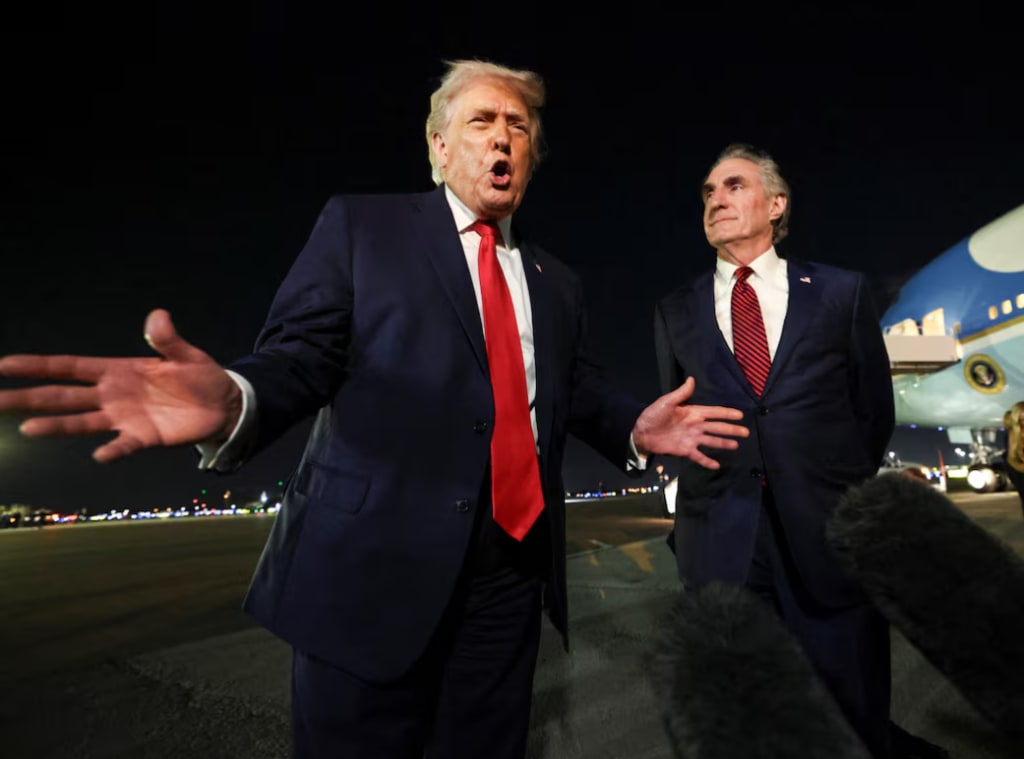
Donald Trump is at it again. In a dramatic escalation of his Greenland ambitions, the former U.S. president has declared there is “no going back” on his plans for the Arctic island, sharing leaked texts with global leaders and even AI-generated mock-ups online. What started as a provocative idea has now evolved into a full-blown geopolitical spectacle — one that has set off alarms in Europe, stirred debate in Washington, and captured the attention of observers around the globe.
Greenland, a sprawling Arctic territory four times the size of Texas, has long been more than just a frozen expanse. Strategically located between North America and Europe, it houses rare minerals, potential energy resources, and military bases critical for early warning systems. The U.S. already maintains a presence on the island, but Trump’s rhetoric suggests he wants more — a permanent, undeniable influence over this key territory.
What makes this latest announcement unusual is the medium. Trump has combined social media announcements with AI-generated images, depicting scenes like him planting an American flag on Greenland or maps showing the island seemingly absorbed into U.S. territory. These visuals, symbolic though they may be, amplify the political shock value and make the story feel almost cinematic. To critics, however, it borders on digital grandstanding that could strain international diplomacy.
Alongside these images, Trump released screenshots of private texts with world leaders — including French President Emmanuel Macron and NATO Secretary-General Mark Rutte. The exchanges, shared publicly, reveal a mix of bewilderment, caution, and careful diplomacy. Macron’s messages question the logic of Trump’s Greenland ambitions, while Rutte offers measured responses that stop short of endorsement. By leaking these conversations, Trump signals transparency to his followers but risks eroding trust with allies who view this as a provocative act.
The reactions have been swift. Denmark, Greenland’s sovereign nation, has repeatedly stated that the island is not for sale. Greenlandic officials insist that while they welcome partnerships and investment, sovereignty is off-limits. European leaders, meanwhile, have criticized the approach as a throwback to colonial thinking. French President Macron labeled it a “new colonial tactic”, while European Commission President Ursula von der Leyen emphasized the need for Europe to safeguard its autonomy in defense and economic policy.
The story extends beyond diplomacy into the financial world. Markets have reacted nervously, reflecting concerns over potential transatlantic tensions. European equities dipped, while U.S. stock futures wavered as investors speculated on whether trade disputes could flare up again. The Greenland episode, seemingly distant geographically, is now directly affecting global economic sentiment.
Despite the theatrics, some U.S. officials urge calm. Treasury Secretary Scott Bessent, speaking at the World Economic Forum in Davos, downplayed fears, suggesting a balanced approach could protect both American and European interests. Yet, the combination of AI visuals, leaked texts, and bold statements makes clear that Trump intends to keep Greenland in the spotlight — and in strategic discussions — for the foreseeable future.
Experts argue that Trump’s Greenland narrative represents more than personal ambition; it reflects a broader shift in U.S. foreign policy toward unilateral action, transactional diplomacy, and public theatrics. By publicly flaunting these communications, Trump challenges traditional diplomatic norms, raising questions about how allies perceive U.S. reliability. For Europe, the episode is a reminder that strategic independence may be more important than ever in a world of unpredictable American policies.
At the same time, supporters claim that asserting influence over Greenland is a smart move for U.S. national security. They point to the island’s rich mineral deposits, Arctic shipping routes opening due to climate change, and proximity to both Russia and China as reasons the United States must act decisively. Whether through diplomacy, investment, or sheer political messaging, Greenland has become a symbol of the Arctic’s emerging importance in global strategy.
Trump’s vow of “no going back” is as much a statement to his supporters as it is a message to the world. It signals unwavering intent, amplifies his geopolitical ambitions, and uses modern digital tools — from social media posts to AI images — to make them undeniable. This approach is polarizing, but undeniably effective at drawing attention and shaping narratives.
For Greenland’s residents, the world is watching with a mix of curiosity and concern. The island has become a flashpoint not just for U.S.-European relations but for global Arctic strategy. How this situation unfolds could influence alliances, trade, and military planning for years to come. Greenland is no longer just a remote outpost of ice; it’s a stage where international power, technology, and politics intersect.
In the end, the story of Trump, leaked texts, and AI mock-ups is about more than one man’s ambition. It’s about how modern tools — digital imagery, public messaging, and social media theatrics — are reshaping diplomacy. It’s about global perceptions of power, sovereignty, and national security. And, most importantly, it’s a reminder that in today’s interconnected world, even the icy expanses of Greenland can become central to the conversations that shape our future.
About the Creator
Muhammad Hassan
Muhammad Hassan | Content writer with 2 years of experience crafting engaging articles on world news, current affairs, and trending topics. I simplify complex stories to keep readers informed and connected.
Keep reading
More stories from Muhammad Hassan and writers in The Swamp and other communities.
An A.I. Start-Up Says It Wants to Empower Workers, Not Replace Them
Artificial intelligence is often portrayed as a job killer, a technology that automates tasks and threatens traditional employment. However, a rising AI start-up is challenging this narrative, stating that its mission is to empower workers rather than replace them. By focusing on augmentation rather than automation, the company aims to demonstrate that AI can enhance human capabilities, improve productivity, and create more meaningful work for employees.
By Muhammad Hassan2 months ago in The Swamp
The Forsyth House Fire
Since 1851, Forsyth House has stood on the corner of Union Street and Gordon Street in the heart of Glasgow. Its iconic, or was... because on Sunday 8th of March, 2026, a fire broke out in a small, seemingly un-named shop in the building and tore all that history down. As I write, the rubble is still unsettled and the street is still blocked off. Central Station is quiet on the upper level, and around 30 small businesses have quite literally gone up in smoke.
By S. A. Crawford3 days ago in The Swamp
First Nations Leaders Head to England to Raise Treaty Concerns with King Charles
A delegation of First Nations leaders from Canada has traveled to England to meet with King Charles III, raising concerns over unresolved treaty obligations and the historical impact of colonial policies. The visit represents a rare opportunity for Indigenous leaders to engage directly with the British monarchy, which has long been viewed as a symbolic authority connected to treaties signed during the colonial era. The delegation includes chiefs and elders from multiple First Nations communities across Canada, representing a diverse range of regions and interests. Their mission is to secure recognition for longstanding grievances related to land rights, resource extraction, and the implementation of treaties originally negotiated between Indigenous communities and the Crown. The leaders emphasize that these treaties are still legally binding under Canadian law and that acknowledgment from the monarchy carries both symbolic and political weight. During preliminary discussions in London, the delegation highlighted concerns that many treaties have been inadequately honored over the past century. Chief Shawn Atleo of the Assembly of First Nations explained, “These agreements were made with the Crown, and yet, too often, their promises have been ignored or inadequately implemented. We come to England not to challenge the monarchy personally, but to seek recognition and a commitment to dialogue that respects the original intentions of these treaties.” King Charles, who has publicly expressed interest in reconciliation and environmental stewardship, reportedly welcomed the delegation and listened to their concerns during a formal audience. While the meeting did not produce immediate policy changes, it was described as a significant step toward acknowledging the historical obligations of the Crown and creating channels for continued discussion. The visit also underscores the complex role of the monarchy in contemporary Canada. Although political authority is vested in the Canadian government, the Crown remains a central figure in treaty law and Indigenous governance structures. Experts note that while King Charles cannot unilaterally enforce treaty obligations, recognition from the monarchy can strengthen Indigenous claims and encourage Canadian authorities to address outstanding issues more seriously. Beyond legal recognition, the delegation emphasized the social and cultural dimensions of their visit. Indigenous leaders brought artifacts, documents, and oral histories to illustrate the historical context of treaties and the impact of colonial policies on their communities. These presentations serve not only to educate British officials and the monarchy but also to reinforce the ongoing cultural and spiritual significance of these agreements for First Nations people. In addition to meetings with King Charles, the delegation has scheduled engagements with members of the British Parliament, legal experts, and historians specializing in colonial law. These discussions aim to foster broader understanding of the treaties and explore avenues for collaboration in addressing contemporary challenges related to Indigenous rights, land stewardship, and community development. The timing of the visit is particularly noteworthy, coming amid ongoing debates in Canada over reconciliation and Indigenous sovereignty. Recent legal rulings have emphasized the binding nature of treaties and the duty of the government to consult and accommodate First Nations communities in matters affecting their lands. Leaders in London hope that raising awareness internationally will complement domestic efforts and create additional pressure for meaningful action. Observers note that the visit carries symbolic significance for both the monarchy and Indigenous communities. For King Charles, it represents an opportunity to reinforce his public image as a monarch engaged with global issues and committed to dialogue and reconciliation. For the First Nations delegation, it demonstrates a proactive approach to asserting treaty rights and preserving cultural heritage in an international context. Reactions from Canadian officials have been cautiously supportive. While the federal government remains the primary authority responsible for treaty implementation, Indigenous Affairs Minister Penny Collenette praised the delegation for taking a diplomatic approach. “Engagement at all levels is important, and raising these issues in London complements ongoing efforts at home,” she said. The delegation plans to return to Canada later this month, with follow-up meetings expected to continue both domestically and internationally. Advocates stress that the visit should be viewed as part of a broader movement to ensure that historical treaties are honored, Indigenous voices are heard, and the principles of justice and fairness guide ongoing governance decisions. As the delegation concludes its visit, leaders expressed hope that the dialogue will mark the beginning of sustained engagement with the monarchy, the UK government, and Canadian authorities. “Our goal is not confrontation, but recognition, understanding, and meaningful action,” said Chief Atleo. “By raising these issues here in England, we hope to reaffirm the commitments made generations ago and ensure that future generations inherit the respect and rights promised to our people.”
By Fiaz Ahmed 7 days ago in The Swamp



Comments
There are no comments for this story
Be the first to respond and start the conversation.